Norwegian 4x4 Protocol: Proven HIIT to Raise VO2 Max
I used this protocol to take my own VO2 max from about 41 to 51. I started by running it, then switched to the bike. Here's the exact session, the science behind it, and what I learned doing it for real.

 Run these workouts on your iPhone, or hands-free on Apple Watch. Get PEAKVO2
 The Norwegian 4x4 protocol is a high-intensity interval training method consisting of four 4-minute intervals at 90-95% of maximum heart rate, separated by 3-minute active recovery periods. Developed at NTNU in Norway, it is the most studied HIIT protocol for improving VO2 max, with research showing 7-10% gains in 8 weeks.
Low cardiorespiratory fitness is a stronger predictor of mortality than smoking, diabetes, or hypertension (Myers et al., 2002; Mandsager et al., 2018). And the Norwegian 4x4 protocol is the most studied HIIT method for improving it. Developed at the Norwegian University of Science and Technology (NTNU), this ~38-minute session has been shown to raise VO2 max by approximately 7-10% in 8 weeks (Helgerud et al., 2007). It's been tested in everyone from heart failure patients to elderly populations, and it works. If you're wondering what counts as a good VO2 max for your age, check the benchmarks before you start.
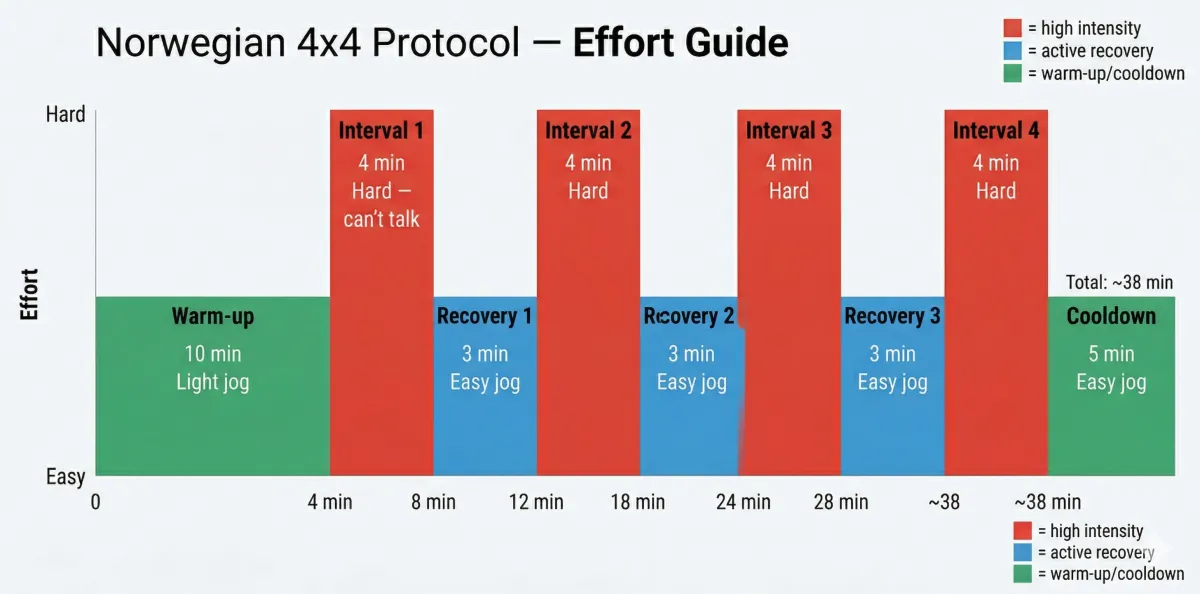
Here's the entire workout at a glance: four hard intervals separated by easy recovery, bookended by a warm-up and cooldown.
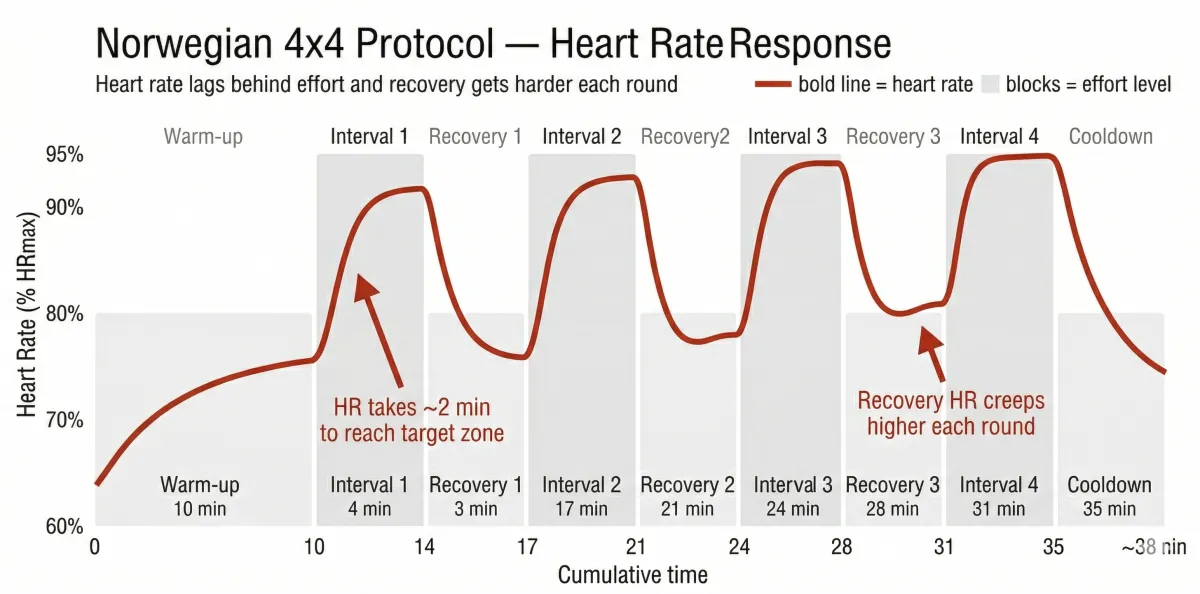
Your heart rate doesn't follow effort instantly. It lags behind on the way up and doesn't fully recover on the way down. Each recovery gets a little harder as the session progresses.
How the 4x4 Took My VO2 Max from 41 to 51
I'm Cristian, and I built PEAKVO2 because I train with this protocol myself. So before the science, here's my own experience with it, honestly.
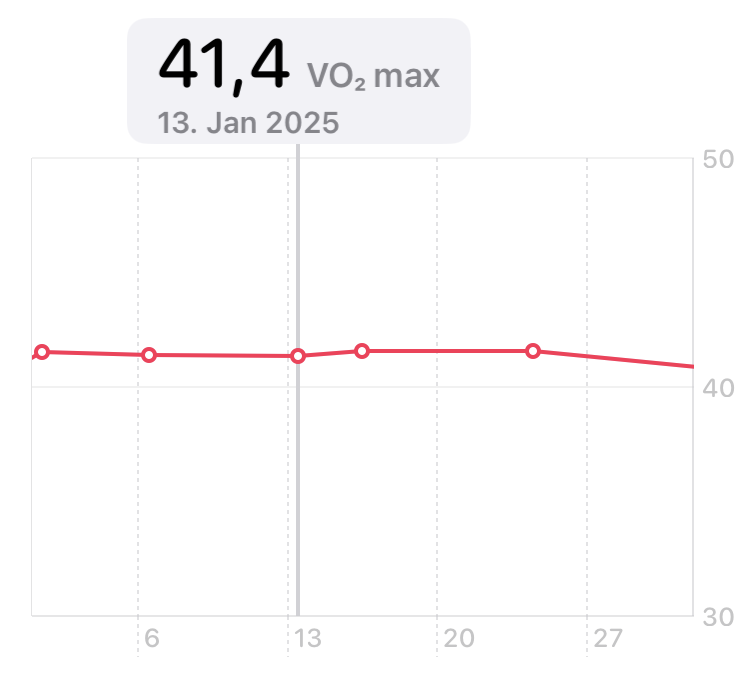
I started by running it. The early weeks were genuinely motivating: my breathing got easier, my recovery between intervals got faster, and my Apple Watch Cardio Fitness estimate started climbing off a low base of around 41. But running just wasn't for me. So I moved the same protocol onto the bike, where I can hold the 90-95% effort precisely and actually look forward to the session.
That switch is the reason I stuck with it. I don't really think of myself as a runner or a cyclist. I train hybrid: strength, hypertrophy, and cardio fitness, cycled through the year in blocks (mesocycles). The 4x4 is what I reach for when a block is about VO2 max, twice a week.
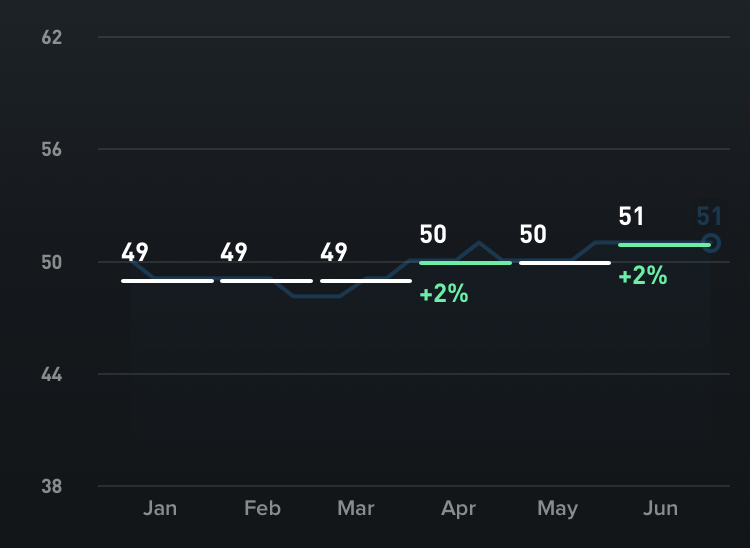
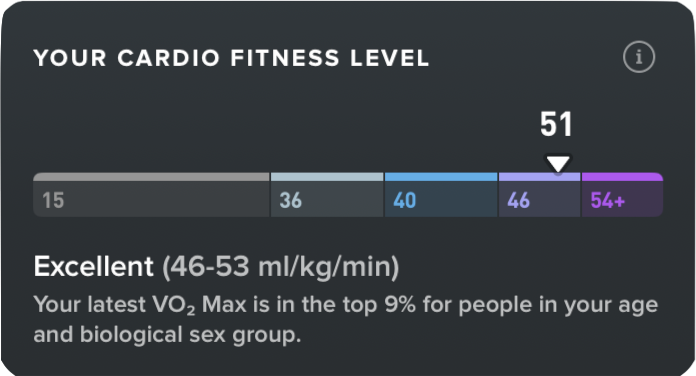
Because cardio only gets the spotlight in some of those blocks, while strength and hypertrophy take it in others, the climb has been gradual rather than dramatic. In January 2025 my Apple Watch had me at 41, and today Whoop puts me at 51, which it rates as Excellent and in the top 9% for my age and sex group.
That slow pace is on me, not the protocol. If you make VO2 max your main focus instead of one block among several, you can realistically reach the same kind of gains far faster, as the research further down shows.
A note on the data, because I want to be straight with you. I didn't track this perfectly, and I changed devices along the way. The starting number is from Apple Health in early 2025; the recent trend and the current 51 are from Whoop. These are wearable estimates, not a lab test, and I didn't log every single session. The screenshots below are exactly what my devices show.
A couple of practical notes on how I actually run it. I didn't jump straight into the full 4x4. For the first three weeks I did the 3x3 instead, three 3-minute intervals, until the intensity stopped feeling brutal, and only then stepped up to the 4x4. Both are saved in the app, and the 3x3 is a good on-ramp if the 4x4 feels like too much at first.
I also throw in the occasional Tabata session for variety, and every now and then I do a 4x4 on the rowing machine instead of the bike.
Most people reading this will run the 4x4, and that's exactly how I started, so everything below applies whether you're on your feet or on a bike. Here's the protocol in full, and the research behind why it works.
What Is the Norwegian 4x4 Protocol?
The Norwegian 4x4 is a high-intensity interval training (HIIT) protocol consisting of four 4-minute work intervals at 90-95% of your maximum heart rate, separated by 3-minute active recovery periods at 60-70% HRmax. It was developed by Jan Helgerud and Jan Hoff at NTNU and has been extensively studied by Ulrik Wisløff's Cardiac Exercise Research Group (CERG) at the same institution.
Unlike shorter sprint-based intervals like Tabata, the 4-minute work bouts are long enough to drive your heart to pump near its maximum stroke volume, the amount of blood ejected per beat (Astorino et al., 2017). This sustained cardiac demand is the key mechanism behind VO2 max improvement.
The Science: Why the 4x4 Works
VO2 max (your body's maximum rate of oxygen consumption) is limited primarily by how much oxygen your heart can deliver to working muscles (Bassett & Howley, 2000). The Norwegian 4x4 protocol targets this bottleneck directly.
During each 4-minute interval at 90-95% HRmax, your heart operates near its maximum stroke volume for a sustained period. Over weeks of training, this stimulus causes adaptations (Daussin et al., 2008):
- Increased stroke volume. Your heart pumps more blood per beat.
- Greater cardiac output. More total blood flow to muscles.
- Improved oxygen extraction. Muscles get better at using available oxygen.
- Mitochondrial density. More and larger mitochondria in working muscles.
In a landmark 2007 study published in Medicine & Science in Sports & Exercise, Helgerud and colleagues at NTNU found that the 4x4 protocol performed three times per week for 8 weeks improved VO2 max by approximately 7-9% in moderately trained subjects, significantly more than moderate continuous training or shorter sprint intervals. Stroke volume increased by roughly 10% in the same period.
Subsequent research at NTNU, including the large-scale Generation 100 Study with over 1,500 elderly participants, found that high-intensity intervals produced greater VO2 max improvements than moderate-intensity continuous training, though both groups saw health benefits (Stensvold et al., 2020). Separately, Wisløff et al. (2007) showed that the same 4x4 protocol in heart failure patients improved peak oxygen uptake by 46%, dramatically more than moderate continuous training.
Step-by-Step Workout Breakdown
Here's the complete Norwegian 4x4 session from warm-up to cooldown:
| Phase | Duration | Intensity |
|---|---|---|
| Warm-up | 10 minutes | 60-70% HRmax |
| Interval 1 | 4 minutes | 90-95% HRmax |
| Recovery 1 | 3 minutes | 60-70% HRmax |
| Interval 2 | 4 minutes | 90-95% HRmax |
| Recovery 2 | 3 minutes | 60-70% HRmax |
| Interval 3 | 4 minutes | 90-95% HRmax |
| Recovery 3 | 3 minutes | 60-70% HRmax |
| Interval 4 | 4 minutes | 90-95% HRmax |
| Cooldown | 5 minutes | 60-70% HRmax |
Total time: ~38 minutes. Only 16 minutes are spent at high intensity, but those 16 minutes are potent enough to drive significant cardiovascular adaptation.
How to hit the right intensity
The work intervals should feel hard but sustainable for 4 minutes. You should be breathing heavily and unable to hold a conversation, but not sprinting all-out. If you can't maintain the pace for the full 4 minutes, you started too hard.
A heart rate monitor is essential. A wrist-based tracker like an Apple Watch or Garmin will do the job. Without one, it's nearly impossible to stay in the 90-95% HRmax zone consistently. Going too easy reduces the training stimulus; going too hard means you'll burn out before completing all four intervals.
Who Is the Norwegian 4x4 For?
The protocol works across a wide range of fitness levels and activities:
- Runners. Run the intervals on a track, trail, or treadmill. See our interval training for running guide for more running-specific workouts.
- Cyclists. Perform on a bike trainer or outdoor climb.
- Rowers. Use a rowing machine.
- General fitness. Any activity that elevates heart rate sufficiently (elliptical, stair climber, uphill hiking).
Want to test your baseline first? The beep test and Cooper test are quick field tests that estimate your VO2 max without lab equipment.
The NTNU research has been conducted across a wide range of populations, including cardiac rehabilitation patients recovering from heart failure (Wisløff et al., 2007), demonstrating that the protocol can be adapted for clinical populations, under medical supervision, of course.
How Often Should You Train?
The original Helgerud study used 3 sessions per week. NTNU's CERG group recommends 2-3 sessions per week for most people, which balances training stimulus with adequate recovery.
- Research-tested dose: 3x per week for 8 weeks (Helgerud et al., 2007)
- Practical recommendation: 2x per week for 8-10 weeks (CERG guidelines)
- Maintenance: 1x per week once your target VO2 max is reached
Space sessions at least 48 hours apart. If you're over 40, recovery between sessions becomes even more important. You can do other training on non-interval days (easy runs, strength work, or skill practice) but avoid stacking two high-intensity sessions back to back.
Common Mistakes to Avoid
1. Going too hard during recovery
The 3-minute recovery periods should be genuinely easy. Walking or very light jogging at 60-70% HRmax. If your heart rate doesn't drop enough during recovery, you won't be able to sustain the intensity in later intervals.
2. Skipping the warm-up
Ten minutes feels like a lot, but the warm-up is critical. It gradually increases cardiac output and prepares your muscles for high-intensity work. Jumping straight to 90% HRmax from cold increases injury risk and makes the first interval feel much harder than it needs to.
3. Starting the first interval too hard
It takes about 1-2 minutes for your heart rate to climb to the target zone. Start the first interval at a pace you'd expect to sustain, and let your heart rate build naturally. If you go anaerobic in the first minute, you'll fade badly by interval 3.
4. Training more than 3 times per week
More is not better with high-intensity interval training. The cardiovascular adaptations happen during recovery. Overdoing it leads to fatigue accumulation, depressed heart rate variability, and stalled progress (Meeusen et al., 2013).
5. Not tracking your heart rate
Perceived effort is unreliable during intervals. It changes with fatigue, sleep, stress, and caffeine. A heart rate monitor keeps you honest and ensures you're actually training in the zone that drives VO2 max adaptation.
How to Track Your Progress
If you train with an Apple Watch, your VO2 max estimate (shown as "Cardio Fitness" in the Health app) will update over time as your cardiovascular fitness improves. Expect to see changes after 4-6 weeks of consistent training. For the most accurate measurement, find a VO2 max testing lab near you.
Other markers of progress include:
- Lower resting heart rate
- Faster heart rate recovery after intervals
- Being able to sustain a faster pace at the same heart rate
- Higher power output (if cycling) at the same heart rate
Norwegian 4x4 vs. Other Interval Protocols
How does the Norwegian 4x4 compare to other popular HIIT methods?
| Protocol | Work / Rest | Total Time | Intensity | Best For |
|---|---|---|---|---|
| Norwegian 4x4 | 4 min / 3 min x 4 | ~38 min | 90-95% HRmax | VO2 max (most researched) |
| Tabata | 20 sec / 10 sec x 8 | ~4 min | All-out | Time-efficient anaerobic power |
| 30/30 intervals | 30 sec / 30 sec x 15-25 | ~15-25 min | 90-95% HRmax | Beginners, manageable chunks |
| Zone 2 training | Continuous | 45-90 min | 60-70% HRmax | Fat oxidation, aerobic base |
| Tempo runs | Continuous | 20-40 min | 80-88% HRmax | [Lactate threshold](/blog/lactate-threshold/) |
The Norwegian 4x4 stands out because its 4-minute intervals sustain near-maximal cardiac output long enough to drive stroke volume adaptation. The original Tabata study (Tabata et al., 1996) actually showed respectable VO2 max gains (~15%), but 20-second all-out efforts also develop anaerobic capacity, which isn't the primary goal here. Zone 2 training improves endurance and fat oxidation but is less effective at raising your VO2 max ceiling on its own.
For the best results, combine 2-3 sessions of the Norwegian 4x4 per week with 2-3 sessions of easy Zone 2 training. This "polarized" approach, where ~80% of training is easy and ~20% is very hard, is what elite endurance athletes naturally gravitate toward (Seiler & Kjerland, 2006) and has been shown to produce greater VO2 max gains than threshold-only or high-volume approaches (Stöggl & Sperlich, 2014).
Run the Norwegian 4x4 in PEAKVO2
PEAKVO2 has the Norwegian 4x4 built in: it counts down every 4-minute interval and 3-minute recovery, holds you to the 90-95% and 60-70% heart rate zones, and taps your wrist at each switch, on iPhone or hands-free on Apple Watch. Start it and just run.
Start the Norwegian 4x4Frequently Asked Questions
How often should you do the Norwegian 4x4?
Two to three times per week. The original Helgerud study used 3x/week; CERG's practical guidelines suggest 2x/week is sufficient for most people. Space sessions at least 48 hours apart. Once per week is enough for maintenance after you've reached your target. More than 3x/week increases overtraining risk without additional VO2 max benefit.
How long until you see results from the Norwegian 4x4?
Most people feel subjective improvements (easier breathing, faster recovery) within 2-3 weeks. Measurable VO2 max gains typically appear after 4-6 weeks. The landmark NTNU study showed a 7-9% VO2 max improvement after 8 weeks of training three times per week, with larger gains likely in less fit individuals.
Can beginners do the Norwegian 4x4?
Yes, but build up to it. Start with our interval training for beginners guide, which uses walk-run intervals and 30/30 formats to condition your cardiovascular system over 6 weeks. Then progress to 2x4 minutes, then 3x4, then the full 4x4. The intensity is relative to your max heart rate, so the protocol automatically scales to your fitness level.
Is the Norwegian 4x4 better than Tabata?
For VO2 max improvement, the Norwegian 4x4 has a stronger evidence base. The 4-minute work intervals sustain near-maximal cardiac output long enough to drive stroke volume adaptation. Tabata's original study did show VO2 max gains, but 20-second all-out bursts also heavily develop anaerobic capacity. The Norwegian 4x4 is specifically designed to target the cardiovascular system, making it a better choice if VO2 max is the primary goal.
Can you do the Norwegian 4x4 on a bike?
Absolutely. The protocol was originally tested on both treadmills and bike ergometers. Cycling works especially well because you can precisely control intensity via power output. The same heart rate zones apply: 90-95% HRmax during work, 60-70% during recovery.
Do you need a heart rate monitor?
Strongly recommended. The protocol's effectiveness depends on staying in the 90-95% HRmax zone during work intervals. Without a heart rate monitor, most people either go too hard (burning out by interval 3) or too easy (not reaching the threshold for VO2 max adaptation). An Apple Watch or Garmin provides sufficient accuracy for this purpose.
The Bottom Line
The Norwegian 4x4 protocol is the most researched HIIT method for VO2 max improvement, and by extension, one of the most powerful tools we have for cardiovascular health and longevity. It's backed by decades of research from NTNU, takes under 40 minutes, and works for runners, cyclists, and anyone who wants to improve their cardiovascular fitness. Start with 2-3 sessions per week, track your heart rate, respect the recovery periods, and you'll see measurable improvements within 8 weeks. Use our VO2 max improvement calculator to project how long it takes to reach your goal. For a deeper look at what your VO2 max score means at your age and sex, check our normative charts.
Keep Reading
- Why Did My VO2 Max Drop? 6 Reasons and How to Get It Back
- Heart Rate Zones Explained: What Your Heart Rate Should Be in Each Workout
- Hyrox Training: How to Improve VO2 Max and Drop Your Time
- Norwegian 4x4 Training Plan: Week-by-Week Guide with the PEAKVO2 App
- Best VO2 Max Training Apps, Compared by What You Need
- Free Programmable Interval Timer
- HIIT Workouts for Fat Loss: 6 Sessions and What the Research Says
- 15 Best Exercises for HIIT Workouts
- What Is a Good VO2 Max? Charts by Age and Gender
- How to Improve Your Apple Watch Cardio Fitness Score
- The Beep Test: Complete Guide and Score Tables
- Endurance Training Workouts: 10 Sessions for Every Fitness Level
Find a VO2 Max Testing Lab
Get your VO2 max measured with clinical-grade equipment. 160+ labs worldwide.
Browse LabsReferences
- Myers J, Prakash M, Froelicher V, et al. Exercise capacity and mortality among men referred for exercise testing. N Engl J Med. 2002;346(11):793-801. PubMed
- Mandsager K, Harb S, Cremer P, et al. Association of cardiorespiratory fitness with long-term mortality among adults undergoing exercise treadmill testing. JAMA Netw Open. 2018;1(6):e183605. PubMed
- Helgerud J, Høydal K, Wang E, et al. Aerobic high-intensity intervals improve VO2max more than moderate training. Med Sci Sports Exerc. 2007;39(4):665-671. PubMed
- Wisløff U, Støylen A, Loennechen JP, et al. Superior cardiovascular effect of aerobic interval training versus moderate continuous training in heart failure patients. Circulation. 2007;115(24):3086-3094. PubMed
- Stensvold D, Viken H, Steinshamn SL, et al. Effect of exercise training for five years on all cause mortality in older adults — the Generation 100 randomised trial. BMJ. 2020;371:m3485. PubMed
- Bassett DR Jr, Howley ET. Limiting factors for maximum oxygen uptake and determinants of endurance performance. Med Sci Sports Exerc. 2000;32(1):70-84. PubMed
- Daussin FN, Zoll J, Dufour SP, et al. Effect of interval versus continuous training on cardiorespiratory and mitochondrial functions. Am J Physiol Regul Integr Comp Physiol. 2008;295(1):R264-R272. PubMed
- Astorino TA, Edmunds RM, Clark A, et al. High-intensity interval training increases cardiac output and VO2max. Med Sci Sports Exerc. 2017;49(2):265-273. PubMed
- Tabata I, Nishimura K, Kouzaki M, et al. Effects of moderate-intensity endurance and high-intensity intermittent training on anaerobic capacity and VO2max. Med Sci Sports Exerc. 1996;28(10):1327-1330. PubMed
- Seiler KS, Kjerland GØ. Quantifying training intensity distribution in elite endurance athletes. Scand J Med Sci Sports. 2006;16(1):49-56. PubMed
- Stöggl T, Sperlich B. Polarized training has greater impact on key endurance variables than threshold, high intensity, or high volume training. Front Physiol. 2014;5:33. PubMed
- Meeusen R, Duclos M, Foster C, et al. Prevention, diagnosis, and treatment of the overtraining syndrome: joint consensus statement. Med Sci Sports Exerc. 2013;45(1):186-205. PubMed