Tabata Workouts: What They Are and How to Do Them Right

 Run these workouts on your iPhone, or hands-free on Apple Watch. Get PEAKVO2
 A Tabata workout consists of 8 rounds of 20 seconds of maximum effort followed by 10 seconds of rest, totaling 4 minutes. Developed by Japanese researcher Dr. Izumi Tabata, this protocol improved VO2 max by 14% and anaerobic capacity by 28% in just 6 weeks in the original 1996 study (Tabata et al., 1996). It remains one of the most time-efficient interval training methods ever tested.
Tabata is not a brand name or a workout style. It is a specific protocol with a specific structure, backed by peer-reviewed research. The 2:1 work-to-rest ratio (20 seconds on, 10 seconds off) was chosen deliberately because it pushes both the aerobic and anaerobic energy systems to their limits simultaneously. If you are looking for a workout that delivers measurable fitness gains in minimal time, this is the most studied option.
What Is a Tabata Workout?
A Tabata workout follows a fixed structure:
- Work period: 20 seconds at maximum intensity
- Rest period: 10 seconds of complete rest
- Rounds: 8
- Total time: 4 minutes
Set your tabata timer to 20 seconds on, 10 seconds off, 8 rounds. On an Apple Watch, PEAKVO2 runs Tabata as a guided workout: it taps your wrist when each 20-second burst ends and again when the 10 seconds of rest are up, so you never break effort to check a clock. The exercise can be anything that allows you to reach near-maximum effort: sprints, cycling, squats, burpees, or rowing. What matters is the intensity. The work intervals should be performed at roughly 170% of VO2 max, which in practice means going as hard as you possibly can for each 20-second burst.
A single Tabata round takes 4 minutes, but most people add a warm-up (5 minutes) and cooldown (3 minutes), bringing the total session to about 12 minutes. You can also stack multiple Tabata rounds with different exercises for a longer session, with 1 to 2 minutes of rest between rounds.
The Original Tabata Study
The protocol comes from a 1996 study published in Medicine & Science in Sports & Exercise by Dr. Izumi Tabata and colleagues at the National Institute of Fitness and Sports in Kanoya, Japan. The study was originally designed to optimize training for the Japanese Olympic speed skating team.
Two groups of moderately trained subjects trained 5 days per week for 6 weeks:
| Group | Protocol | Duration | Intensity |
|---|---|---|---|
| Moderate-intensity | 60 minutes of continuous cycling | 60 min/session | 70% VO2 max |
| Tabata (HIIT) | 8 rounds of 20s on / 10s off cycling | 4 min/session | 170% VO2 max |
The results were striking:
- Moderate group: VO2 max increased by ~10%. Anaerobic capacity did not change.
- Tabata group: VO2 max increased by ~14%. Anaerobic capacity increased by 28%.
The Tabata group trained for a fraction of the time yet saw larger aerobic improvements and massive anaerobic gains. This made the study one of the most cited papers in exercise science. A 2024 umbrella review of 36 meta-analyses confirmed that high-intensity interval protocols like Tabata produce significant cardiorespiratory fitness improvements across populations (Poon et al., 2024).
Benefits of Tabata Workout Training
Tabata training works both energy systems simultaneously, which is what makes it unique among interval protocols. If you are looking for a structured tabata training workout, this section explains why the protocol is so effective before the workouts below give you exactly what to do.
Aerobic adaptations (VO2 max)
During the later rounds of a Tabata set, your aerobic system is working at or near its maximum capacity to deliver oxygen. Even though each work interval is only 20 seconds, the short rest means oxygen demand stays elevated across all 8 rounds. Over weeks of training, this drives the same adaptations that longer intervals produce: increased stroke volume, more mitochondria, and greater cardiac output (Gibala et al., 2012). For a complete breakdown of every method to improve your VO2 max, see our evidence-based guide. If you want to know what a good VO2 max looks like for your age, check our benchmarks.
Anaerobic adaptations (power and capacity)
The 170% VO2 max intensity forces your muscles to rely heavily on anaerobic glycolysis, producing lactate faster than your body can clear it. Over time, this increases your muscles' buffering capacity and their tolerance for high-intensity work. This is why the original study saw a 28% increase in anaerobic capacity. No other protocol tested in the same study produced this dual benefit.
EPOC and calorie burn
The extreme intensity of Tabata creates a large excess post-exercise oxygen consumption (EPOC) effect. Your metabolism stays elevated for hours after the workout as your body restores oxygen levels and clears metabolic byproducts. Research suggests that high-intensity intermittent protocols produce greater fat loss than moderate-intensity continuous exercise, even with less total exercise time (Trapp et al., 2008). This makes Tabata a popular tabata workout for belly fat reduction, though spot reduction is a myth. Fat loss occurs across the entire body in response to an overall calorie deficit combined with high-intensity exercise.
6 Tabata Workout Examples
Below are six tabata workout routines covering different exercises and equipment. Each uses the standard structure: 20 seconds on, 10 seconds off, 8 rounds. Set your tabata interval timer before you start, or follow our walkthrough on programming Tabata in an interval timer app. Add a 5-minute warm-up and 3-minute cooldown to every session. These are the best exercises for tabata workout sessions because they allow maximum power output with simple form.
1. Bodyweight Tabata Workout
The simplest tabata workout bodyweight option. No equipment, any space. This is an ideal tabata workout for beginners who want to try the protocol with familiar movements.
| Round | Exercise |
|---|---|
| 1 and 2 | Burpees |
| 3 and 4 | Jump squats |
| 5 and 6 | Mountain climbers |
| 7 and 8 | High knees |
Go all-out on every round. If burpees are too demanding, substitute squat thrusts (burpees without the push-up or jump). You can also create a tabata squat workout by replacing all exercises with squat variations: bodyweight squats, jump squats, sumo squats, and pulse squats.
2. Running Tabata
Best performed on a track, field, or treadmill.
| Round | Exercise |
|---|---|
| 1 through 8 | Sprint 20 seconds, stand or walk 10 seconds |
On a treadmill, set the speed to your sprint pace and straddle the belt during rest periods (see our HIIT treadmill workouts for more treadmill protocols). On a track, sprint the straights and walk the rest. This is closest to the original study protocol. For longer running intervals and structured programs, see our interval training for running guide.
3. Cycling Tabata Workout
Stationary bike or spin bike. This cycling tabata workout mirrors the original study's exact modality.
| Round | Exercise |
|---|---|
| 1 through 8 | Pedal at maximum resistance and cadence for 20 seconds, stop pedaling for 10 seconds |
Aim for the highest wattage you can sustain across all 8 rounds. Your power will drop by rounds 6 through 8. That is normal and expected.
4. Tabata Core Workout
This tabata abs workout targets your midsection with four exercises.
| Round | Exercise |
|---|---|
| 1 and 2 | Bicycle crunches |
| 3 and 4 | Plank jacks |
| 5 and 6 | V-ups |
| 7 and 8 | Russian twists |
Core exercises are harder to perform at true Tabata intensity. Focus on maximum speed with controlled form. If V-ups are too hard, substitute leg raises.
5. Kettlebell Tabata Workout
Requires one kettlebell. Choose a moderate weight since you need to maintain explosive speed for 8 rounds.
| Round | Exercise |
|---|---|
| 1 and 2 | Kettlebell swings |
| 3 and 4 | Goblet squats |
| 5 and 6 | Kettlebell swings |
| 7 and 8 | Kettlebell clean and press (alternating arms) |
The kettlebell swing is ideal for Tabata because it is a ballistic, full-body movement that naturally produces high power output.
6. Beginner Tabata (Modified)
If standard Tabata is too intense, start here. This uses a reversed 10:20 ratio (10 seconds work, 20 seconds rest) to build tolerance.
| Phase | Weeks 1 and 2 | Weeks 3 and 4 |
|---|---|---|
| Work | 10 seconds | 15 seconds |
| Rest | 20 seconds | 15 seconds |
| Rounds | 8 | 8 |
| Total | 4 minutes | 4 minutes |
After 4 weeks, progress to the full 20:10 protocol. The exercises can be lower-impact versions: step-back lunges instead of jump squats, marching in place instead of high knees. For a broader view of beginner interval options, see our interval training for beginners guide.
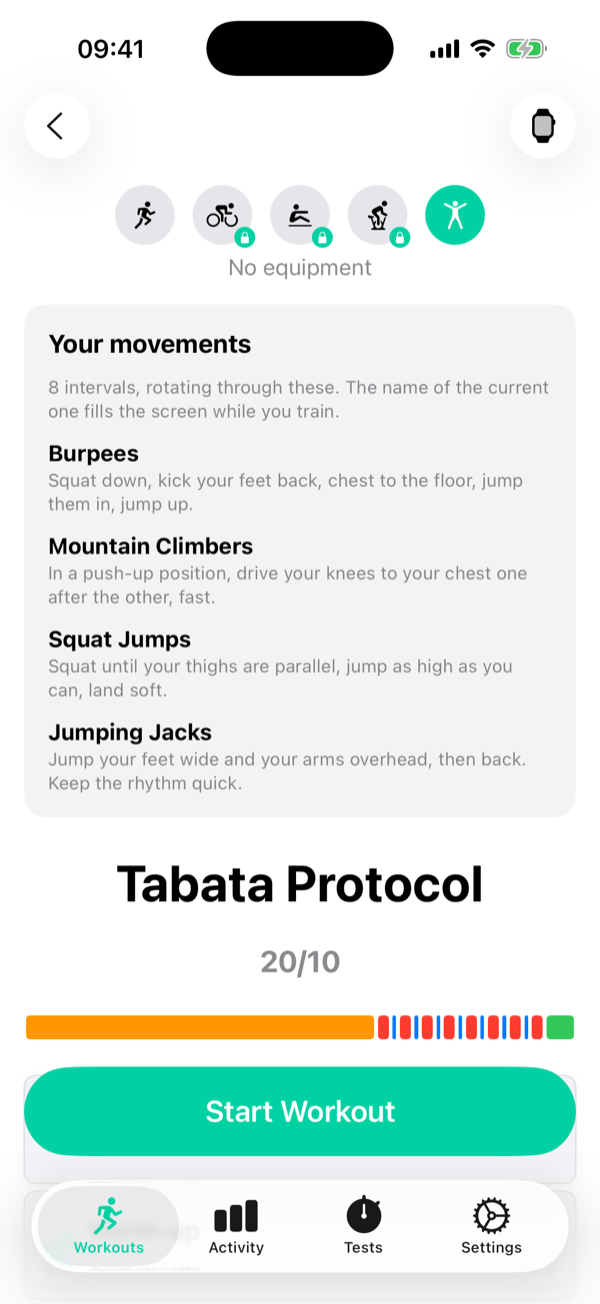
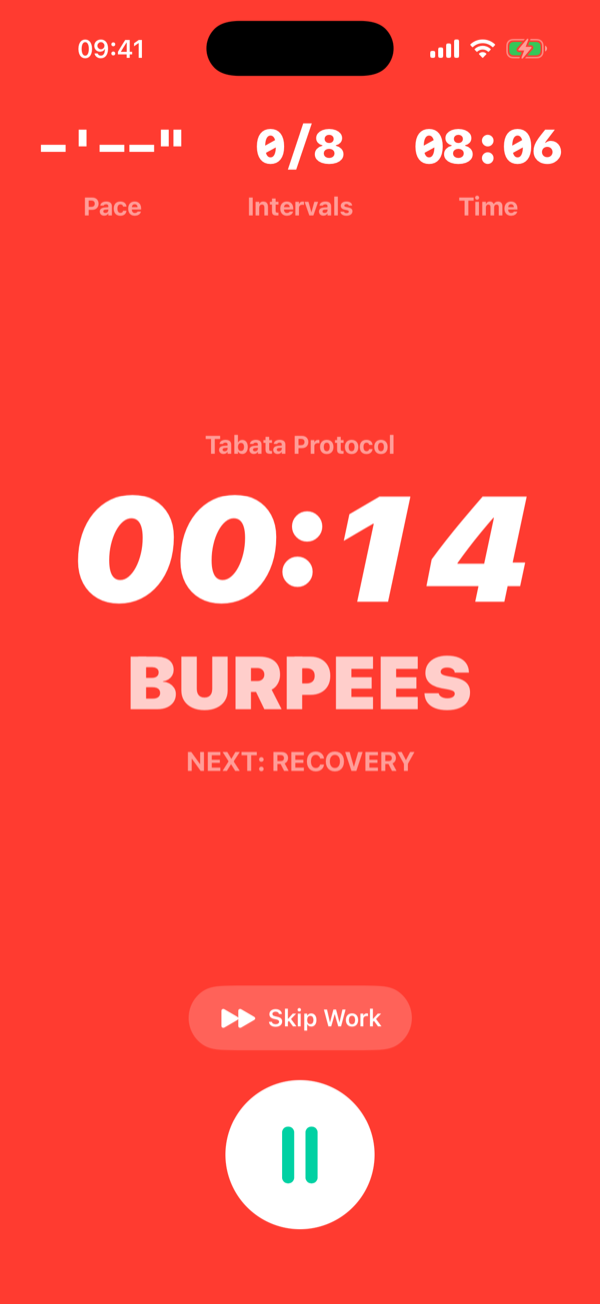
Do Bodyweight Tabata in PEAKVO2
The bodyweight tabata above needs no equipment and no watching the clock. PEAKVO2 has a Bodyweight category of guided tabata and HIIT workouts that run the 20 seconds on, 10 seconds off structure for you, full screen, with a haptic cue at every switch, so you just do your burpees and jump squats while the app counts the eight rounds. As the benefits section covered, that all-out bodyweight work is a genuine VO2 max stimulus, which means you build your aerobic engine with nothing but your own body.
4-Week Tabata Workout Plan
This tabata workout plan assumes you are already doing some regular exercise. If you are completely new to interval training, spend 4 to 6 weeks on our beginner interval plan first.
| Week | Sessions | What to do | Off days |
|---|---|---|---|
| 1 | 2 | 1 round per session (4 min). Pick any workout above. | 2 to 3 zone 2 sessions |
| 2 | 2 | 1 round per session. Try a different workout each day. | 2 to 3 zone 2 sessions |
| 3 | 3 | 2 rounds per session (8 min total, with 2 min rest between rounds). | 2 zone 2 sessions |
| 4 | 3 | 2 to 3 rounds per session (8 to 12 min total). Mix different workouts within one session. | 2 zone 2 sessions |
Space tabata sessions at least 48 hours apart. The intensity is extreme, and your body needs recovery time to adapt. Pair tabata days with easy zone 2 training on off days for a balanced tabata workout routine that builds both your aerobic base and your anaerobic ceiling.
Tabata vs. Norwegian 4x4
Both protocols improve VO2 max, but they work differently and serve different goals.
| Tabata | Norwegian 4x4 | |
|---|---|---|
| Work interval | 20 seconds | 4 minutes |
| Rest interval | 10 seconds | 3 minutes |
| Total rounds | 8 | 4 |
| Session time | ~4 minutes (12 with warm-up) | ~38 minutes |
| Intensity | All-out (~170% VO2 max) | 90-95% HRmax |
| Primary benefit | Aerobic + anaerobic capacity | VO2 max (strongest evidence) |
| VO2 max improvement | ~14% in 6 weeks | ~7-10% in 8 weeks |
| Best for | Time-pressed athletes, power sports | Endurance athletes, steady VO2 max gains |
The Norwegian 4x4 has a larger body of supporting research and is the protocol most cardiologists and exercise physiologists recommend for cardiovascular health (Helgerud et al., 2007). Tabata is better when time is extremely limited or when anaerobic capacity is a priority (team sports, martial arts, combat sports).
You can use both in the same training week. A common approach: one Norwegian 4x4 session for VO2 max, one Tabata session for anaerobic power, and three zone 2 sessions for the aerobic base.
Common Mistakes
Confusing "Tabata-style" with actual Tabata
Many group fitness classes and workout videos label any 20:10 format as "Tabata." If the intensity during work intervals is moderate rather than all-out, you are doing regular interval training. Real Tabata requires maximum effort on every round. If you can comfortably hold a conversation during the work intervals, you are not doing Tabata.
Not warming up
Four minutes of all-out effort on a cold body is a recipe for muscle strains and joint injuries. Five minutes of progressive warm-up (light cardio, dynamic stretches, gradually increasing intensity) is essential. This is especially important for running and cycling Tabata where the explosive movements stress tendons and ligaments.
Doing Tabata every day
The protocol generates extreme metabolic stress. Daily Tabata sessions lead to overtraining, elevated cortisol, depressed immune function, and stalled fitness gains (Meeusen et al., 2013). Two to three sessions per week is the upper limit for most people. Recovery days are when the adaptations actually happen.
Using exercises that are too complex
The 20-second work window requires movements you can perform explosively with minimal setup. Exercises with complex form (Olympic lifts, handstand push-ups, muscle-ups) break down when performed at maximum speed under fatigue. Stick to simple, full-body movements: sprints, squats, burpees, swings, cycling.
Ignoring the rest periods
Ten seconds of rest is part of the protocol. Do not stretch, walk around, or adjust equipment during rest. Stand still (or sit on the bike), breathe, and prepare for the next round. The deliberately short rest is what creates the metabolic demand that drives both aerobic and anaerobic adaptations.
PEAKVO2. The interval app for your cardio fitness.
Run Tabata as a guided Apple Watch workout: the 20:10 timing handled on your wrist, a haptic tap at every transition, and a target heart rate zone for each phase.
Download PEAKVO2Frequently Asked Questions
How long is a Tabata workout?
A single Tabata round is exactly 4 minutes: 8 cycles of 20 seconds work and 10 seconds rest. With a warm-up and cooldown, a complete session takes about 12 minutes. You can extend the workout by doing 2 to 3 Tabata rounds with different exercises, separated by 1 to 2 minutes of rest, for a total of 20 to 25 minutes.
Is Tabata good for weight loss?
Yes. The extreme intensity creates significant EPOC (afterburn), elevating your metabolism for hours after the workout. Research shows that high-intensity intermittent exercise reduces body fat more effectively than moderate continuous exercise, even with less total training time (Trapp et al., 2008). However, Tabata alone is not sufficient for weight loss without attention to overall calorie balance.
Can beginners do Tabata?
Not at full intensity. The original protocol requires all-out effort at 170% of VO2 max, which is extremely demanding. Beginners should start with the modified version (10 seconds on, 20 seconds off) or first build a fitness base with our interval training for beginners guide. After 4 to 6 weeks of regular interval training, most people can attempt full Tabata.
What exercises are best for Tabata?
Exercises that are simple, full-body, and allow maximum power output. The best tabata workout exercises include: burpees, sprint cycling, running sprints, jump squats, kettlebell swings, mountain climbers, rowing, and high knees. Avoid exercises with complex form that degrades under fatigue.
Is Tabata better than running?
It depends on your goal. For VO2 max improvement and fat loss, 4 minutes of Tabata produces comparable or greater adaptations than 30 to 60 minutes of moderate running (Tabata et al., 1996). For building an aerobic base, endurance, and lactate threshold, longer runs and zone 2 training are more effective. The best approach combines both.
How many times a week should I do Tabata?
Two to three times per week, with at least 48 hours between sessions. The extreme intensity requires full recovery. Fill the remaining days with low-intensity exercise like walking or zone 2 training. More than 3 Tabata sessions per week increases overtraining risk without additional benefit.
Test Your Fitness Level
Use our VO2 max calculator to estimate your cardiovascular fitness and set a training target.
Calculate Your VO2 MaxKeep Reading
- Tabata vs Norwegian 4x4: Which Interval Protocol Is Better?
- Free Programmable Interval Timer
- HIIT Workouts for Fat Loss: 6 Sessions and What the Research Says
- 15 Best Exercises for HIIT Workouts
- Interval Training for Beginners: What It Is and How to Start
- Norwegian 4x4 Protocol: Proven HIIT to Raise VO2 Max
- What Is a Good VO2 Max? Charts by Age and Gender
- Zone 2 Training: The Foundation of Endurance Fitness
References
- Tabata I, Nishimura K, Kouzaki M, et al. Effects of moderate-intensity endurance and high-intensity intermittent training on anaerobic capacity and VO2max. Med Sci Sports Exerc. 1996;28(10):1327-1330. PubMed
- Poon ET, Li HY, Gibala MJ, Wong SH, Ho RS. High-intensity interval training and cardiorespiratory fitness in adults: an umbrella review of systematic reviews and meta-analyses. Scand J Med Sci Sports. 2024;34(5):e14652. PubMed
- Gibala MJ, Little JP, MacDonald MJ, Hawley JA. Physiological adaptations to low-volume, high-intensity interval training in health and disease. J Physiol. 2012;590(5):1077-1084. PubMed
- Trapp EG, Chisholm DJ, Freund J, Boutcher SH. The effects of high-intensity intermittent exercise training on fat loss and fasting insulin levels of young women. Int J Obes. 2008;32(4):684-691. PubMed
- Helgerud J, Hoydal K, Wang E, et al. Aerobic high-intensity intervals improve VO2max more than moderate training. Med Sci Sports Exerc. 2007;39(4):665-671. PubMed
- Meeusen R, Duclos M, Foster C, et al. Prevention, diagnosis, and treatment of the overtraining syndrome: joint consensus statement. Med Sci Sports Exerc. 2013;45(1):186-205. PubMed