VO2 Max by Age: Chart of Normative Scores and What's Good

 Run these workouts on your iPhone, or hands-free on Apple Watch. Get PEAKVO2
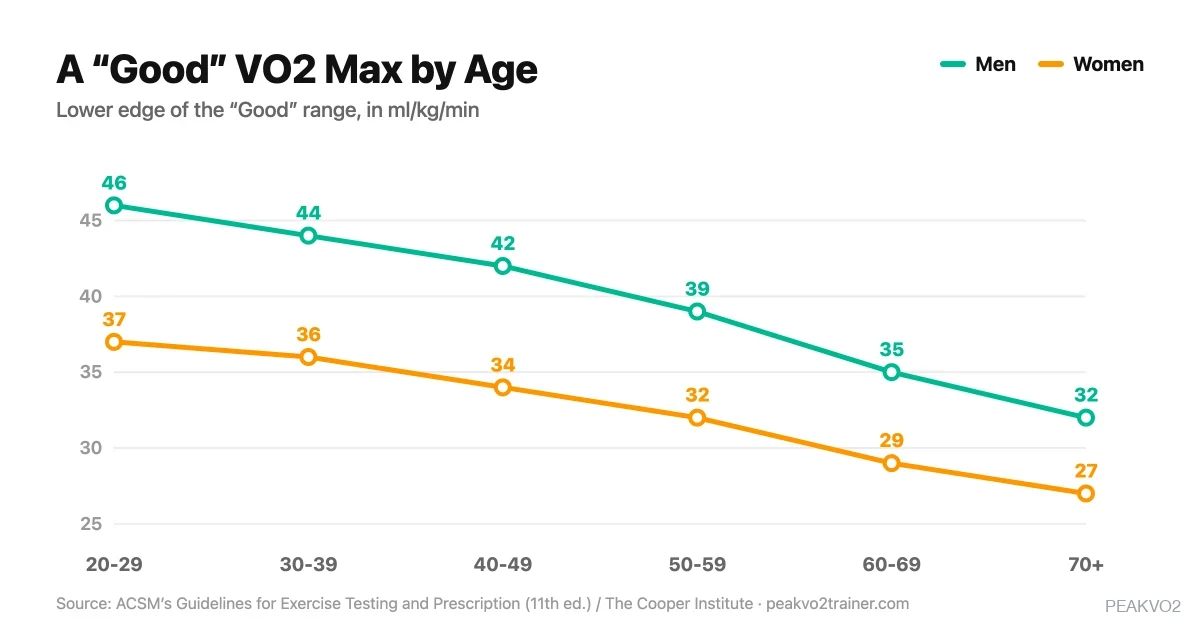
 A good VO2 max depends on your age and sex. For men, a good score is roughly 46+ at age 20-29, 42+ at 40-49, and 35+ at 60-69 ml/kg/min; women's thresholds run about 10 to 15 percent lower. Beating your age-group average is what cuts mortality risk the most.
Your VO2 max changes with age, so the same number can be excellent at 60 and below average at 30. Find your exact bracket in the charts below, or estimate your score with the calculator just below and get your category instantly. The charts come from ACSM and Cooper Institute data, and the rest of this guide explains what each category means for your health and longevity.
Estimate Your VO2 Max
Don't have a score yet? Estimate it from any of 5 validated field tests. Pick the test you have a result for, enter the numbers, and you get your VO2 max plus the matching category for your age and sex from the charts below.
Run as far as you can in 12 minutes, on a flat track or course. Enter the distance covered. How to run the Cooper test →
Run 1.5 miles (2.41 km) as fast as you can. Enter your finish time. Common in US military fitness assessments.
Walk 1 mile (1.61 km) as fast as you can. Take your finish heart rate immediately afterward. Best for people who do not run.
The 20-meter shuttle run. Enter the last full level you completed. How to run the beep test →
No exercise required. Uses the ratio of your max heart rate to resting heart rate (Uth-Sørensen method). Most accurate when resting HR is taken first thing in the morning, lying down.
A well-run field test typically lands within 3 to 5 ml/kg/min of a lab value. For the full method details and a projection of how fast you can improve, see the standalone VO2 max calculator.
VO2 max is the single best measure of cardiovascular fitness. It tells you how much oxygen your body can use during all-out exercise, measured in milliliters per kilogram of body weight per minute (ml/kg/min). Higher is better, and the answer to "is mine good?" always depends on your age and sex. If your number came from a wearable and looks alarmingly low, also read how to improve your Apple Watch cardio fitness score since wearable estimates are frequently off. On a Fitbit, the same number is your Cardio Fitness Score by age.
VO2 Max Chart by Age and Sex
The values below are the normative percentiles from The Cooper Institute's Aerobics Center Longitudinal Study, a cohort of more than 80,000 adults who completed maximal treadmill tests with direct gas analysis, as published in ACSM's Guidelines for Exercise Testing and Prescription (11th edition, 2021, Table 4.7). These are the same charts used in clinical exercise testing, and they remain current as of 2026. Find your decade and sex to see where your score falls.
Men's VO2 Max Chart by Age
| Age | Poor | Below Avg | Average | Above Avg | Good | Excellent | Superior |
|---|---|---|---|---|---|---|---|
| 20-29 | <33 | 33-36 | 37-41 | 42-45 | 46-52 | 53-59 | 60+ |
| 30-39 | <31 | 31-34 | 35-39 | 40-43 | 44-50 | 51-56 | 57+ |
| 40-49 | <28 | 28-32 | 33-37 | 38-41 | 42-48 | 49-54 | 55+ |
| 50-59 | <25 | 25-29 | 30-34 | 35-38 | 39-45 | 46-51 | 52+ |
| 60-69 | <22 | 22-25 | 26-30 | 31-34 | 35-41 | 42-47 | 48+ |
| 70+ | <19 | 19-22 | 23-27 | 28-31 | 32-37 | 38-43 | 44+ |
Values in ml/kg/min.
Women's VO2 Max Chart by Age
Women have lower VO2 max values than men at every age due to physiological differences in hemoglobin, body composition, and heart size. A "good" VO2 max for a woman by age is typically 10 to 15 percent lower than for a man at the same fitness level. For training strategies specific to women, see our VO2 max guide for women.
| Age | Poor | Below Avg | Average | Above Avg | Good | Excellent | Superior |
|---|---|---|---|---|---|---|---|
| 20-29 | <24 | 24-28 | 29-32 | 33-36 | 37-41 | 42-47 | 48+ |
| 30-39 | <23 | 23-27 | 28-31 | 32-35 | 36-40 | 41-45 | 46+ |
| 40-49 | <21 | 21-25 | 26-29 | 30-33 | 34-38 | 39-43 | 44+ |
| 50-59 | <19 | 19-22 | 23-27 | 28-31 | 32-36 | 37-41 | 42+ |
| 60-69 | <17 | 17-20 | 21-24 | 25-28 | 29-33 | 34-38 | 39+ |
| 70+ | <15 | 15-18 | 19-22 | 23-26 | 27-31 | 32-36 | 37+ |
Values in ml/kg/min.
What Do These Categories Mean?
- Poor / Below Average: Your cardiovascular system is significantly undertrained. Even small improvements here produce large health benefits. A person at 25 ml/kg/min who reaches 30 ml/kg/min has meaningfully reduced their mortality risk.
- Average: You're at the population midpoint. For general health, this is adequate, but research suggests pushing above average provides substantial longevity benefits.
- Above Average / Good: You're in a strong position. You exercise regularly and your cardiovascular system is well-adapted.
- Excellent / Superior: You're at competitive athlete or highly trained recreational athlete levels. Maintaining this range is associated with the lowest mortality risk across all studies.
What Does a VO2 Max of 35, 40, 45, or 50 Mean?
The same number lands in very different categories depending on your age and sex. Here is how four common scores read against the charts above.
- A VO2 max of 35: For a man, below average to average through your 40s, above average in your 50s, and good past 60. For a woman, above average in your 20s and 30s and good from your 40s onward.
- A VO2 max of 40: For a man, average in your 20s, above average in your 30s and 40s, and good to excellent from 50 on. For a woman, good in your 20s and 30s, excellent in your 40s and 50s, and superior past 60.
- A VO2 max of 45: For a man, above average in your 20s, good through your 50s, and excellent to superior past 60. For a woman, excellent in your 20s and 30s and superior from your 40s on.
- A VO2 max of 50: For a man, good in your 20s and 30s, excellent in your 40s and 50s, and superior past 60. For a woman, superior at every age, approaching trained-athlete territory.
To pin down exactly where your number falls, match your age and sex in the charts above, or use the calculator above to estimate your score from a field test and get your category instantly.
What Do Elite Athletes Score?
For context, here are VO2 max values from professional and elite athletes:
| Athlete / Sport | VO2 Max (ml/kg/min) |
|---|---|
| Kilian Jornet (ultra runner) | 89.5 |
| Oskar Svendsen (cyclist, highest ever recorded) | 97.5 |
| Elite male distance runners | 75-85 |
| Elite female distance runners | 65-75 |
| Pro male cyclists (Tour de France) | 70-85 |
| Pro female cyclists | 60-70 |
| Elite male rowers | 65-75 |
| Elite cross-country skiers | 75-90 |
| Professional soccer players | 55-67 |
| Recreational runners | 40-55 |
| Average untrained adult (M) | 35-40 |
| Average untrained adult (F) | 27-31 |
The gap between an untrained adult and an elite endurance athlete is enormous, but even modest improvements within your own range have significant health implications.
VO2 Max and Longevity: The Numbers
VO2 max isn't just a fitness metric. It's the strongest predictor of all-cause mortality, stronger than smoking, hypertension, or diabetes as a risk factor (Myers et al., 2002; Mandsager et al., 2018). Knowing how to improve your VO2 max becomes one of the highest-leverage interventions for long-term health.
A study in the Journal of the American College of Cardiology following 4,137 healthy adults for 24 years found that each 1 MET increase in fitness (roughly 3.5 ml/kg/min of VO2 max) was associated with (Imboden et al., 2018):
- 11.6% reduction in all-cause mortality
- 16.1% reduction in cardiovascular death
A separate JACC study tracking 5,107 men over 46 years found that each unit increase in VO2 max was associated with 45 additional days of life expectancy (Clausen et al., 2018).
A study from the Cleveland Clinic, tracking over 122,000 patients, found that people with "elite" cardiorespiratory fitness had an 80% lower risk of death compared to those in the lowest fitness group. The researchers concluded there is "no upper limit" to the benefit of higher cardiorespiratory fitness (Mandsager et al., 2018).
The takeaway: moving from "poor" to "average" is life-changing. Moving from "average" to "good" is still highly meaningful. Every point matters.
How to Measure Your VO2 Max
Lab test (gold standard)
The most accurate way is a graded exercise test in a sports medicine lab. You run on a treadmill or pedal a bike ergometer at increasing intensity while wearing a mask that measures your oxygen consumption and CO2 output. The test takes about 10-15 minutes to reach your maximum.
Lab tests typically cost $150-$400. You can find VO2 max testing labs near you in our lab directory.
Wearable estimates
Modern smartwatches provide VO2 max estimates that are surprisingly accurate for most people:
- Apple Watch estimates VO2 max during outdoor walks and runs
- Garmin watches estimate VO2 max using Firstbeat analytics during running and cycling
- COROS, Polar, Suunto also provide estimates using similar heart rate and pace algorithms
Wearable estimates are useful for tracking trends over time, even if the absolute number may differ slightly from a lab test.
Field tests
If you don't have a lab or smartwatch, field tests can estimate your VO2 max:
- The Beep Test: Progressive 20m shuttle run. Your final level maps to an estimated VO2 max.
- Cooper 12-Minute Run: Run as far as you can in 12 minutes. Distance correlates to VO2 max.
- 1-Mile Walk Test: Walk a mile as fast as possible. Heart rate at the finish estimates VO2 max.
How to Improve Your VO2 Max
VO2 max is highly trainable. Most people can improve by 5-15% in 8-12 weeks with the right training. If you want an app to guide the sessions, see the best VO2 max training apps. Key principles:
High-intensity interval training works best
Research consistently shows that structured intervals at 90-95% of max heart rate produce significantly greater VO2 max gains than moderate steady-state exercise. The sweet spot is 2 interval sessions per week.
Proven protocols
- Norwegian 4x4: 4x4 minutes at 90-95% HRmax with 3-minute active recovery. The gold standard, backed by extensive research.
- 30/30 intervals: 30 seconds hard, 30 seconds easy for 15-25 minutes. Accessible and effective. See our interval training for beginners guide for a full 6-week plan.
- Tabata: 8x20 seconds all-out with 10-second rest. Short and intense.
Age is not a barrier
If you're over 40, don't let age discourage you. VO2 max is improvable at any age. People in their 60s have increased VO2 max by 19-22% through structured training. The protocols scale to your individual max heart rate, not an absolute pace.
Test and improve your VO2 max in PEAKVO2
PEAKVO2 estimates your VO2 max from a built-in field test, shows your category for your age and sex, and runs the interval workouts that actually move it, like the Norwegian 4x4, guided on iPhone and Apple Watch with your VO2 max tracked over time.
Get PEAKVO2 freeThe Bottom Line
A "good" VO2 max depends on your age and sex. Use the charts above to see where you stand. But regardless of your current number, the most important thing is the direction: improving your VO2 max, at any level, reduces mortality risk and improves quality of life. Whether you use a lab test, a smartwatch, or a field test, knowing your number gives you a baseline to build from.
Use our VO2 max improvement calculator to project how long it will take to reach your target.
Frequently Asked Questions
What is a good VO2 max for my age?
It depends on your sex and age. For example, a 40-year-old man scoring 42-48 ml/kg/min is in the "Good" range, while a 40-year-old woman in the same range would need 34-38 ml/kg/min (learn why women's scores differ). See the normative charts above for exact thresholds by decade. Note that two people with the same VO2 max can perform very differently in sustained efforts, because performance also depends on lactate threshold, the percentage of VO2 max you can hold without fatiguing.
What is VO2 max?
VO2 max is the maximum amount of oxygen your body can take in and use during intense exercise, measured in millilitres of oxygen per kilogram of body weight per minute (ml/kg/min). It is the single best measure of cardiorespiratory fitness, because it reflects how well your heart, lungs, blood and muscles work together to deliver and use oxygen. A higher number means a higher ceiling for sustained effort.
What is a good VO2 max for a man?
For men, the "Good" band starts at roughly 46 ml/kg/min in the 20s, 44 in the 30s, 42 in the 40s, 39 in the 50s, 35 in the 60s, and 32 from 70 onward. For comparison, the average for men in their 20s is 37 to 41, so clearing the good threshold puts you clearly above the population midpoint for your decade.
What is a good VO2 max for a woman?
For women, the "Good" band starts at roughly 37 ml/kg/min in the 20s, 36 in the 30s, 34 in the 40s, 32 in the 50s, 29 in the 60s, and 27 from 70 onward. Women's thresholds sit about 10 to 15 percent below men's at every age because of differences in haemoglobin, body composition and heart size (why women's scores differ).
What is a good VO2 max for a 50-year-old man?
For a 50-year-old man, a good VO2 max is about 39 to 45 ml/kg/min. The average for that age band is 30 to 34, 46 to 51 is excellent, and 52 or higher is superior. Moving up even one band sharply lowers mortality risk.
What is a good VO2 max for a 40-year-old woman?
For a 40-year-old woman, a good VO2 max is roughly 34 to 38 ml/kg/min, with 39 to 43 rated excellent and 44 or higher superior. The average for that age is 26 to 29, so anything in the mid 30s is already strong.
What is a good VO2 max for a 60-year-old?
For a 60-year-old man, a good VO2 max is about 35 to 41 ml/kg/min; for a 60-year-old woman, about 29 to 33. Above those ranges is excellent for the age group, and 42 or higher for men or 34 or higher for women is excellent to superior.
What is the average VO2 max by age?
Average VO2 max declines roughly 10 percent per decade after age 30 in sedentary adults. Approximate population averages: men 37-41 (ages 20-29), 35-39 (30-39), 33-37 (40-49), 30-34 (50-59), 26-30 (60-69), 23-27 (70+). Women: 29-32 (20-29), 28-31 (30-39), 26-29 (40-49), 23-27 (50-59), 21-24 (60-69), 19-22 (70+). All values in ml/kg/min. The decline is partly biological and partly deconditioning, and most of it is reversible with structured training.
What VO2 max do I need for longevity?
Research shows there is no upper limit to the benefit of higher cardiorespiratory fitness. Each 1 MET increase (roughly 3.5 ml/kg/min) is associated with an 11.6% reduction in all-cause mortality. Moving from "poor" to "average" is life-changing, and further improvements remain meaningful.
Can I improve my VO2 max?
Yes. Most people can improve VO2 max by 5-15% in 8-12 weeks with structured interval training. The Norwegian 4x4 protocol is the most research-backed method. Even people over 40 respond well to training.
How do I measure my VO2 max without a lab?
The most accurate non-lab options are: a wearable like Apple Watch or Garmin (accurate to within a few ml/kg/min), the beep test (r = 0.84-0.92 correlation with lab values), or the Cooper 12-minute run test (r = 0.90).
Is this the ACSM VO2 max chart?
Yes. The tables above are the normative percentile values published in ACSM's Guidelines for Exercise Testing and Prescription (11th edition, 2021, Table 4.7), based on The Cooper Institute's Aerobics Center Longitudinal Study of more than 80,000 adults. They are the same reference charts used in clinical exercise testing.
Is VO2 max the same as cardiovascular fitness?
VO2 max is the gold standard measure of cardiovascular fitness. It measures the maximum amount of oxygen your body can use during intense exercise. Higher values mean your heart, lungs, and muscles are more efficient at delivering and using oxygen.
References
- Myers J, Prakash M, Froelicher V, et al. Exercise capacity and mortality among men referred for exercise testing. N Engl J Med. 2002;346(11):793-801. PubMed
- Mandsager K, Harb S, Cremer P, et al. Association of cardiorespiratory fitness with long-term mortality among adults undergoing exercise treadmill testing. JAMA Netw Open. 2018;1(6):e183605. PubMed
- Imboden MT, Harber MP, Whaley MH, et al. Cardiorespiratory fitness and mortality in healthy men and women. J Am Coll Cardiol. 2018;72(19):2283-2292. PubMed
- Clausen JSR, Marott JL, Holtermann A, et al. Midlife cardiorespiratory fitness and the long-term risk of mortality: 46 years of follow-up. J Am Coll Cardiol. 2018;72(9):987-995. PubMed
- Helgerud J, Høydal K, Wang E, et al. Aerobic high-intensity intervals improve VO2max more than moderate training. Med Sci Sports Exerc. 2007;39(4):665-671. PubMed