The Beep Test: Scores, Levels, and VO2 Max Estimation

 Run these workouts on your iPhone, or hands-free on Apple Watch. Get PEAKVO2
 The 20-meter beep test estimates VO2 max with a correlation of r = 0.84 to 0.92 against laboratory testing, making it the most validated field test for aerobic fitness in adults. A trained 30-year-old reaching Level 9 has an estimated VO2 max of about 43 ml/kg/min; a Level 12 finisher sits near 53. All you need is 20 meters of flat space, audio for the beeps, and willingness to run to your maximum.
The beep test (also called the 20-meter shuttle run, multi-stage fitness test, or pacer test) is one of the most widely used field tests for aerobic fitness in the world. It's used by military organizations, police and fire departments, sports teams, and schools to assess cardiovascular endurance. This guide covers how the test works, what your level means, the math behind the VO2 max estimate, and how to push your score higher with structured training.
How the Beep Test Works
The test is simple. Two lines are marked 20 meters apart. You run back and forth between them, turning each time you hear a beep. The beeps start slow and get progressively faster.
The test is divided into levels, and each level contains a set number of shuttles (one shuttle = one 20m lap). At Level 1, you have about 9 seconds to cover 20 meters, which is a comfortable jog. By Level 13, you have under 5 seconds, which is a flat-out sprint. The test ends when you can't reach the line before the beep twice in a row.
Key rules
- Start behind the line and begin running on the first beep
- You must reach or pass the opposite line before the next beep
- If you arrive early, wait at the line for the next beep
- Missing one beep is a warning; missing two consecutive beeps ends the test
- Your score is the last level and shuttle you completed
The original protocol was developed by Luc Léger at the Université de Montréal and has been validated in dozens of studies since (Léger & Lambert, 1982; Léger et al., 1988).
Run the Beep Test in PEAKVO2
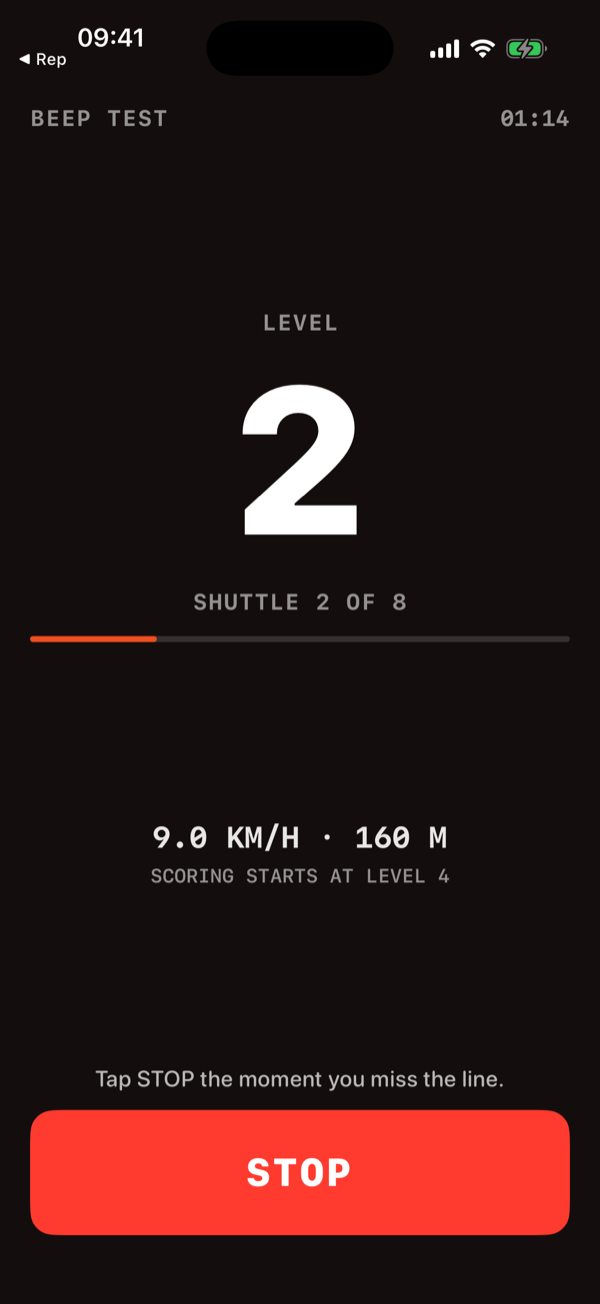
You do not need a separate audio track, a stopwatch, or someone counting your levels from the sideline. PEAKVO2 has the beep test built into its Tests tab, alongside the Cooper test, the 1.5 mile run, and the Rockport walk: mark two lines 20 meters apart, tap Start, and the app plays the shuttle audio, speeds the beeps up at each level, counts your level and shuttle on screen so you never lose track, and turns your last full shuttle into an estimated VO2 max the moment you tap STOP. It rates that estimate against your age and sex, and because the same app runs the interval workouts that raise the number, you test and train in one place.

Beep Test Levels Explained
The test has 21 levels. Each level is faster than the last, increasing by 0.5 km/h per level:
| Level | Speed (km/h) | Shuttles | Cumulative Distance |
|---|---|---|---|
| 1 | 8.5 | 7 | 140 m |
| 2 | 9.0 | 8 | 300 m |
| 3 | 9.5 | 8 | 460 m |
| 4 | 10.0 | 9 | 640 m |
| 5 | 10.5 | 9 | 820 m |
| 6 | 11.0 | 10 | 1,020 m |
| 7 | 11.5 | 10 | 1,220 m |
| 8 | 12.0 | 11 | 1,440 m |
| 9 | 12.5 | 11 | 1,660 m |
| 10 | 13.0 | 11 | 1,880 m |
| 11 | 13.5 | 12 | 2,120 m |
| 12 | 14.0 | 12 | 2,360 m |
| 13 | 14.5 | 13 | 2,620 m |
Most recreational athletes finish between Level 5 and Level 9. Competitive athletes typically reach Level 11 or higher. Elite endurance athletes can push past Level 15.
What's a Good Beep Test Score?
Your score depends heavily on age and sex. Here are general benchmarks:
| Rating | Men (20-39) | Women (20-39) |
|---|---|---|
| Excellent | Level 12+ | Level 10+ |
| Good | Level 9-11 | Level 7-9 |
| Average | Level 7-8 | Level 5-6 |
| Below Average | Level 5-6 | Level 4-5 |
| Poor | Below Level 5 | Below Level 4 |
These are general population norms. Standards for police, military, and sports teams vary by organization.
Because a good score shifts with age, see the full beep test score by age chart for average and good levels from your 20s to your 60s, plus youth standards.
What do professional athletes score?
For context, here are typical requirements and scores from professional and occupational settings:
- Professional soccer players: Level 13+ is common, with elite players reaching Level 15-17
- Military special forces: Often require Level 10.1+ as a minimum standard
- Police fitness tests: Typically require Level 5-7 depending on the jurisdiction
- AFL (Australian Football): Pre-season targets are often Level 13+
How to Estimate VO2 Max From Your Beep Test Score
The level you reach maps to an estimated VO2 max via tables originally published by Ramsbottom et al., 1988, which remain the calibration most coaches and online calculators use today. The relationship is approximately linear and can be summarized as VO2 max (ml/kg/min) ≈ 11.5 + 3.5 × level.
| Final Level | Estimated VO2 Max (ml/kg/min) |
|---|---|
| 4.2 | 26.8 |
| 5.2 | 30.2 |
| 6.2 | 33.6 |
| 7.2 | 37.1 |
| 8.2 | 40.5 |
| 9.2 | 43.9 |
| 10.2 | 47.4 |
| 11.2 | 50.8 |
| 12.2 | 54.3 |
| 13.2 | 57.6 |
Values are approximate adult norms. The decimal portion (e.g., 9.2) reflects Level 9, Shuttle 2.
Plug your level into our VO2 max calculator for an instant estimate plus an age- and sex-adjusted category. The calculator uses the same Ramsbottom approximation and cross-references the score against ACSM percentile norms.
The original Léger equation VO2 max = 31.025 + 3.238 × speed - 3.248 × age + 0.1536 × speed × age (Léger et al., 1988) was derived from a mixed cohort including youth and tends to underestimate VO2 max in trained adults. Most current calculators favor the Ramsbottom approximation for adults, which is why the table above is preferred over the raw Léger output.
The beep test provides a surprisingly accurate estimate compared to a VO2 max lab test. Research shows a correlation of r = 0.84 to 0.92 with laboratory-measured VO2 max, making it one of the best field tests available (Léger et al., 1988; Stickland et al., 2003).
Why the Beep Test Predicts VO2 Max So Well
A field test that correlates 0.84 to 0.92 with a laboratory VO2 max measurement is unusually accurate. The reasons trace back to how the protocol was designed:
- Externally paced. The beeps remove pacing strategy as a confound. Two athletes at the same fitness level finish at the same level, regardless of their tactical experience. Self-paced tests like a 5K time trial reward pacing skill in addition to fitness (Buchheit & Laursen, 2013).
- Progressive to maximum. The speed increases until you can no longer match it. That is the definition of a maximal incremental exercise test, the same structure used in lab VO2 max testing.
- Long enough to fully recruit aerobic metabolism. Most participants run for 6 to 14 minutes, which is well within the steady-state aerobic energy system. Sub-2-minute tests, by contrast, draw heavily on anaerobic stores and correlate less reliably with VO2 max.
- Skeletal muscle activation matches running gait. The 180-degree turns add a small mechanical cost that is consistent across participants, so the test compares apples to apples.
Subsequent validation studies have confirmed the original Léger correlation across a wide range of populations: trained and untrained adults (Ramsbottom et al., 1988), children using the PACER variant (Mahar et al., 2011), and team-sport athletes where shuttle-running fitness mirrors actual game demands (Stickland et al., 2003). Test-retest reliability is also high (r > 0.90 in most studies), meaning a repeat of the same test on the same person produces a very similar score.
The main caveats: the beep test is less accurate at the extremes (very low or very elite VO2 max), and it is sensitive to motivation. A submaximal effort produces an underestimate. To get a reliable number, run to genuine failure.
Beep Test vs. Cooper Test
The beep test isn't the only field test for aerobic fitness. The Cooper test (run as far as you can in 12 minutes) is another popular option. Here's how they compare:
| Beep Test | Cooper Test | |
|---|---|---|
| What you need | 20m space + audio | Track or GPS + timer |
| Pacing | Externally paced (beeps) | Self-paced |
| Duration | Variable (until failure) | Fixed (12 minutes) |
| Best for | Groups, indoor testing | Runners, outdoor testing |
| VO2 max accuracy | r = 0.84 to 0.92 | r = 0.90 |
The beep test is better for group testing because everyone runs to the same audio. The Cooper test is better for experienced runners who can pace themselves over 12 minutes. Both give reliable VO2 max estimates.
How to Improve Your Beep Test Score
If you want to score higher, the key is improving your VO2 max through structured interval training:
1. Train your aerobic base
Before jumping into intervals, build a foundation with easy running (Zone 2, conversational pace) 3-4 times per week. This develops the cardiovascular infrastructure that supports high-intensity work.
2. Add interval training
The most effective way to improve VO2 max, and therefore your beep test score, is high-intensity interval training. If you have never done intervals before, start with our interval training for beginners guide. Once you have a base, protocols like the Norwegian 4x4 (4×4 minutes at 90-95% HRmax) are proven to increase VO2 max by 10-15% in 8 weeks. After the beep test tells you your number, an Apple Watch app like PEAKVO2 is how you train it up: it runs the 4x4 as a guided workout, showing the target heart rate zone during each interval and tapping your wrist when recovery starts.
3. Practice the test itself
The beep test has a specific skill component: the 180-degree turn every 20 meters. Practicing the shuttle pattern improves your efficiency and pacing. Even 1-2 practice sessions before a real test can improve your score by a level.
4. Pace the early levels
A common mistake is starting too fast. The early levels are deliberately easy. Use them to settle into a rhythm. Don't sprint ahead of the beeps. Match the pace exactly and conserve energy for the levels where it counts.
5. Track heart rate to confirm intensity
A wrist-based monitor like an Apple Watch or Garmin helps you verify your interval sessions are actually hitting the 90-95% HRmax zone that drives VO2 max adaptation. Many of these devices also produce their own VO2 max estimate from outdoor runs, which serves as a secondary check on your beep test trend over weeks. For a comparison of how different wearables stack up for VO2 max accuracy, see our fitness tracker guide.
Common Mistakes That Lower Your Beep Test Score
The same protocol run by the same athlete on two different days can yield different scores depending on these factors:
1. Starting too fast in the early levels
The biggest single mistake. Sprinting ahead of the beeps in Levels 1 to 4 burns energy you need at Level 8+. Match the pace exactly. The early levels are designed to be easy. They are warm-up disguised as testing.
2. Not warming up before the test
Going from cold to Level 1 puts your cardiovascular system behind for the entire test. Spend at least 8 to 10 minutes jogging easily plus a few short strides before the first beep, the same warm-up structure used in the Norwegian 4x4 protocol.
3. Sloppy turns
Each shuttle is exactly 20 meters, but a sloppy turn can add a foot or two to the trip. Over 80+ shuttles in a long test, that adds up. Plant your foot at or behind the line and pivot tight. Practice the turn on its own a few times before the real test.
4. Testing while underrecovered
A poor night's sleep, a hard workout the day before, dehydration, or significant stress all reduce VO2 max performance on the day. Fitness research has shown that overreaching reduces measurable performance even when subjective effort feels normal (Meeusen et al., 2013). Test on a fresh day for a representative score.
5. Submaximal effort
The beep test only works if you run to genuine failure, the point where you cannot reach the next line in time twice in a row. Stopping at "this feels hard enough" produces an underestimate. The protocol is designed around maximal incremental effort, and the score is only valid at that effort.
Run the beep test on your iPhone
BeepRunner plays the official 20m beep test with audio cues and automatic level tracking. Instant VO2 max estimation when you're done.
Download BeepRunnerWho Uses the Beep Test?
The beep test is a standard fitness assessment in dozens of countries and organizations:
- Schools and universities use it for physical education testing (often called the "pacer test" in the US)
- Military forces including NATO countries use it for recruit fitness screening
- Police and fire departments use it as part of entrance and annual fitness requirements
- Professional sports teams use it for pre-season fitness assessments, especially in soccer, rugby, and Australian football
- Clinical settings use it to assess cardiorespiratory fitness in populations where laboratory testing isn't practical
Its popularity comes from practicality: no expensive equipment, easy to administer to large groups, and validated accuracy for VO2 max estimation.
The Bottom Line
The beep test is a simple, validated, and widely trusted measure of aerobic fitness. Your final level maps directly to an estimated VO2 max, giving you a concrete number to track and improve. Whether you're preparing for a fitness assessment, testing your team, or just curious where you stand, the beep test is one of the most accessible ways to measure cardiovascular endurance, and with the right training, your score can improve significantly.
For detailed normative data, see our VO2 max charts by age and gender. Plug your beep test level into our VO2 max calculator for an instant estimate plus an age-and-sex-adjusted category.
Frequently Asked Questions
How many levels are in the beep test?
The standard beep test has 21 levels. Each level is faster than the last, increasing by 0.5 km/h per level starting at 8.5 km/h. Most recreational athletes finish between Level 5 and Level 9. Competitive athletes typically reach Level 11 or higher.
What is a good beep test score?
For men aged 20-39, Level 9-11 is considered "Good" and Level 12+ is "Excellent." For women in the same age range, Level 7-9 is "Good" and Level 10+ is "Excellent." Standards vary by organization — military and police fitness tests typically require Level 5-10 as minimums.
How accurate is the beep test for estimating VO2 max?
The beep test has a correlation of r = 0.84 to 0.92 with laboratory-measured VO2 max, making it one of the most accurate field tests available. It was developed and validated by Luc Léger at the Université de Montréal.
How can I improve my beep test score?
The most effective approach is to improve your VO2 max through high-intensity interval training. The Norwegian 4x4 protocol can increase VO2 max by 10-15% in 8 weeks. Also practice the test itself — the 180-degree turns every 20 meters have a skill component that improves with practice.
Keep Reading
- VO2 Max Calculator: 5 Methods Including the Beep Test
- The Cooper Test: 12-Minute Run to Estimate Your VO2 Max
- Norwegian 4x4 Protocol: Best HIIT to Raise VO2 Max
- VO2 Max by Age: Charts of Normative Scores and What's Good
- Best Fitness Tracker for VO2 Max: 6 Devices Compared
- Beep Test for Soccer: Scores by Position and How to Train
Find a VO2 Max Testing Lab
Cross-validate your beep test result against a clinical gas exchange measurement at one of 160+ labs worldwide.
Browse LabsReferences
- Léger LA, Lambert J. A maximal multistage 20-m shuttle run test to predict VO2 max. Eur J Appl Physiol Occup Physiol. 1982;49(1):1-12. PubMed
- Léger LA, Mercier D, Gadoury C, Lambert J. The multistage 20 metre shuttle run test for aerobic fitness. J Sports Sci. 1988;6(2):93-101. PubMed
- Ramsbottom R, Brewer J, Williams C. A progressive shuttle run test to estimate maximal oxygen uptake. Br J Sports Med. 1988;22(4):141-144. PubMed
- Stickland MK, Petersen SR, Bouffard M. Prediction of maximal aerobic power from the 20-m multi-stage shuttle run test. Can J Appl Physiol. 2003;28(2):272-282. PubMed
- Mahar MT, Guerieri AM, Hanna MS, Kemble CD. Estimation of aerobic fitness from 20-m multistage shuttle run test performance. Am J Prev Med. 2011;41(4 Suppl 2):S117-S123. PubMed
- Buchheit M, Laursen PB. High-intensity interval training, solutions to the programming puzzle: Part I. Sports Med. 2013;43(5):313-338. PubMed
- Meeusen R, Duclos M, Foster C, et al. Prevention, diagnosis, and treatment of the overtraining syndrome: joint consensus statement. Med Sci Sports Exerc. 2013;45(1):186-205. PubMed
- Helgerud J, Høydal K, Wang E, et al. Aerobic high-intensity intervals improve VO2max more than moderate training. Med Sci Sports Exerc. 2007;39(4):665-671. PubMed
- Bassett DR Jr, Howley ET. Limiting factors for maximum oxygen uptake and determinants of endurance performance. Med Sci Sports Exerc. 2000;32(1):70-84. PubMed