How to Improve Your Apple Watch Cardio Fitness Score (VO2 Max)
 Run these workouts on your iPhone, or hands-free on Apple Watch. Get PEAKVO2
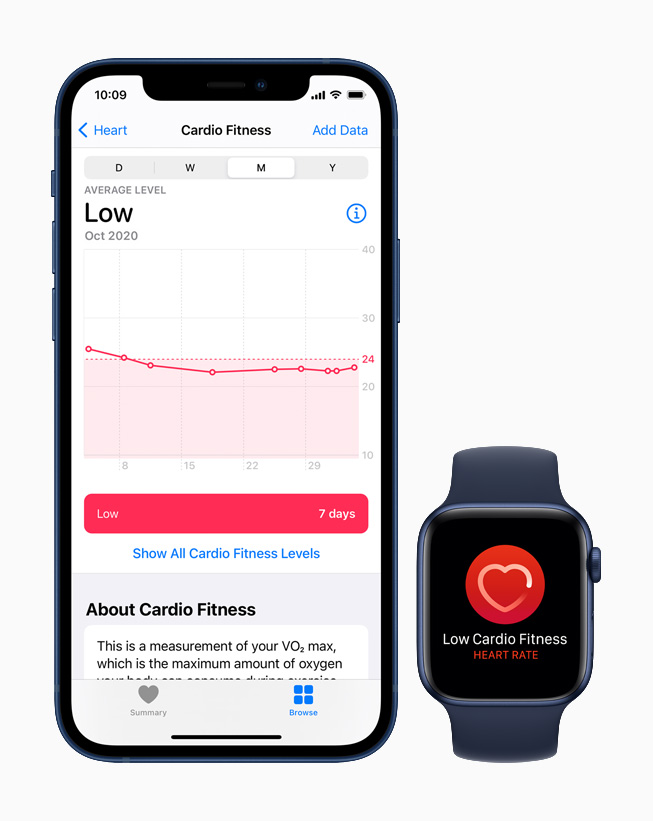
 If your Apple Watch sent you a "Low Cardio Fitness" notification, or you've noticed your VO2 max score sitting stubbornly in the "Below Average" range, you're not alone. Apple Watch tracks your cardio fitness over time, and many users are surprised (or alarmed) by what they see. Watch estimates are frequently off by 5 to 15 percent in either direction, so before assuming the worst, check whether the reading actually matches your demographic using our VO2 max charts by age and sex. If you're wondering how Apple Watch stacks up against other wearables, see our comparison of the best fitness trackers for VO2 max. The good news: your score can improve significantly with the right kind of training.
What Your Apple Watch Cardio Fitness Score Actually Means
The "Cardio Fitness" number in Apple Health is an estimate of your VO2 max, the maximum amount of oxygen your body can use during intense exercise, measured in milliliters per kilogram of body weight per minute (ml/kg/min).
VO2 max is widely considered the single best indicator of cardiovascular fitness. Higher values mean your heart, lungs, and muscles are more efficient at delivering and using oxygen. It's also the strongest predictor of all-cause mortality — stronger than smoking, blood pressure, or diabetes (Myers et al., 2002; Mandsager et al., 2018).
How Apple Watch Estimates VO2 Max
Apple Watch doesn't measure VO2 max directly (that requires a lab with a gas analyzer and treadmill). Instead, it estimates it using:
- Heart rate data from the optical sensor during outdoor walks and runs
- Motion data from the accelerometer and GPS to determine pace and terrain
- Your health profile: age, sex, height, and weight
The algorithm looks at the relationship between your heart rate and your walking/running speed. A person whose heart rate stays low at a brisk walking pace has higher cardio fitness than someone whose heart rate spikes at the same speed.
Apple's method has been validated internally against laboratory testing. Apple's own white paper reports accuracy within about 1.2-1.4 ml/kg/min for outdoor walking and running activities, though independent peer-reviewed studies have found somewhat larger errors in practice.

What's a Good Cardio Fitness Score?
Apple categorizes your score as Low, Below Average, Above Average, or High based on your age and sex. Here are general reference ranges:
| Age | Low | Below Avg | Above Avg | High |
|---|---|---|---|---|
| 20-29 (M) | <38 | 38-43 | 44-51 | 52+ |
| 20-29 (F) | <28 | 28-33 | 34-40 | 41+ |
| 30-39 (M) | <35 | 35-41 | 42-49 | 50+ |
| 30-39 (F) | <26 | 26-31 | 32-38 | 39+ |
| 40-49 (M) | <33 | 33-39 | 40-47 | 48+ |
| 40-49 (F) | <24 | 24-29 | 30-36 | 37+ |
| 50-59 (M) | <30 | 30-36 | 37-44 | 45+ |
| 50-59 (F) | <22 | 22-27 | 28-34 | 35+ |
| 60+ (M) | <26 | 26-32 | 33-40 | 41+ |
| 60+ (F) | <20 | 20-24 | 25-31 | 32+ |
Values in ml/kg/min. Ranges are approximate and based on population norms.
Why Your Score Might Be Low (Even If You Exercise)
Several factors can cause your Apple Watch cardio fitness score to appear lower than expected:
1. You mostly exercise indoors
Apple Watch primarily estimates VO2 max during outdoor walks and runs where it can use GPS to measure pace. Treadmill runs, cycling, swimming, and gym workouts generally don't update your cardio fitness score. If your main exercise is indoor, your score may not reflect your actual fitness.
2. Your watch isn't calibrated
Apple Watch calibrates its motion sensors by learning your stride. If you've never done an outdoor walk or run of at least 20 minutes with good GPS signal, the estimates may be inaccurate. To calibrate, do a 20+ minute outdoor walk or run in an open area with clear sky.
3. Your health profile is incorrect
The algorithm uses your age, sex, height, and weight. If these are outdated or wrong in Apple Health, the VO2 max estimate will be off. Check Settings > Health > Health Details.
4. Medications affect your heart rate
Beta blockers, calcium channel blockers, and some other medications lower your heart rate. Since the algorithm uses the heart rate-to-pace relationship, artificially suppressed heart rates can make the estimate unreliable.
5. You haven't worn the watch long enough
Apple Watch needs multiple outdoor walking or running sessions to produce a stable estimate. If you recently got your watch or switched wrists, give it a few weeks of regular outdoor activity.
How to Get More Accurate Readings
- Do outdoor workouts. Aim for at least 1-2 outdoor walks or runs per week of 20+ minutes.
- Ensure a snug watch fit. The heart rate sensor needs consistent skin contact.
- Calibrate your watch. Do a 20-minute outdoor walk in an open area with clear GPS.
- Keep your health profile current. Weight especially affects the ml/kg/min calculation.
- Walk briskly or run. The algorithm works best when your heart rate is elevated above resting.
The Fastest Way to Actually Improve Your Score
Once you're confident your readings are accurate, the question becomes: how do you raise your VO2 max?
The answer is high-intensity interval training, specifically workouts that push your heart rate to 90-95% of its maximum for sustained periods. This zone (often called "Zone 5") is where your heart operates at peak stroke volume, driving the cardiovascular adaptations that increase VO2 max.
Why intervals beat steady-state cardio
Moderate-intensity exercise (like a 30-minute easy jog) is good for general health but relatively slow at improving VO2 max. Research consistently shows that structured intervals (where you alternate between hard effort and recovery) produce significantly greater VO2 max gains in less total training time (Helgerud et al., 2007).
Proven interval protocols for VO2 max
- Norwegian 4x4: 4x4 minutes at 90-95% HRmax with 3-minute recoveries. The gold standard for VO2 max training.
- Tabata: 8x20 seconds all-out with 10-second rest. Short, brutal, and effective.
- 30/30 intervals: 30 seconds hard, 30 seconds easy, repeated for 15-25 minutes. Accumulates significant time at high intensity with manageable fatigue.
How much improvement to expect
With consistent interval training (2 sessions per week), most people see a VO2 max increase of 5-15% over 8-12 weeks. For someone starting at 35 ml/kg/min, that's a jump to 37-40 ml/kg/min, often enough to move from "Below Average" to "Above Average" on the Apple Watch scale. To pick an app that runs these sessions for you, see the best VO2 max training apps.
PEAKVO2. The interval app for your cardio fitness.
Structured interval workouts with automatic phase transitions on your wrist.
Download PEAKVO2A Simple Plan to Raise Your Score
- Week 1-2: Establish your baseline. Do 2-3 outdoor walks or runs so your Apple Watch has accurate data.
- Week 3+: Add 2 interval sessions per week. Start with the Norwegian 4x4 protocol if you're new to intervals.
- Track weekly: Check your cardio fitness trend in Apple Health. Look for a gradual upward slope.
- Be patient: Cardiovascular adaptation takes 4-6 weeks to show up in VO2 max estimates. Don't expect overnight changes.
The combination of accurate measurement (outdoor workouts with good GPS) and effective training (structured intervals at 90-95% HRmax) is the fastest path to a higher Apple Watch cardio fitness score, and more importantly, to better cardiovascular health.
For detailed normative data, see our VO2 max charts by age and gender. If you use a Garmin, we also have a guide to improving your Garmin VO2 max estimate. You can also use our VO2 max improvement calculator to project how long it will take to reach your goal.
Frequently Asked Questions
How accurate is the Apple Watch VO2 max estimate?
Apple Watch estimates VO2 max during outdoor walks and runs by analyzing the relationship between heart rate and pace. Studies show it is generally accurate to within 1-2 ml/kg/min of laboratory values for walking and running activities. Indoor workouts and non-running activities typically do not update the estimate. If you are wondering whether the estimate reads differently for women, see our VO2 max guide for women.
Why is my Apple Watch cardio fitness score low even though I exercise?
The most common reason is that you exercise mostly indoors. Apple Watch primarily estimates VO2 max during outdoor walks and runs where GPS is available. Treadmill runs, cycling, swimming, and gym workouts generally don't update your score. Other factors include an uncalibrated watch, incorrect health profile data, or medications that affect heart rate.
How long does it take to improve my Apple Watch cardio fitness score?
With consistent interval training (2 sessions per week at 90-95% of max heart rate), most people see a 5-15% improvement in 8-12 weeks. Apple Watch updates its estimate gradually, so expect to see changes in the Health app trend after 4-6 weeks of training.
Does Apple Watch measure VO2 max during cycling or swimming?
No. Apple Watch currently estimates VO2 max only during outdoor walks and runs. It cannot estimate VO2 max during cycling, swimming, or indoor workouts because the algorithm relies on the relationship between heart rate and GPS-measured walking or running pace.
References
- Myers J, Prakash M, Froelicher V, et al. Exercise capacity and mortality among men referred for exercise testing. N Engl J Med. 2002;346(11):793-801. PubMed
- Mandsager K, Harb S, Cremer P, et al. Association of cardiorespiratory fitness with long-term mortality among adults undergoing exercise treadmill testing. JAMA Netw Open. 2018;1(6):e183605. PubMed
- Helgerud J, Høydal K, Wang E, et al. Aerobic high-intensity intervals improve VO2max more than moderate training. Med Sci Sports Exerc. 2007;39(4):665-671. PubMed