15 Best Exercises for HIIT Workouts (With Interval Structures)

 Run these workouts on your iPhone, or hands-free on Apple Watch. Get PEAKVO2
 The best exercises for HIIT workouts share three qualities: they recruit large muscle groups, they allow explosive effort without complex technique, and they can be repeated safely under fatigue. Not every exercise belongs in a HIIT session. Isolation movements, heavy barbell lifts, and anything requiring precise balance at high speed create injury risk without additional training benefit. The 15 exercises below are the ones that actually work, organized by category so you can build a session from whatever you have available.
Set up your programmable interval timer before you start. Each exercise below includes a recommended interval structure, but HIIT is fully customizable. The general principle: work intervals should be 20 to 60 seconds at 80 to 95% of maximum effort, with rest periods equal to or longer than the work period for beginners, and shorter than work for advanced athletes.
What Makes an Exercise Good for HIIT?
Three criteria separate effective HIIT exercises from poor ones:
- Large muscle recruitment. The more muscle mass involved, the higher your heart rate climbs and the greater the metabolic demand. Full-body movements outperform isolation exercises for HIIT.
- Simple movement pattern. Form should hold up under fatigue. If technique degrades dangerously at high speed, the exercise does not belong in a HIIT circuit.
- Scalable intensity. You should be able to go harder or easier by adjusting speed, range of motion, or load without changing the fundamental movement.
A 2024 umbrella review confirmed that high-intensity interval training improves cardiovascular fitness more than continuous moderate exercise across all studied populations (Poon et al., 2024). The exercises you choose determine whether you get there safely.
Bodyweight HIIT Exercises (No Equipment)
These work anywhere with minimal space. They form the backbone of most home HIIT workouts.
1. Burpees
Muscles worked: Chest, shoulders, quads, hamstrings, core.
Stand, drop to a push-up position, perform a push-up, jump your feet to your hands, and explode upward into a jump. Land softly and immediately begin the next rep.
Why it works for HIIT: The burpee is the single most effective bodyweight exercise for HIIT because it demands full-body power through an enormous range of motion. Heart rate spikes within seconds.
Interval structure: 20 seconds work / 10 seconds rest (Tabata) or 30 seconds work / 30 seconds rest for sustained sets.
Modification: Remove the push-up and jump (step back, step forward, stand). This cuts the intensity roughly in half while preserving the movement pattern.
2. Jump Squats
Muscles worked: Quads, glutes, hamstrings, calves, core.
Squat until your thighs are parallel to the floor, then drive explosively upward into a jump. Land with soft knees and immediately descend into the next squat.
Why it works for HIIT: Targets the largest muscle group in the body (quads and glutes) with an explosive plyometric component that elevates heart rate fast.
Interval structure: 30 seconds work / 30 seconds rest. The landing impact accumulates, so equal rest prevents form breakdown.
Modification: Remove the jump and perform fast bodyweight squats instead.
3. Mountain Climbers
Muscles worked: Core, hip flexors, shoulders, quads.
Start in a push-up position. Drive one knee toward your chest, then rapidly switch legs in a running motion. Keep your hips level and your core braced.
Why it works for HIIT: Low impact per rep but extremely high rep rate. You can sustain mountain climbers at maximum speed longer than burpees, accumulating more time at an elevated heart rate.
Interval structure: 40 seconds work / 20 seconds rest. The 2:1 ratio works here because the per-rep impact is low.
Modification: Slow the pace to a deliberate knee drive (2 seconds per rep) rather than a sprint.
4. High Knees
Muscles worked: Hip flexors, quads, calves, core.
Run in place, driving each knee to hip height. Pump your arms as if sprinting. Stay on the balls of your feet.
Why it works for HIIT: Mimics sprinting without forward travel, making it ideal for small spaces. The upright posture engages the core differently from mountain climbers.
Interval structure: 30 seconds work / 30 seconds rest. Pairs well with mountain climbers in an alternating circuit.
Modification: March in place with exaggerated knee lifts instead of running.
5. Tuck Jumps
Muscles worked: Quads, glutes, calves, hip flexors, core.
Jump vertically and pull both knees to your chest at the peak. Land softly and immediately jump again.
Why it works for HIIT: The highest-power bodyweight exercise on this list. Heart rate reaches near-maximum within 10 seconds. Extremely taxing, which is why the intervals are short.
Interval structure: 15 seconds work / 45 seconds rest. The 1:3 ratio compensates for the extreme intensity.
Modification: Replace with jump squats if tuck jumps are too demanding on the knees.
6. Plank Jacks
Muscles worked: Core, shoulders, hip abductors, calves.
Start in a plank position. Jump your feet wide, then jump them back together. Keep your hips stable throughout.
Why it works for HIIT: Lower intensity than burpees but still maintains an elevated heart rate. Works as an active recovery exercise within a harder circuit.
Interval structure: 40 seconds work / 20 seconds rest. Good for filling a "moderate" slot between two harder exercises.
Modification: Step one foot out at a time instead of jumping both.
Do Bodyweight HIIT in PEAKVO2
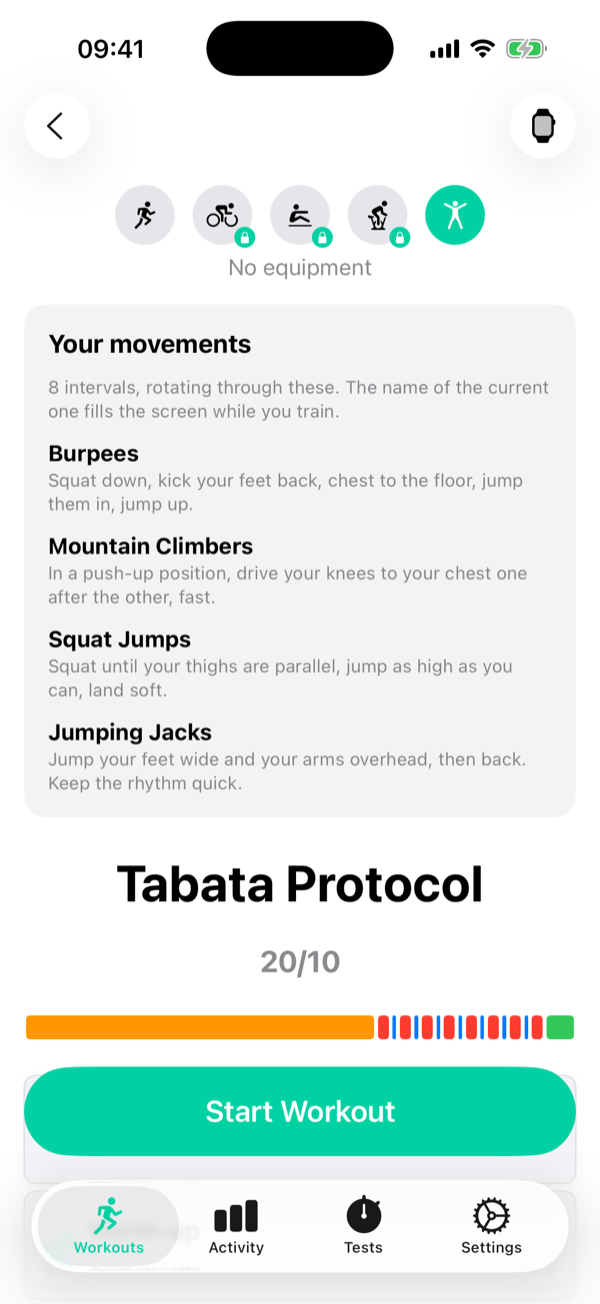
These six moves are all you need for a real VO2 max session, and PEAKVO2 has a Bodyweight category of guided workouts built around exactly this kind of no-equipment circuit. Pick a Bodyweight workout, prop the phone up, and the app runs every work and rest interval full screen with a countdown and haptic cues, so you push through burpees and mountain climbers without once glancing at a timer. Intensity is what drives the adaptation, not the equipment, so a hard bodyweight circuit raises your VO2 max the same way a machine session does, with nothing but the floor.
Equipment HIIT Exercises
A single piece of equipment opens up higher-load options that challenge strength and power simultaneously.
7. Kettlebell Swings
Muscles worked: Glutes, hamstrings, core, shoulders, grip.
Hinge at the hips with a flat back, grip the kettlebell with both hands, and drive it forward with a powerful hip snap. The arms guide the bell; the power comes from the hips. Let it swing back between your legs and repeat.
Why it works for HIIT: The hip hinge plus ballistic element produces enormous power output without the joint stress of jumping. You can sustain high intensity for longer than most plyometric exercises.
Interval structure: 30 seconds work / 30 seconds rest. Use a weight that allows 12 to 15 reps per 30 seconds without form breakdown.
Modification: Use a lighter kettlebell or perform deadlift-stance hip hinges without the swing.
8. Dumbbell Thrusters
Muscles worked: Quads, glutes, shoulders, triceps, core.
Hold dumbbells at shoulder height. Squat to parallel, then drive up explosively and press the dumbbells overhead in one continuous motion. Lower the dumbbells back to shoulders as you descend into the next squat.
Why it works for HIIT: Combines a squat and an overhead press into a single movement that taxes the entire body. One of the highest calorie-burning exercises per minute.
Interval structure: 20 seconds work / 40 seconds rest. The overhead component fatigues shoulders fast, so shorter work periods maintain quality.
Modification: Use lighter dumbbells or perform the squat and press as two separate movements.
9. Battle Ropes
Muscles worked: Shoulders, arms, core, back, legs (if incorporating squats).
Grip one end of the rope in each hand. Alternate slamming the ropes up and down as fast as possible, creating waves that travel to the anchor point. Stay in a quarter-squat position.
Why it works for HIIT: Non-impact, so joint-friendly, but produces heart rates comparable to sprinting. The upper-body focus complements lower-body plyometric exercises in a circuit.
Interval structure: 30 seconds work / 30 seconds rest. Alternating waves for 30 seconds is brutally effective.
Modification: Use thinner or shorter ropes. Perform seated waves if standing is not possible.
10. Medicine Ball Slams
Muscles worked: Lats, core, shoulders, quads, hip flexors.
Lift a medicine ball overhead with both arms extended, then slam it into the ground as hard as possible. Catch the bounce (or pick it up) and repeat immediately.
Why it works for HIIT: Full-body power in the concentric phase, plus the squat to pick it up adds a lower-body component. The aggressive slamming movement is psychologically satisfying during hard intervals.
Interval structure: 20 seconds work / 20 seconds rest. Short bursts of maximum-power slams with brief recovery.
Modification: Use a lighter ball. Reduce the overhead reach if shoulder mobility is limited.
11. Box Jumps
Muscles worked: Quads, glutes, hamstrings, calves, core.
Stand facing a plyo box. Swing your arms and jump onto the box, landing softly with both feet flat. Stand fully upright, then step down (do not jump down during HIIT). Reset and repeat.
Why it works for HIIT: Develops explosive lower-body power. Stepping down rather than jumping down reduces eccentric impact, making it safer for higher rep counts.
Interval structure: 20 seconds work / 40 seconds rest. The step-down between reps naturally limits rep count, which is appropriate for this exercise.
Modification: Use a lower box. Perform broad jumps on the floor if no box is available.
Cardio Machine HIIT Exercises
Machines control variables precisely, making them ideal for structured interval programs.
12. Assault Bike Sprints
Muscles worked: Quads, hamstrings, glutes, shoulders, biceps, triceps, core.
Pedal and push/pull the handles as fast as possible. The air resistance increases with speed, so you cannot coast.
Why it works for HIIT: The assault bike is arguably the single best HIIT machine because it uses all four limbs simultaneously and the resistance self-scales. It is nearly impossible to cheat the intensity.
Interval structure: 20 seconds all-out / 40 seconds easy pedal. This is the protocol used in most CrossFit conditioning tests.
Modification: Use arms only or legs only to reduce total-body demand.
13. Rowing Machine Intervals
Muscles worked: Back, legs, core, biceps, shoulders.
Drive with the legs first, lean back slightly, then pull the handle to your sternum. Return in reverse order: arms, lean, legs.
Why it works for HIIT: Engages 86% of your muscles in a single stroke. The smooth, non-impact movement allows all-out effort without joint stress. Measurable output (watts, pace) makes progression easy to track.
Interval structure: 30 seconds hard / 30 seconds easy. Or use the Norwegian 4x4 protocol with 4 minutes hard / 3 minutes easy for VO2 max focus.
Modification: Reduce stroke rate to 22 to 24 per minute instead of the sprint pace of 30+.
14. Treadmill Sprints
Muscles worked: Quads, hamstrings, glutes, calves, core.
Set the treadmill to your sprint speed. Straddle the belt, start it, then step on and sprint. When the work period ends, grab the rails and straddle the belt again.
Why it works for HIIT: Running is the most natural high-intensity movement. Treadmill sprints eliminate pacing uncertainty because the belt forces a consistent speed.
Interval structure: 30 seconds sprint / 60 seconds standing rest or slow walk. See our interval training for running guide for complete treadmill programs.
Modification: Use an incline walk (12 to 15% grade at 3.5 mph) instead of flat sprinting. This produces similar heart rates with dramatically less impact.
15. Ski Erg Sprints
Muscles worked: Lats, core, triceps, shoulders, hip flexors.
Stand in front of the ski erg, reach overhead, and pull both handles down simultaneously while hinging at the hips. The motion mimics cross-country ski poling.
Why it works for HIIT: Upper-body dominant, making it an excellent complement to lower-body exercises in a circuit. Non-impact and self-paced. The hinge component adds posterior chain engagement.
Interval structure: 30 seconds work / 30 seconds rest. Pairs excellently with assault bike or rowing for a machine-only HIIT circuit.
Modification: Reduce the range of motion by not hinging as deeply.
3 Sample HIIT Workouts Using These Exercises
Set your interval timer to the structures below. If you train with an Apple Watch, PEAKVO2 runs these work and rest phases for you, tapping your wrist when each phase ends and showing the next one, so you never break form mid-burpee to look at a timer. Warm up for 5 minutes with light cardio and dynamic stretches before every session.
Workout 1: Bodyweight Only (12 minutes)
| Exercise | Work | Rest |
|---|---|---|
| Burpees | 30s | 30s |
| Mountain climbers | 30s | 30s |
| Jump squats | 30s | 30s |
| High knees | 30s | 30s |
Repeat for 3 rounds. Total work time: 6 minutes.
Workout 2: Equipment Circuit (16 minutes)
| Exercise | Work | Rest |
|---|---|---|
| Kettlebell swings | 30s | 15s |
| Dumbbell thrusters | 20s | 25s |
| Box jumps | 20s | 25s |
| Medicine ball slams | 20s | 25s |
Repeat for 4 rounds. Rest 60 seconds between rounds.
Workout 3: Machine Intervals (20 minutes)
| Exercise | Work | Rest |
|---|---|---|
| Assault bike sprint | 20s | 40s |
| Rowing sprint | 30s | 30s |
| Ski erg sprint | 30s | 30s |
Repeat for 5 rounds. The varied work/rest ratios match each machine's intensity profile.
How to Choose the Right HIIT Exercises
Match exercises to your goal
- Cardiovascular fitness and VO2 max: Choose exercises that use the most muscle mass (burpees, rowing, assault bike). Longer intervals of 30 to 60 seconds at 90 to 95% of max heart rate are most effective for VO2 max improvement (Helgerud et al., 2007).
- Fat loss: Any exercise that elevates heart rate significantly will work. Prioritize exercises you can sustain with good form for the entire work period. Consistency over time matters more than exercise selection for body composition.
- Athletic power: Focus on plyometrics (tuck jumps, box jumps, jump squats) with longer rest periods (1:3 or 1:4 ratio). These develop reactive strength and rate of force development.
Avoid these in HIIT circuits
- Heavy barbell lifts (deadlifts, cleans, snatches at near-max). Form degrades dangerously under cardiovascular fatigue.
- Single-leg balance exercises (pistol squats, single-leg deadlifts). Coordination fails before conditioning improves.
- Machines with slow transitions (cable machines, pin-loaded stations). The time spent adjusting kills the heart rate benefit.
- Exercises you cannot perform with good form when fresh. If it is hard slow, it is dangerous fast.
How Often to Do HIIT Workouts
Two to three HIIT sessions per week is sufficient for most people. The adaptations happen during recovery, not during the workout itself (Meeusen et al., 2013). Space sessions at least 48 hours apart and fill recovery days with zone 2 training or easy movement.
If you are new to HIIT, start with our interval training for beginners guide, which uses lower intensities and longer rest periods to build a foundation before progressing to the exercises above.
PEAKVO2. The interval app for your cardio fitness.
Run guided HIIT protocols like Tabata and 30/30 on your Apple Watch, with automatic phase transitions, a haptic tap when each interval ends, and the target heart rate zone for every phase.
Download PEAKVO2Frequently Asked Questions
What are the best exercises for HIIT at home?
Burpees, jump squats, mountain climbers, high knees, and tuck jumps require zero equipment and minimal space. A single set of dumbbells or a kettlebell adds thrusters and swings to the options. Set a programmable interval timer and you have a complete HIIT setup at home. Our guide on using an interval timer app shows how to program HIIT, Tabata, and circuits step by step.
How long should a HIIT workout be?
Most effective HIIT sessions last 15 to 25 minutes of total work and rest, not counting warm-up and cooldown. The original Tabata protocol is only 4 minutes. Longer is not better. The intensity must stay high throughout. If you can go for 45 minutes, you are not working hard enough during the intervals.
Can I do HIIT every day?
No. Daily HIIT increases overtraining risk, elevates cortisol, and stalls fitness gains. Two to three sessions per week with at least one rest day between them is the evidence-based recommendation. Use off days for zone 2 training (walking, easy cycling, swimming) to build your aerobic base without interfering with recovery.
What is the best work-to-rest ratio for HIIT?
It depends on your fitness level and the exercise intensity. Beginners: 1:2 or 1:3 (20 seconds work, 40 to 60 seconds rest). Intermediate: 1:1 (30 seconds work, 30 seconds rest). Advanced: 2:1 (40 seconds work, 20 seconds rest) or Tabata (20:10). The ratio should allow you to maintain the same quality in the last interval as the first.
Should I do the same HIIT exercises every session?
No. Vary exercises across sessions to prevent overuse injuries and provide different training stimuli. Alternate between bodyweight days, equipment days, and machine days. Your cardiovascular system adapts to the intensity regardless of which exercises you use.
Time Your HIIT Intervals
Build any interval sequence with custom work, rest, and rounds. Audio beeps count you down at every transition.
Open Interval TimerKeep Reading
- Free Programmable Interval Timer
- Circuit Training: How to Build, Time, and Progress a Circuit Workout
- HIIT Workouts for Fat Loss: 6 Sessions and What the Research Says
- HIIT Workouts for Women: 6 Sessions and How to Train Around Your Cycle
- HIIT Treadmill Workouts: 6 Interval Sessions
- Interval Training for Beginners: What It Is and How to Start
- Tabata Workouts: What They Are and How to Do Them Right
- Interval Training for Running: Workouts, Programs, and Plans
- Norwegian 4x4 Protocol: Proven HIIT to Raise VO2 Max
- Zone 2 Training: The Foundation of Endurance Fitness
- Training for Muscular Endurance: Exercises, Sets, and Programs
- Endurance Training Workouts: 10 Sessions for Every Fitness Level
References
- Poon ET, Li HY, Gibala MJ, Wong SH, Ho RS. High-intensity interval training and cardiorespiratory fitness in adults: an umbrella review of systematic reviews and meta-analyses. Scand J Med Sci Sports. 2024;34(5):e14652. PubMed
- Helgerud J, Høydal K, Wang E, et al. Aerobic high-intensity intervals improve VO2max more than moderate training. Med Sci Sports Exerc. 2007;39(4):665-671. PubMed
- Tabata I, Nishimura K, Kouzaki M, et al. Effects of moderate-intensity endurance and high-intensity intermittent training on anaerobic capacity and VO2max. Med Sci Sports Exerc. 1996;28(10):1327-1330. PubMed
- Meeusen R, Duclos M, Foster C, et al. Prevention, diagnosis, and treatment of the overtraining syndrome: joint consensus statement. Med Sci Sports Exerc. 2013;45(1):186-205. PubMed
- Gibala MJ, Little JP, MacDonald MJ, Hawley JA. Physiological adaptations to low-volume, high-intensity interval training in health and disease. J Physiol. 2012;590(5):1077-1084. PubMed