Norwegian 4x4 Training Plan: Week-by-Week Guide with the PEAKVO2 App

 Run these workouts on your iPhone, or hands-free on Apple Watch. Get PEAKVO2
 This is a practical 8-week plan for running the Norwegian 4x4 protocol consistently enough to actually move your VO2 max. Most people read about the 4x4, try it once, find it brutal, and abandon it. The protocol works only if you complete the full 8-week dose: two sessions per week, four 4-minute intervals each session, at the right intensity. Helgerud's original study showed 7 to 10% VO2 max gains in 8 weeks at three sessions per week (Helgerud et al., 2007). Two sessions per week gets you most of those gains with significantly better sustainability for non-athletes.
This guide gives you the week-by-week progression, exact intensity targets, the full PEAKVO2 app setup, and how to use Apple Watch so the workout captures the cardiovascular data that proves the plan is working.
The Norwegian 4x4 Protocol in 30 Seconds
The protocol is four 4-minute intervals at 90 to 95% of your maximum heart rate, each followed by 3 minutes of active recovery at 60 to 70% HRmax, bookended by a warm-up and cooldown.
| Phase | Duration | Intensity |
|---|---|---|
| Warm-up | 8 to 10 min | 60 to 70% HRmax |
| Interval 1 | 4 min | 90 to 95% HRmax |
| Recovery 1 | 3 min | 60 to 70% HRmax |
| Interval 2 | 4 min | 90 to 95% HRmax |
| Recovery 2 | 3 min | 60 to 70% HRmax |
| Interval 3 | 4 min | 90 to 95% HRmax |
| Recovery 3 | 3 min | 60 to 70% HRmax |
| Interval 4 | 4 min | 90 to 95% HRmax |
| Cooldown | 5 min | Easy |
Total session: 33 to 38 minutes. Only 16 minutes are spent at high intensity, but those 16 minutes are the entire training stimulus.
For the science behind why this specific structure works, see the full Norwegian 4x4 protocol guide. This article focuses on how to actually do it for 8 weeks straight.
Before You Start: Four Prerequisites
The Norwegian 4x4 is an advanced protocol. Trying it without baseline fitness produces failed sessions, not training adaptation.
1. Aerobic base. You should be able to run 30 minutes continuously at conversational pace, or the equivalent on a bike or rower (30 min steady, no significant heart rate drift). If you cannot, build that base first with zone 2 training or our interval training for beginners plan.
2. Know your max heart rate. Estimate with the Tanaka formula: 208 − (0.7 × age). For a 40-year-old, that is 180 bpm, so the 90 to 95% target zone is 162 to 171 bpm. Formula estimates are within ±10 bpm for most people, but a VO2 max lab test gives you the measured value if you want precision.
3. A heart rate monitor. Apple Watch, Garmin, Polar, Wahoo, or a chest strap. Without one, you will either go too hard (and fail by interval 3) or too easy (and miss the VO2 max stimulus). Wrist-based monitors are accurate enough for this protocol if the band is snug.
4. A baseline VO2 max estimate. You need a number to measure progress against. Use our VO2 max calculator with a Cooper test or 1.5-mile run result, or trust your Apple Watch's Cardio Fitness number. Write it down. You retest in week 8.
The 8-Week Plan
Two sessions per week, spaced at least 72 hours apart. Same protocol every session. The variable that changes week to week is your effort calibration and recovery quality. Pair Norwegian 4x4 days with 1 to 2 zone 2 sessions of 45 to 60 minutes on non-interval days to build the aerobic base that supports the intervals.
| Week | Sessions | Modification | Goal |
|---|---|---|---|
| 1 | 2 | 3 intervals instead of 4 | Survive. Learn the rhythm. |
| 2 | 2 | 3 intervals, push effort | Reach 85% HRmax in interval 3 |
| 3 | 2 | Full 4 intervals | Complete all 4 at consistent quality |
| 4 | 2 | Full 4 intervals | Hit 90% HRmax in intervals 3 and 4 |
| 5 | 2 | Full 4 intervals | Hit 92% HRmax in intervals 3 and 4 |
| 6 | 2 | Full 4 intervals | Sustain 92 to 95% in intervals 3 and 4 |
| 7 | 2 | Full 4 intervals + optional 3rd session | Race-day pacing |
| 8 | 2 | Full 4 intervals + retest VO2 max | Measure the gain |
Weeks 1 and 2: Build tolerance
Cap the first sessions at three 4-minute intervals, not four. This is non-negotiable for most people. The metabolic shock of four maximum-effort intervals when your body has never experienced them produces sessions where you crawl through interval 4 at 75% HRmax, which is exactly the intensity that does not drive VO2 max adaptation.
Three intervals at the right intensity beats four intervals where the last one is garbage.
Aim for 80 to 85% HRmax in the work intervals during week 1. Let the heart rate find the right zone naturally as you settle into the pace. Recovery should drop heart rate below 75% HRmax. If it does not, your warm-up was probably too short or you went too hard in the work interval.
Weeks 3 and 4: Full protocol, conservative pace
Move to the full four intervals. Keep the effort conservative: aim to complete all four at consistent quality rather than blowing up by interval 3. The first time you complete a full 4x4 at consistent pace, it should feel hard but finishable.
Target 88 to 92% HRmax in intervals 1 and 2. Allow heart rate to drift up to 92 to 95% in intervals 3 and 4 as cardiovascular fatigue accumulates. This drift is normal and expected. What is not normal: heart rate falling in late intervals because pace dropped. If that happens, the intensity is wrong.
Weeks 5 and 6: Hit the zone
By now the protocol should feel familiar. Push intensity in intervals 3 and 4 to genuinely sit in the 92 to 95% HRmax zone, not just touch it briefly at the end. This is where the protocol does its work. The cardiovascular system spends meaningful time at near-maximal stroke volume, which drives the adaptation.
If you can comfortably hold a conversation at any point during the work intervals, intensity is too low. If form breaks down in interval 4, intensity is too high. The right cue: by the last minute of intervals 3 and 4, you should be counting down the seconds.
Weeks 7 and 8: Peak and test
You can add an optional third session per week in week 7 if recovery is solid (resting heart rate stable, sleep quality intact, motivation high). Most people should stay at two. The marginal benefit of a third weekly session is small compared to the recovery cost.
In week 8, retest your VO2 max with the same method you used in week 0 (Cooper test, 1.5-mile run, or your Apple Watch's Cardio Fitness reading). Expect 5 to 10% improvement if you completed 14 to 16 sessions over the 8 weeks and hit the intensity targets. Some people see more, some less, and untrained beginners often see the biggest jumps.
How to Run the Norwegian 4x4 on PEAKVO2
The PEAKVO2 app handles every timing and transition decision so you can focus entirely on effort. Here is the exact setup from open to finish.
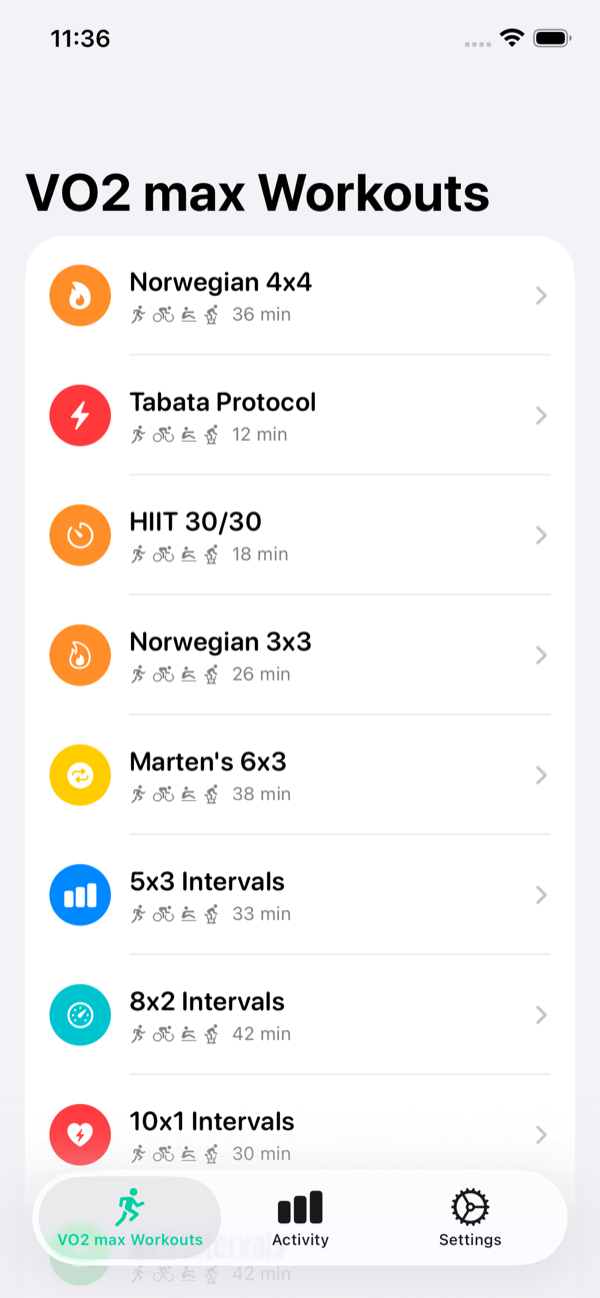
Step 1: Open the workout list
Launch PEAKVO2. The home tab is "VO2 max Workouts." Tap Norwegian 4x4 at the top of the list.
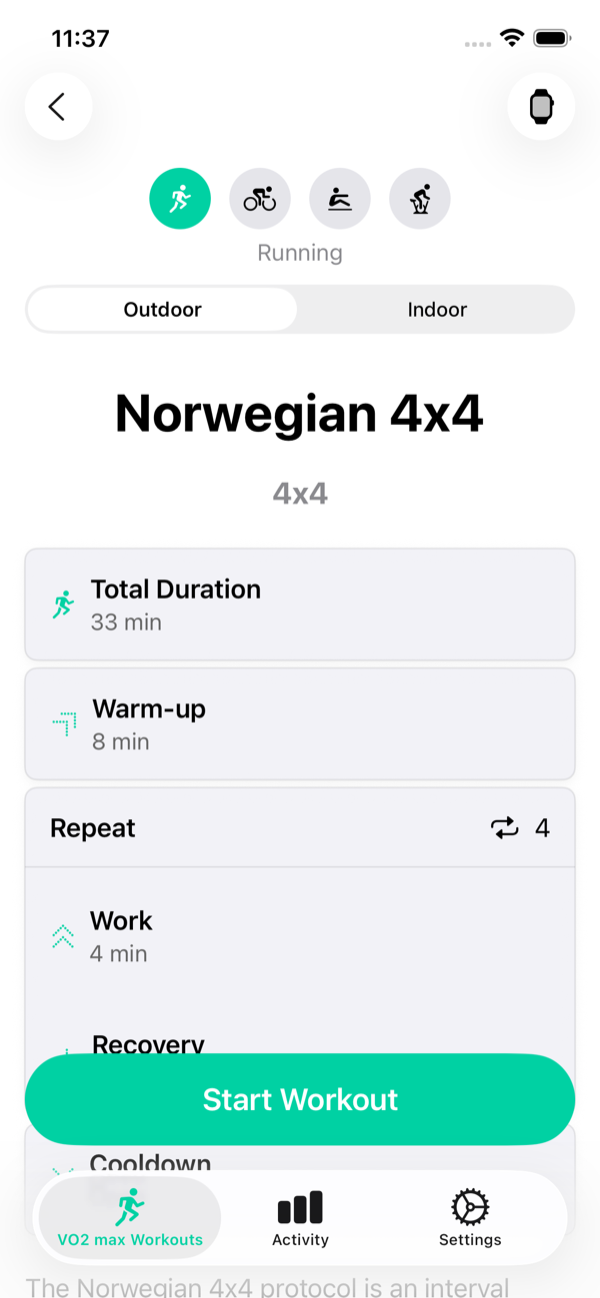
Step 2: Configure activity and environment
The detail screen lets you pick the activity (Running, Cycling, Swimming, Rowing) and toggle between Outdoor and Indoor. The phase breakdown is visible: warm-up, 4× work + recovery, cooldown. Total session is 33 minutes.
Step 3: Send the workout to Apple Watch (recommended)
With your Apple Watch paired, PEAKVO2 can hand the session off to the watch. The watch then runs a native workout (the same kind of session you would start from the built-in Workout app) using the interval pattern PEAKVO2 sent. You get continuous heart rate from the watch's optical sensor, calorie estimation, GPS when outdoors, and a workout that lands in Apple Health when finished.
Without Apple Watch, the workout is timer-driven on iPhone only. You see the phase color and countdown but not heart rate. If hitting the 90 to 95% HRmax zone is the point (and it is, for Norwegian 4x4), wearing the watch is the difference between training the protocol and training a guess.
Step 4: During the workout
The phase color tells you what to do without reading any numbers:
- Orange = warm-up. Build effort gradually. Heart rate should reach 60 to 70% HRmax by the end.
- Red = work. Push to 90 to 95% HRmax. Big numbers in the center are the countdown.
- Blue = recovery. Easy effort. Heart rate should drop below 75% HRmax.
- Green = cooldown. Walk or easy jog.

The top of the screen shows pace, interval count (1/4, 2/4, etc.), and elapsed time. The skip button lets you advance manually if you need to bail on a rep. The pause button stops the timer for breaks (it does not affect the cumulative interval count). Haptic alerts on Apple Watch fire at each transition so you do not have to look at the screen mid-interval.
Step 5: Review your progress
The Activity tab is where the 8-week plan pays off. PEAKVO2 tracks your estimated VO2 max trend, your total weekly minutes, your session count, and a year-in-review heatmap. Sessions from other apps that touch Apple Health also count toward your totals, so your full training load is visible in one place.
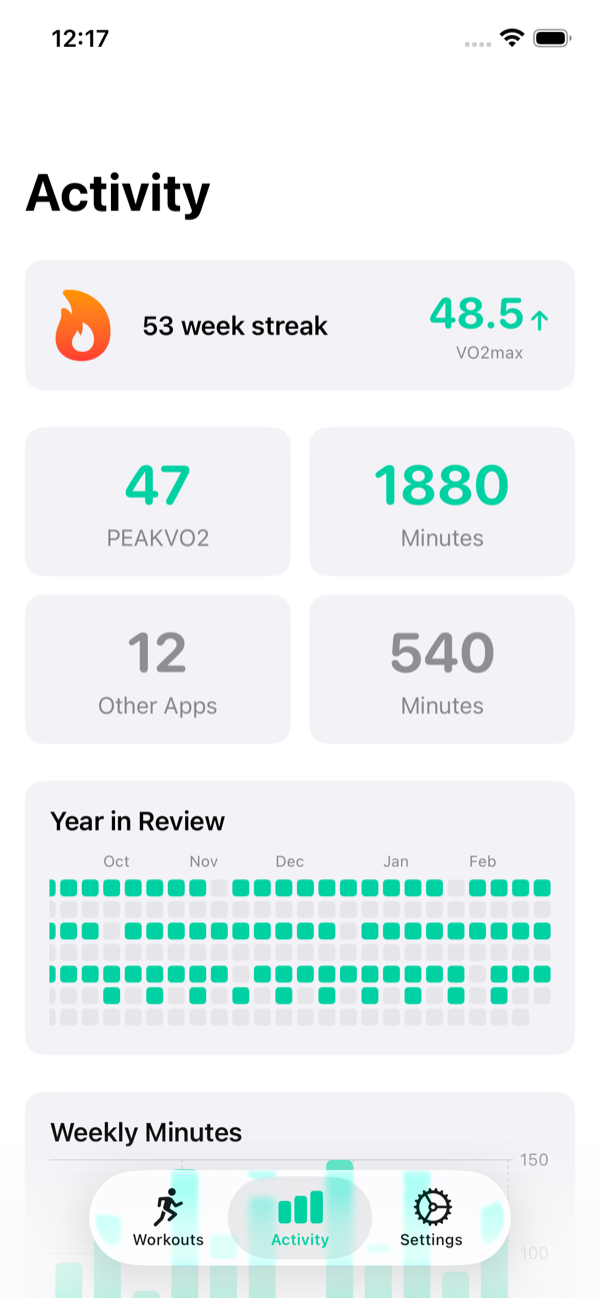
If you train the plan as written, your VO2 max number in this tab should climb measurably over the 8 weeks. Watch for the streak counter to roll past 4 weeks, then past 8. Consistency is the lever; the protocol just turns it.
Heart Rate Zones: How to Dial Intensity
The protocol is defined by heart rate percentage, not by pace. Pace matters only as the lever that drives heart rate into the right zone.
Calculating HRmax. The Tanaka formula (208 − 0.7 × age) is more accurate than the older 220 − age for most adults (Tanaka et al., 2001). For a 35-year-old, HRmax estimate is 184 bpm. The 90 to 95% work zone is 166 to 175 bpm. The 60 to 70% recovery zone is 110 to 129 bpm.
These are estimates. The most accurate way to know your true HRmax is a maximal field test (after a 10-minute warm-up, run 4 to 5 minutes at increasing effort until you cannot push harder; record peak HR) or a lab-based VO2 max test that captures HR data alongside oxygen consumption.
Why "hard but talkable" is the wrong cue. Norwegian 4x4 work intervals are above the lactate threshold. You cannot hold conversation in the work intervals, full stop. If you can, intensity is too low. The right cue is: by the last minute of intervals 3 and 4, single-word answers are all you have.
Why recovery matters more than people think. The 3-minute recovery is short. If your heart rate does not drop below 75% HRmax during recovery, you went too hard in the preceding work interval. This compounds: each subsequent work interval starts with elevated HR, peaks higher, and intensity is no longer where it needs to be. Walking or very easy jogging is what the recovery looks like, not a moderate jog.
Pacing Strategy: How Each Interval Should Feel
This is the rhythm you are training your nervous system to recognize.
- Interval 1 should feel manageable. You should finish thinking "I can do this three more times."
- Interval 2 is where reality sets in. The accumulating fatigue starts to matter. Heart rate sits higher than interval 1 at the same pace.
- Interval 3 should make you question your life choices. You are in the zone but it is uncomfortable.
- Interval 4 is the hardest by design. The fact that you know it is the last one helps you push.
If interval 4 is suddenly easier than interval 3, you held back too much in interval 3. If you can sprint the last 30 seconds of interval 4 with energy to spare, the previous intervals were submaximal. The goal is consistent, near-maximal effort across all four intervals, not negative splits.
Troubleshooting: 5 Common Problems
"I cannot sustain the intensity for 4 minutes." Drop to three intervals for 1 to 2 weeks. The metabolic and neuromuscular demand of four intervals is real, and trying to white-knuckle through them ends in low-quality sessions that produce nothing. Three quality intervals beat four broken ones, every time.
"Recovery feels way too short, my HR will not drop." Two causes. Either the work intervals are too hard (heart rate dropping below 75% HRmax in 3 minutes requires you to have been at 90 to 95%, not 100%), or your aerobic base is too thin (recovery is a cardiovascular function and improves with zone 2 work). Add a zone 2 session per week and reassess in 2 weeks.
"I am not seeing VO2 max gains after 4 weeks." Three checks. Are you training twice per week with at least 48 hours between sessions? Are you hitting 90 to 95% HRmax in intervals 3 and 4? Is your VO2 max tracker actually updating (Apple Watch needs outdoor running data to update Cardio Fitness; an indoor-only training pattern can mask real gains in the algorithm).
"My legs are wrecked between sessions." Space sessions 72+ hours apart. Add a zone 2 day in between to promote blood flow and recovery. If wreckage persists, your warm-up may be too short or you may be running on harder surfaces than your body can absorb. Try rotating in a non-impact day on a bike or rower.
"I get bored doing the same workout." Rotate the modality. The protocol works the same on a bike, rower, treadmill, or outdoor run. PEAKVO2 supports all four modalities natively. Or vary the surface: track Monday, hills Thursday, treadmill in winter. The intensity is what matters; the movement is interchangeable.
PEAKVO2. The interval app for your cardio fitness.
PEAKVO2 handles every phase transition, color-codes the screen so you always know what to do, and sends the workout to Apple Watch for continuous heart rate. Eight protocols total.
Download PEAKVO2What to Do After Week 8
Two paths from here, depending on what you want next.
Maintenance. One Norwegian 4x4 session per week is enough to maintain VO2 max gains for most people. Pair it with 2 to 3 zone 2 sessions of 45 to 60 minutes and you have a sustainable weekly structure that holds your fitness without burning you out. This is the long-term play for general health and longevity.
Progression. If you want to keep pushing, two options inside PEAKVO2. Norwegian 3x3 (in the workouts list) shortens both the work and recovery, increasing the relative intensity. Marten's 6x3 adds two intervals and shortens recovery, which dramatically increases total training stimulus. Either is a step up from 4x4 once you have completed 8+ weeks of consistent 4x4 work.
Whatever you pick, take a deload week first: one Norwegian 4x4 session at conservative effort, plus easy zone 2 on other days. The deload lets accumulated fatigue clear before the next progression. Skipping it is the most common reason people stall out at the 12-week mark.
Frequently Asked Questions
How long until I see results from the Norwegian 4x4?
Subjective improvements (easier breathing, faster recovery from hard efforts) usually appear in 2 to 3 weeks. Measurable VO2 max improvements typically show up by week 4 to 6 if you train twice per week at the right intensity. The full 7 to 10% gain reported in the original NTNU studies took 8 weeks of consistent training at 2 to 3 sessions per week.
Do I need an Apple Watch for Norwegian 4x4 on PEAKVO2?
You can run the workout on iPhone alone (the timer and phase transitions work without a watch), but Norwegian 4x4 is defined by heart rate percentage. Without continuous HR, you are guessing at intensity. Apple Watch (or any HR monitor paired to the app via Apple Health) gives you the data the protocol requires. For Norwegian 4x4 specifically, training without HR is training a different workout.
Can I do Norwegian 4x4 on a bike or rower?
Yes. The protocol was originally tested on both treadmills and bike ergometers and the cardiovascular adaptation is the same. PEAKVO2 supports Running, Cycling, Swimming, and Rowing for the Norwegian 4x4 directly. Pick the modality your body recovers best from. Many runners alternate bike days and run days to reduce impact load.
Is Norwegian 4x4 safe for older adults?
The protocol has been studied in populations from elderly subjects to heart failure patients with strong safety and efficacy data when supervised (Wisløff et al., 2007; Stensvold et al., 2020). For adults over 60 or with cardiovascular risk factors, talk to your doctor before starting and consider beginning with the modified 3-interval version for the first 4 weeks. The intensity zones are percentage-based, so they scale naturally to any starting fitness.
How is Norwegian 4x4 different from Tabata?
Tabata is 20 seconds work, 10 seconds rest, 8 rounds (4 minutes total) at near-maximal anaerobic effort. Norwegian 4x4 is 4 minutes work, 3 minutes rest, 4 rounds (33 minutes total) at near-maximal aerobic effort. Tabata primarily trains anaerobic capacity; the 4x4's longer work intervals sustain cardiac output near maximum, which is what drives VO2 max specifically. Different protocols for different goals. Run Tabata for power and time efficiency; run the 4x4 for VO2 max.
Can I do Norwegian 4x4 every day?
No. Daily Norwegian 4x4 produces accumulated fatigue without additional adaptation benefit. Two sessions per week is the research-validated dose. Three is the upper limit for trained athletes. Beyond that, recovery cannot keep pace with the demand and heart rate variability drops, which is the body's signal that adaptation has stalled. Use non-interval days for zone 2 work, strength training, or rest.
Keep Reading
- Norwegian 4x4 Protocol: Proven HIIT to Raise VO2 Max (the full science and history)
- How to Improve VO2 Max: The Complete Evidence-Based Guide (every method ranked)
- VO2 Max Training Plan: An 8-Week Multi-Protocol Program (mixes the 4x4 with 30/30 and tempo)
- Free Programmable Interval Timer
- HIIT Workouts for Fat Loss
- Zone 2 Training: The Foundation of Endurance Fitness
- VO2 Max Calculator
- What Is a Good VO2 Max? Charts by Age and Gender
References
- Helgerud J, Hoydal K, Wang E, et al. Aerobic high-intensity intervals improve VO2max more than moderate training. Med Sci Sports Exerc. 2007;39(4):665-671. PubMed
- Wisløff U, Støylen A, Loennechen JP, et al. Superior cardiovascular effect of aerobic interval training versus moderate continuous training in heart failure patients: a randomized study. Circulation. 2007;115(24):3086-3094. PubMed
- Stensvold D, Viken H, Steinshamn SL, et al. Effect of exercise training for five years on all cause mortality in older adults — the Generation 100 randomised trial. BMJ. 2020;371:m3485. PubMed
- Mandsager K, Harb S, Cremer P, et al. Association of cardiorespiratory fitness with long-term mortality among adults undergoing exercise treadmill testing. JAMA Netw Open. 2018;1(6):e183605. PubMed
- Tanaka H, Monahan KD, Seals DR. Age-predicted maximal heart rate revisited. J Am Coll Cardiol. 2001;37(1):153-156. PubMed
- Meeusen R, Duclos M, Foster C, et al. Prevention, diagnosis, and treatment of the overtraining syndrome: joint consensus statement. Med Sci Sports Exerc. 2013;45(1):186-205. PubMed