Heart Rate Zones Explained: What Your Heart Rate Should Be in Each Workout
 Run these workouts on your iPhone, or hands-free on Apple Watch. Get PEAKVO2
 The five heart rate zones run from Z1 (50-60% of max HR, very easy) up to Z5 (90-100%, maximal). For VO2 max and interval work, target 90-95% of your max heart rate during the work phase and drop to 60-70% in recovery. Your max heart rate is best estimated with the Tanaka formula: 208 minus (0.7 times your age). Here is the target heart rate for every phase and protocol.
The 5 Heart Rate Zones
Each zone corresponds to a percentage of your maximum heart rate and trains a different physiological system.
| Zone | % of Max HR | What It Trains |
|---|---|---|
| Z1 | 50-60% | Recovery, very easy movement |
| Z2 | 60-70% | Aerobic base, fat oxidation |
| Z3 | 70-80% | Aerobic capacity, tempo |
| Z4 | 80-90% | Lactate threshold |
| Z5 | 90-100% | VO2 max, maximal effort |
How to Find Your Max Heart Rate
The most accurate age-based formula comes from a meta-analysis of 351 studies: the Tanaka formula gives 208 minus (0.7 times your age) (Tanaka et al., 2001). It outperforms the old "220 minus age" across a wide age range.
Example for a 40-year-old: 208 minus (0.7 times 40) = 208 minus 28 = 180 bpm max HR.
- Z5 (90-100%): 162-180 bpm (your 90-95% work-interval target is 162-171 bpm)
- Z4 (80-90%): 144-162 bpm
- Z3 (70-80%): 126-144 bpm
- Z2 (60-70%): 108-126 bpm
- Z1 (50-60%): 90-108 bpm
The formula is a population average, so your true max may be 5-10 bpm higher or lower. A lab or field test gives a more precise number. As a rule of thumb, max HR tends to decline about 1 bpm per year of age, but fitness level does not change the max itself. To get your zones in bpm for your exact age, including Karvonen zones from your resting heart rate, use our max heart rate calculator, or jump straight to the zone 2 calculator for the easy-day range.
For a complete treatment of zone 2 specifically, including pacing by effort and lactate levels, see zone 2 training.
What Your Heart Rate Should Be During a Workout
Heart rate targets vary by workout phase. Knowing the right number for each phase is more useful than a single "target zone" for the whole session.
Work Phase
For VO2 max and interval work, the target is 90-95% of your maximum heart rate (Helgerud et al., 2007). At 180 bpm max, that is 162-171 bpm during each work interval.
One important caveat: heart rate lags effort. It takes roughly 1-2 minutes for your heart rate to climb into the target zone after an interval begins. This means the first minute of each interval will read lower than your true intensity, and very short efforts (20-second Tabata bursts) will never reach the zone number on your watch even when you are working all-out. For short intervals, go by perceived effort rather than the number.
Recovery Phase
Between intervals, target 60-70% of max HR (108-126 bpm for the 180 bpm example). Keep moving rather than standing still: active recovery at a walk or very easy jog maintains circulation and speeds the clearance of metabolic byproducts. Dropping all the way to rest between intervals extends the time before the next work phase is productive, which reduces the overall training stimulus of the session.
Warm-Up
Ramp gradually over about 10 minutes before the first work interval. Starting a high-intensity interval with a cold cardiovascular system forces the body to catch up just as the real effort begins, which delays hitting the target zone and increases injury risk. A 10-minute warm-up that reaches approximately Z2-Z3 means the first work interval can reach Z5 within the first minute instead of the second.
Target Heart Rate by Workout
| Workout | Work-Phase HR | Recovery HR |
|---|---|---|
| Norwegian 4x4 | 90-95% HRmax | 60-70% HRmax |
| Tabata (20/10) | All-out effort (HR lags) | N/A (10 sec too short) |
| HIIT 30/30 | 85-95% HRmax | 60-70% HRmax |
| Zone 2 Steady | 60-70% HRmax | No intervals |
| Threshold | 80-88% HRmax (Z4) | 60-70% HRmax |
Norwegian 4x4: Four intervals of four minutes at 90-95% HRmax, each followed by three minutes of active recovery at 60-70%. This is the protocol with the strongest VO2 max evidence and the one where heart rate monitoring matters most, since the work intervals are long enough that you can confirm you are actually in the target zone. See the full Norwegian 4x4 protocol for structure and programming.
Tabata: Twenty seconds all-out, ten seconds rest, eight rounds. The 10-second recovery is too short for heart rate to drop meaningfully between rounds, and the 20-second bursts are too short for heart rate to fully climb. Go by effort during the work phase, not the number. Full details and exercise options in Tabata workouts.
HIIT 30/30: Thirty seconds hard, thirty seconds easy, repeated 8-12 times. Slightly longer work intervals mean heart rate has more time to climb, so a watch reading of 85-95% during the latter part of each interval confirms the intensity is honest. See HIIT exercises for movement options and interval training for beginners for a starter version.
Zone 2 steady: Sixty to seventy percent HRmax, continuous. No intervals, no recovery phases. The entire session is the recovery zone. For the full methodology, see zone 2 training.
Threshold: Sustained effort at 80-88% HRmax (upper Z4), held for 20-40 minutes without interval breaks. Used in interval training for running as a tempo run and in lactate threshold training to push the sustainable ceiling higher.
Which Zone Actually Builds VO2 Max
VO2 max responds most strongly to work in Z4 and Z5, specifically intervals that spend time at 90-95% HRmax. This is why the Norwegian 4x4 and similar high-intensity interval formats consistently outperform moderate continuous training for VO2 max gains (Helgerud et al., 2007).
Zone 2 builds the aerobic base that supports the high-intensity work. Without a strong Z2 foundation, the body struggles to recover between hard sessions and between intervals within a session. The two zones are not competing; they serve different functions in the same long-term program.
The research-backed approach is a polarized distribution: roughly 80% of weekly training volume at low intensity (Z1-Z2) and 20% at high intensity (Z4-Z5), with very little time in the middle zones (Seiler, 2010). Spending most sessions in Z3 is the most common mistake in recreational training because it feels hard enough to be useful but sits in the zone that provides the weakest stimulus for either aerobic base or VO2 max.
Why does VO2 max matter enough to structure training around? A large clinical study found that cardiorespiratory fitness is the strongest predictor of long-term survival, stronger than any traditional risk factor (Mandsager et al., 2018). Moving from low to above-average fitness carries a survival benefit comparable to quitting smoking. For more, see how to improve VO2 max and what is a good VO2 max.
Why Your Watch's Zones Can Be Wrong
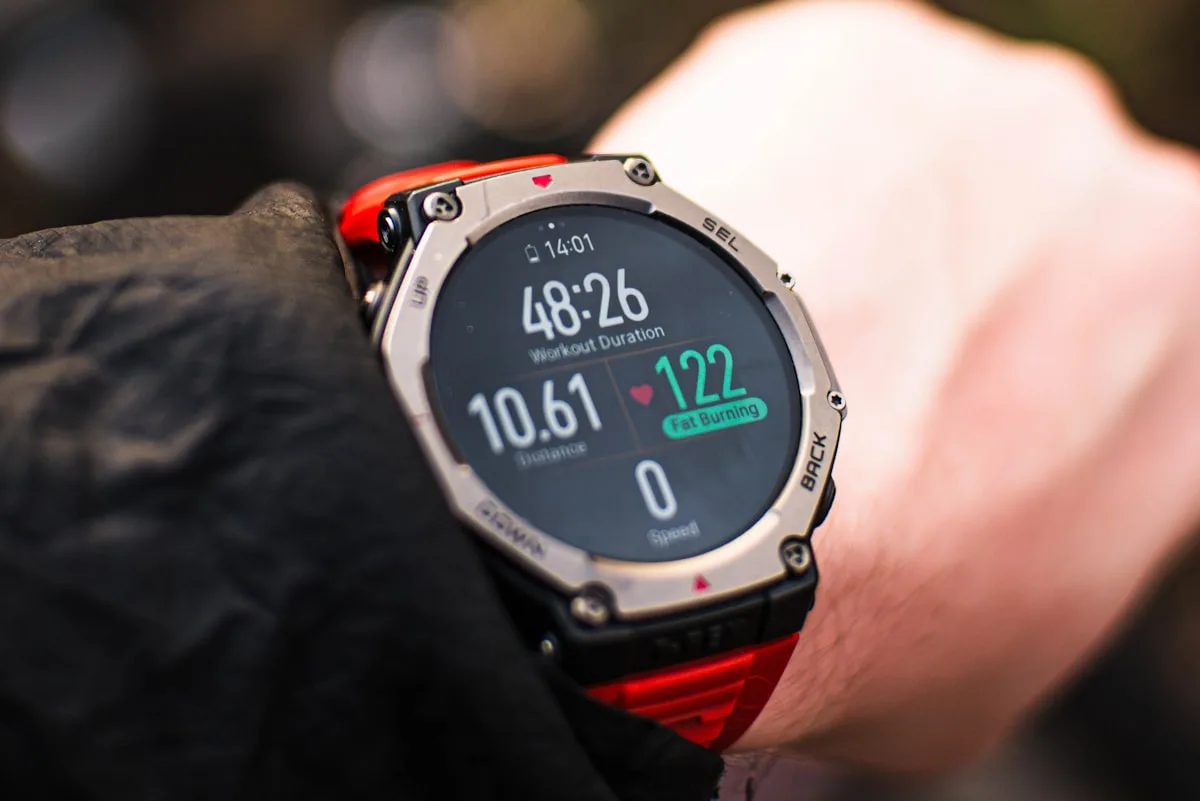
Most wrist heart rate sensors introduce 5-10 second lag on rapidly changing signals. During intervals, this means your watch may be displaying your heart rate from a minute ago just as you finish a hard burst. The number looks low not because your intensity was low, but because the sensor is catching up.
Optical wrist sensors are also vulnerable to cadence lock, where the sensor picks up the motion frequency of your arm swing instead of your actual pulse. This is most common during running at a steady pace, where the stride frequency happens to match a plausible heart rate range.
A second source of error is how devices set your max HR and zones. Apple Watch uses one formula; Garmin uses a different default and adjusts over time based on workout data. The same real-time heart rate of 160 bpm might sit in Z4 on one device and Z3 on another because the underlying max HR estimates differ. For guidance on interpreting zone data from each platform, see Apple Watch cardio fitness and Garmin VO2 max, and for choosing a device, see best fitness tracker for VO2 max.
For interval work, a chest strap provides the most accurate reading because it measures electrical activity directly rather than optical reflectance. If you notice your watch consistently reads 10-15 bpm below what your effort suggests during intervals, cadence lock or sensor lag is the likely cause.
PEAKVO2. The interval app for your cardio fitness.
PEAKVO2 runs the Norwegian 4x4 and other protocols on Apple Watch with color-coded work and recovery phases, live heart rate, and haptic cues at every transition, so you stay in the zone without watching the screen.
Download PEAKVO2Frequently Asked Questions
What heart rate should I be at to improve my VO2 max?
Target 90-95% of your maximum heart rate during the work intervals. For a 40-year-old with a max HR of 180 bpm (from the Tanaka formula), that is 162-171 bpm. The key is spending meaningful time in this range, which is why protocols like the Norwegian 4x4 use four-minute intervals long enough to confirm you are actually in the zone rather than just approaching it.
What should my target heart rate be for intervals?
For the hard work intervals, target 90 to 95 percent of your maximum heart rate; during recovery, drop to 60 to 70 percent. At a max of 180 bpm that is roughly 162 to 171 bpm for the work bouts and 108 to 126 bpm for recovery. Very short efforts like 20-second Tabata bursts will not reach the zone on your watch even at full effort, so judge those by perceived effort. Calculate your own bpm bands with the max heart rate calculator.
What should my heart rate be during HIIT?
For the work intervals in HIIT, aim for 85-95% of your max HR. In practice this means you are working hard enough that conversation is impossible and you are aware of your breathing on every breath. Heart rate lags effort during short intervals, so if your watch reads 80% during a 30-second burst, your true intensity is likely higher. The recovery intervals should bring you down to 60-70% before the next round. PEAKVO2, an Apple Watch interval app, shows the target heart rate zone for each work and recovery phase and taps your wrist at every transition.
What heart rate should I recover to between intervals?
Sixty to seventy percent of your maximum heart rate is the target recovery zone. This keeps circulation active and speeds lactate clearance while giving the cardiovascular system enough rest to produce a quality next interval. Standing completely still between intervals lets the heart rate drop further, but the passive rest does not accelerate recovery and reduces the cumulative training effect of the session.
How do I warm up to my target heart rate?
Spend about 10 minutes gradually increasing effort from Z1 into Z2-Z3 before the first work interval. A practical sequence is 3-4 minutes of easy walking or jogging, then 3-4 minutes at a moderate pace, then 2-3 minutes with two or three short pickups (10-15 seconds at near-work effort) to prime the cardiovascular system. The goal is to arrive at the first interval with your heart rate already in the 70-80% range so it can climb into Z5 within the first minute.
What is my maximum heart rate, and is 220 minus age accurate?
The Tanaka formula (208 minus 0.7 times your age) is more accurate than 220 minus age across the adult age range, based on a meta-analysis of 351 studies with over 18,000 subjects. For a 60-year-old, 220 minus age gives 160 bpm while Tanaka gives 166 (208 minus 42); the gap widens with age, where the old formula increasingly underestimates your true max. Both are population averages; a field test or lab test will give you a personal number.
Is wrist heart rate accurate for intervals?
Wrist optical sensors are reliable for steady-state exercise but introduce meaningful lag and are susceptible to cadence lock during high-intensity intervals. Expect 5-15 bpm error during the rapid changes of interval training. A chest strap eliminates both issues by reading the electrical signal of each heartbeat directly. If you use a wrist sensor for intervals, treat the reading as an approximate trend rather than a precise number, and note whether the device flags any low-confidence readings.
Keep Reading
- Tabata vs Norwegian 4x4: Which Interval Protocol Is Better?
- Zone 2 Training: The Foundation of Endurance Fitness
- Norwegian 4x4 Protocol: The Most Studied VO2 Max Workout
- Tabata Workouts: Origins, Science, and 6 Workout Examples
- How to Improve VO2 Max: The Evidence-Based Guide
- Best Fitness Tracker for VO2 Max: Apple Watch, Garmin, and Polar Tested
References
- Tanaka H, Monahan KD, Seals DR. Age-predicted maximal heart rate revisited. J Am Coll Cardiol. 2001;37(1):153-156. PubMed
- Helgerud J, Hoydal K, Wang E, et al. Aerobic high-intensity intervals improve VO2max more than moderate training. Med Sci Sports Exerc. 2007;39(4):665-671. PubMed
- Seiler S. What is best practice for training intensity and duration distribution in endurance athletes? Int J Sports Physiol Perform. 2010;5(3):276-291. PubMed
- Mandsager K, Harb S, Cremer P, et al. Association of cardiorespiratory fitness with long-term mortality among adults undergoing exercise treadmill testing. JAMA Netw Open. 2018;1(6):e183605. PubMed