Tabata vs Norwegian 4x4: Which Interval Protocol Is Better?

 Run these workouts on your iPhone, or hands-free on Apple Watch. Get PEAKVO2
 The Norwegian 4x4 (four 4-minute intervals at 90-95% of max heart rate, with 3-minute recoveries, about 38 minutes total) is the stronger, better-researched choice for building VO2 max and cardiovascular health. Tabata (8 rounds of 20 seconds all-out with 10 seconds rest, 4 minutes total) is far more time-efficient and better for anaerobic capacity. Both raise VO2 max; they simply do it by different routes.
If you only remember one thing, remember that these two protocols are not really competing for the same job. The 4x4 is a targeted VO2 max and heart-health tool. Tabata is a compressed, brutal hit of mostly anaerobic work that happens to also nudge VO2 max upward. The rest of this article explains where each one wins, what the studies actually found, and how to choose. For the full step-by-step method for each, see the Tabata workouts guide and the Norwegian 4x4 protocol guide; this page is the head-to-head only.
The Two Protocols at a Glance
| Protocol | Structure | Total time | Primary adaptation | Best for | Intensity |
|---|---|---|---|---|---|
| Tabata | 8 x 20 sec work, 10 sec rest | 4 min (about 12 with warm-up and cooldown) | Anaerobic capacity, with a VO2 max effect | Time-crunched days, power and team sports | All-out (about 170% of VO2 max) |
| Norwegian 4x4 | 4 x 4 min work, 3 min recovery | About 38 min with warm-up and cooldown | VO2 max and cardiac output | Endurance, heart health, VO2 max as the goal | 90-95% HRmax (recovery 60-70%) |
The single clearest difference is the length of the work bout. Tabata's efforts are so short that heart rate never fully catches up to the effort; you finish a 20-second burst before your cardiovascular system reaches steady state. The 4x4's 4-minute bouts are long enough to pin your heart near its ceiling for minutes at a time. That contrast drives almost everything below.
What the Research Says
Both protocols trace back to a single landmark study, and comparing those two papers fairly is the heart of this debate.
Tabata, 1996. The original protocol comes from a 6-week study in which one group cycled 8 rounds of 20 seconds all-out with 10 seconds rest, five days per week. That group improved VO2 max by about 14% and, more notably, raised anaerobic capacity by 28%, a dual effect no other protocol in the study matched (Tabata et al., 1996). The result is genuinely impressive, but two caveats matter. The training group was small (n=7), and the subjects were already fit, so how well the exact numbers transfer to a general population is uncertain. The all-out demand is also hard to reproduce outside a lab with a fixed-resistance ergometer.
Helgerud, 2007. The 4x4 comes from a study in which four 4-minute intervals at 90-95% HRmax, three times per week for 8 weeks, improved VO2 max by 7.2%, significantly more than moderate continuous training of matched total work (Helgerud et al., 2007). The percentage is smaller than Tabata's headline 14%, but the comparison is not apples to apples: different subjects, different durations, and different baselines. What tips the balance toward the 4x4 for VO2 max is not that single number but the weight of evidence behind it. The protocol has been replicated across runners, cyclists, older adults, and cardiac patients, and it is the interval method most cardiologists and exercise physiologists point to for cardiovascular health.
So the honest summary is this. Tabata's original result is striking but rests on a tiny, all-out study built around anaerobic capacity. The 4x4 has the larger, more replicated evidence base specifically for VO2 max and cardiac adaptation. Both are real; the depth of support differs.
VO2 Max: Which Builds It More
VO2 max is limited mostly by how much oxygen-rich blood your heart can pump to working muscles, so the protocol that spends more time near maximal cardiac output has the mechanical advantage. That is where the 4x4's long intervals earn their reputation.
During each 4-minute bout at 90-95% HRmax, your heart operates near its maximum stroke volume, the amount of blood ejected per beat, for a sustained stretch. Repeated over weeks, that stimulus drives the central adaptations that raise VO2 max: greater stroke volume, higher cardiac output, and better oxygen extraction in the muscle, alongside peripheral changes like increased mitochondrial density (Gibala et al., 2012). The 4-minute duration is the point. It holds the heart at the ceiling long enough for the signal to register.
Tabata reaches a high aerobic demand too, but mostly in the back half of the set. By rounds 6 through 8, the accumulated oxygen deficit means your aerobic system is running near maximum even during the 10-second rests. That is a real VO2 max stimulus, which is why the original study saw aerobic gains at all. But each individual effort is too short to sustain near-maximal cardiac output the way a 4-minute bout does, and the dominant demand is anaerobic.
Net result: the 4x4 is the more targeted VO2 max tool. Tabata builds VO2 max as a secondary effect and is the efficient option when time, not precision, is the constraint.
Time, Recovery, and Sustainability
This is where Tabata wins outright. The work itself is 4 minutes. Even with a warm-up and cooldown you are done in about 12. Nothing else in structured cardio delivers a comparable stimulus in that little clock time. The catch is that those 4 minutes are genuinely brutal; all-out effort on every round is what makes the protocol work, and it is why so many "Tabata" classes that run at moderate intensity are not really Tabata at all.
The 4x4 asks for about 38 minutes including its 10-minute warm-up and 5-minute cooldown, of which only 16 are at high intensity. It is longer, but each interval is hard-but-sustainable rather than maximal, which many people find more repeatable week to week than the flat-out demand of Tabata.
Both protocols share the same ceiling on frequency: 2 to 3 sessions per week, spaced at least 48 hours apart. The adaptations happen during recovery, not during the session, and stacking high-intensity days back to back invites fatigue accumulation, depressed heart rate variability, and stalled progress. More is not better with either one. If you are over 40, lean toward the lower end and guard recovery even more carefully.
Which Should You Choose
There is no universal winner, only a better fit for your goal. Use this as the decision rule.
Pick the Norwegian 4x4 if:
- VO2 max is the specific number you want to move.
- You care about cardiovascular health, longevity, or building an endurance base.
- You are a runner, cyclist, rower, or hybrid athlete who can give the session about 40 minutes.
- You want the protocol with the deepest, most replicated research behind it.
Pick Tabata if:
- You have almost no time and need a real stimulus in under 15 minutes.
- Your sport rewards anaerobic capacity and repeat-sprint ability: team sports, martial arts, combat sports, racket sports.
- You already have an aerobic base and want to add a sharp anaerobic top end.
Or run both. They complement each other cleanly. A common weekly structure is one 4x4 session for VO2 max, one Tabata session for anaerobic power, and two or three easy zone 2 sessions for the aerobic base underneath. For the exact intervals and progressions, follow the Tabata workouts and Norwegian 4x4 protocol guides, and use heart rate zones to set the targets: 90-95% HRmax for the 4x4 work bouts, 60-70% for its recoveries, and effort-based all-out for Tabata, since heart rate lags too far behind on 20-second efforts to steer by. To estimate your max heart rate, use the Tanaka formula: 208 minus (0.7 times your age).
Run Both in PEAKVO2
Both protocols ship as guided workouts in PEAKVO2 on iPhone and Apple Watch: the Norwegian 4x4 and the Tabata Protocol each run with automatic phase transitions, a haptic tap on your wrist at every transition, and the target heart rate zone shown for the current phase. The zone display matters more for the 4x4, where holding 90-95% HRmax across the interval is the whole point, than for eyeballing a clock, and hands-free phase timing means you never break effort to check a screen.
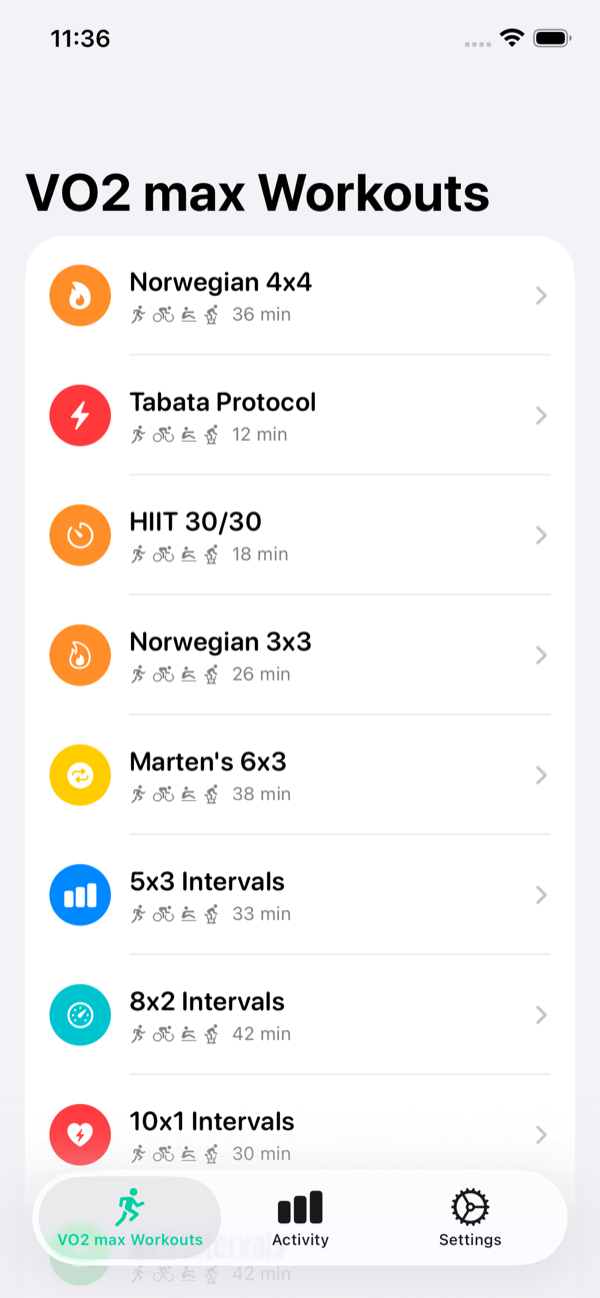
PEAKVO2. The interval app for your cardio fitness.
Run the Norwegian 4x4 and Tabata as guided workouts on iPhone and Apple Watch, with automatic phases, haptic cues, and your target heart rate zone each interval.
Download PEAKVO2Frequently Asked Questions
Is Tabata or the Norwegian 4x4 better for VO2 max?
The Norwegian 4x4 is the better choice for VO2 max specifically. Its 4-minute intervals hold your heart near maximum stroke volume long enough to drive the central adaptations that raise VO2 max, and the protocol has a large, replicated evidence base for exactly that outcome. Tabata does raise VO2 max, but as a secondary effect of mostly anaerobic work, and its original study was small and all-out. If VO2 max is the goal, choose the 4x4.
Which burns more fat, Tabata or the 4x4?
Neither has a decisive edge, because fat loss is driven mainly by overall calorie balance rather than the protocol you pick. Tabata's extreme intensity produces a strong afterburn effect in very little time, while the 4x4 burns more total calories per session simply because it lasts longer. Both work when paired with an overall calorie deficit. Pick the one you will do consistently.
How often can I do each one?
Two to three times per week for either protocol, with at least 48 hours between hard sessions. The adaptations happen during recovery, so more frequency does not mean more progress; it usually means more fatigue. Fill the other days with easy zone 2 work or rest. If you run both protocols in the same week, count them together toward that 2 to 3 session cap.
Is Tabata really only 4 minutes?
The work itself is exactly 4 minutes: 8 rounds of 20 seconds all-out and 10 seconds rest. In practice you add a warm-up and cooldown, bringing a full session to about 12 minutes. The 4 minutes only deliver results if every work interval is genuinely maximal. At moderate effort it becomes ordinary interval training, not Tabata.
Can I combine Tabata and the Norwegian 4x4?
Yes, and they pair well because they target different systems. A common approach is one 4x4 session for VO2 max, one Tabata session for anaerobic power, and two or three easy zone 2 sessions per week for the aerobic base. Keep both high-intensity sessions at least 48 hours apart, and treat them as part of the same weekly hard-session budget rather than adding them on top of a full schedule.
Is the 4x4 or Tabata better for beginners?
The 4x4 is easier to scale because its intensity is set relative to your own max heart rate, so it automatically adjusts to your fitness, and you can start with shorter intervals like a 3x3 before building to the full session. True Tabata demands all-out effort that is hard to reach and hard to recover from when you are new to intervals. Most beginners should build an aerobic base first, then add the 4x4, and save Tabata for once they are conditioned.
Keep Reading
- Tabata Workouts: What They Are and How to Do Them Right
- Norwegian 4x4 Protocol: Proven HIIT to Raise VO2 Max
- Heart Rate Zones Explained: What Your Heart Rate Should Be in Each Workout
- Zone 2 Training: The Complete Guide to Building Your Aerobic Base
- Interval Training for Beginners: What It Is and How to Start
- What Is a Good VO2 Max? Charts by Age and Gender
References
- Tabata I, Nishimura K, Kouzaki M, et al. Effects of moderate-intensity endurance and high-intensity intermittent training on anaerobic capacity and VO2max. Med Sci Sports Exerc. 1996;28(10):1327-1330. PubMed
- Helgerud J, Høydal K, Wang E, et al. Aerobic high-intensity intervals improve VO2max more than moderate training. Med Sci Sports Exerc. 2007;39(4):665-671. PubMed
- Gibala MJ, Little JP, Macdonald MJ, Hawley JA. Physiological adaptations to low-volume, high-intensity interval training in health and disease. J Physiol. 2012;590(5):1077-1084. PubMed