Stamina vs Endurance: The Real Difference, Explained Simply

 Run these workouts on your iPhone, or hands-free on Apple Watch. Get PEAKVO2
 Endurance is the ability to sustain a submaximal effort over time: holding an easy running pace for an hour, riding for three, hiking all day. Stamina is the ability to sustain a near-maximal effort without fading: keeping the pace when it burns, staying strong in the last round. The words describe different ends of the intensity scale, but the same aerobic engine drives both, so you do not need two training programs. You need one bigger engine.
The Two Definitions
The confusion exists because everyday speech uses stamina and endurance interchangeably, while coaches and exercise scientists use them to point at two different qualities.
Endurance is about duration at moderate intensity. It answers the question "how long can you keep going?" A person with good endurance holds a conversational pace for a long time without their heart rate drifting up and without needing to stop. The limiting factor is how well the body delivers oxygen and burns fuel with it: the heart's pumping capacity, the blood's carrying capacity, and the aerobic machinery inside the muscles.
Stamina is about resisting fatigue at high intensity. It answers the question "how long can you keep going hard?" A person with good stamina holds a pace near their ceiling without falling apart: the final kilometer of a race, the last two minutes of a round, the fourth interval when the first three already hurt. The limiting factor is how close that ceiling sits to the demanded effort, and how well the body clears the byproducts of working near it.
| Endurance | Stamina | |
|---|---|---|
| Definition | Sustaining a submaximal effort over time | Sustaining near-maximal output and resisting fatigue |
| Typical intensity | Low to moderate, conversational | High, hard to hold |
| Time scale | Tens of minutes to hours | Seconds to minutes at a time |
| Limited mainly by | Oxygen delivery and aerobic efficiency | How far below your ceiling the effort sits |
| Everyday example | A long, steady hike | The last kilometer of a race at full effort |
| Best developed by | Easy aerobic volume (zone 2) | High-intensity intervals |
| Shared foundation | The aerobic engine, measured as VO2 max | |
A useful test: if you slowed down, could you continue almost indefinitely? If yes, you are in endurance territory. If the effort would remain hard even slightly slower, you are drawing on stamina.
Where Cardio and Conditioning Fit In
Two more words get mixed into the same conversation, and they sit at different levels.
Cardio is not a quality you have, it is a category of exercise you do. Running, cycling, rowing, swimming, and brisk walking are all cardio: rhythmic work that elevates your heart rate and trains the cardiovascular system. Cardio is the input; endurance and stamina are outputs.
Conditioning is sport-specific work capacity: the ability to meet the demands of your particular activity and recover between its efforts. A soccer player's conditioning is repeated sprints with jogging between them. A boxer's conditioning is three hard minutes, one minute of rest, repeated. Conditioning combines endurance, stamina, and the specific movements of the sport. When an athlete says they are "gassing out," they mean their conditioning does not match the sport's demands yet.
| Term | What it is | Example |
|---|---|---|
| Cardio | A category of exercise that elevates heart rate | A 40-minute easy run |
| Endurance | Capacity to sustain submaximal effort over time | Holding that run for 90 minutes |
| Stamina | Capacity to sustain near-maximal effort | Surging the final kilometer without fading |
| Conditioning | Sport-specific work capacity and recovery | Repeating hard rounds with short rest, all match long |
Muscular Stamina Is a Different Thing
One more distinction prevents a common mix-up. The ability of a specific muscle group to repeat contractions, holding a plank, doing 30 push-ups, carrying a heavy bag up the stairs, is muscular endurance, sometimes called muscular stamina. It is local to the muscle and trained with reps and holds, not with aerobic volume. Everything else in this article refers to whole-body, cardiovascular stamina and endurance. If the muscle-level quality is what you want to build, that is covered in muscular endurance training.
One Engine Drives Both
Here is the part that makes the distinction less important than it looks: stamina and endurance run on the same engine. That engine is your aerobic system, and its size is measured as VO2 max, the maximum rate at which your body can take in and use oxygen.
A bigger engine moves both qualities at once. When VO2 max rises, an easy pace costs a smaller fraction of your capacity, so you can hold it longer: that is endurance. And a hard pace sits further below your new ceiling, so it stops being near-maximal and becomes holdable: that is stamina. Same number, both directions.
This is why the fittest people you know seem to have both without training them separately. Their ceiling is high, so yesterday's hard is today's moderate. It is also why VO2 max is worth measuring rather than guessing: it is the one number that summarizes the engine behind stamina, endurance, and conditioning alike. If you do not know where you stand, what is a good VO2 max has the age-based norms and a calculator, and an Apple Watch estimates the same quantity as its cardio fitness score.
The engine also matters beyond sport. In a study of 122,007 adults, cardiorespiratory fitness predicted long-term survival with no upper limit to the benefit (Mandsager et al., 2018).
Does the Difference Change How You Train?
At the margins, yes. Easy aerobic volume in zone 2 is the most direct builder of endurance, and high-intensity intervals are the most direct builder of stamina. Interval training raises VO2 max more per session than continuous moderate work: in trained subjects, the Norwegian 4x4 protocol raised VO2 max by 7.2% in eight weeks, more than moderate continuous training over the same period (Helgerud et al., 2007), and a meta-analysis across 28 controlled trials confirmed the interval advantage on average (Milanović et al., 2015).
But you do not choose one. The programs that build both qualities fastest combine a large share of easy volume with a small share of hard intervals, roughly 80/20, which is how elite endurance athletes across sports actually distribute their training (Seiler, 2010). The easy majority grows the base that endurance rests on; the hard minority pushes the ceiling that stamina depends on. The full method, with heart rate targets and a weekly structure, is in how to build endurance and stamina.
If stamina is your weak side, the classic session is the Norwegian 4x4: four minutes hard at 90 to 95% of max heart rate, three minutes easy, four times through. You can run it in the browser timer right now.
Train Both with PEAKVO2
Stamina work only counts when the hard minutes are actually hard, and that is exactly when reading a screen becomes impossible. PEAKVO2 runs interval protocols like the Norwegian 4x4 hands-free on iPhone and Apple Watch: automatic phase transitions, a haptic tap at your wrist when the work starts and ends, and the target heart rate zone shown for the current phase. Between sessions it tracks your VO2 max, so you can watch the engine behind your stamina and endurance grow.
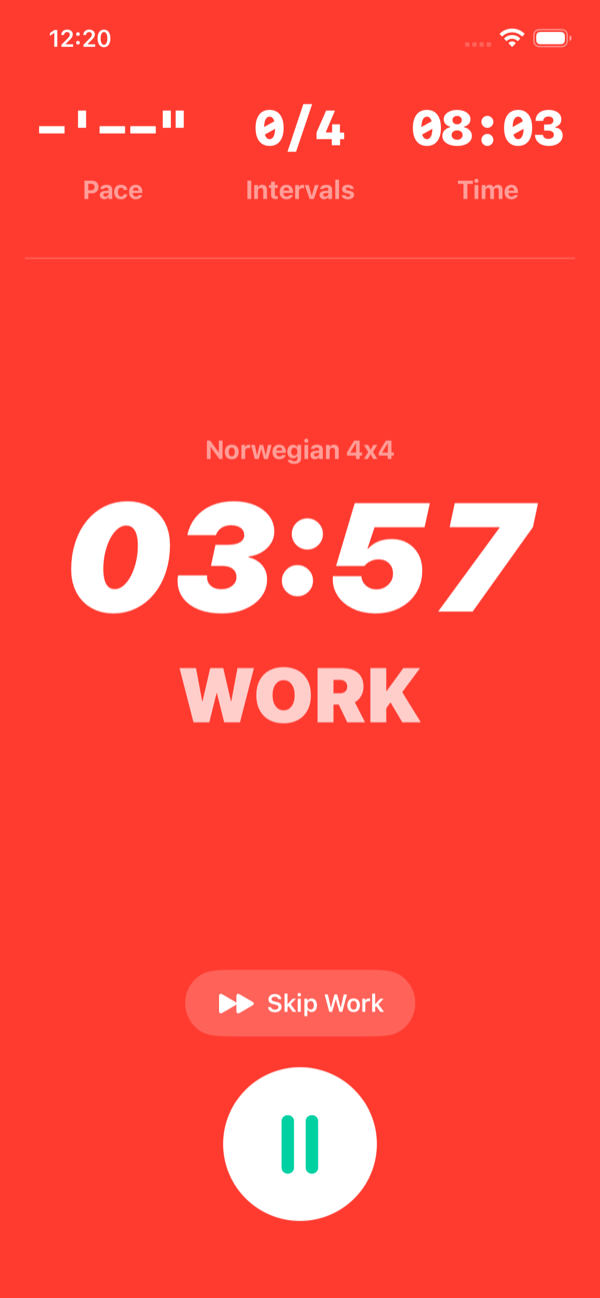
PEAKVO2. The interval app for your cardio fitness.
Run the stamina intervals and the easy endurance sessions on iPhone and Apple Watch, with your target heart rate zone each phase and your VO2 max tracked over time.
Download PEAKVO2Frequently Asked Questions
What is the difference between stamina and endurance?
Endurance is your capacity to sustain a submaximal effort for a long time, like holding an easy running pace for an hour. Stamina is your capacity to sustain a near-maximal effort without fading, like the hard final minutes of a race. Put simply, endurance is about duration at an easy to moderate intensity, while stamina is about holding a high intensity. Both are driven by the same aerobic engine, your VO2 max.
Is stamina the same as endurance?
No, but they overlap. Endurance is sustaining a submaximal effort over time, like holding an easy pace for an hour. Stamina is sustaining a near-maximal effort without fading, like the final hard minutes of a race. In everyday speech the words are used interchangeably, and for most training purposes that is fine, because both are driven by the same aerobic engine.
Which is better to train, stamina or endurance?
Train both with one program. Easy aerobic volume builds endurance directly, and one or two weekly high-intensity interval sessions build stamina directly. The 80/20 split, mostly easy with a little hard, develops both at once because they share the same foundation: your VO2 max. Choosing one over the other leaves the other half of your fitness on the table.
What is the difference between stamina and cardio?
Cardio is a category of exercise, rhythmic activity that elevates your heart rate, like running or cycling. Stamina is a quality you build, the capacity to sustain hard effort without fading. Doing cardio is one of the ways you develop stamina, so the two relate as input and output rather than as competing terms.
Is conditioning the same as stamina?
Not quite. Conditioning is sport-specific work capacity: the ability to meet your sport's particular pattern of efforts and recover between them, like repeated sprints in soccer or hard rounds in boxing. It combines stamina, endurance, and the sport's specific movements. Stamina is one ingredient of conditioning rather than a synonym for it.
How do I increase my stamina?
Add one or two high-intensity interval sessions per week on top of a base of easy aerobic work. A proven session is the Norwegian 4x4: four intervals of four minutes at 90 to 95% of max heart rate with three minutes of easy recovery. In a controlled trial this raised VO2 max, the engine behind stamina, by 7.2% in eight weeks. Keep the remaining sessions genuinely easy so you recover enough to hit the hard ones properly.
What does stamina mean in fitness?
In fitness, stamina means the capacity to sustain effort near your maximum without fading: holding a hard pace, finishing strong, repeating high-effort rounds. It is closely tied to VO2 max, the maximum rate at which your body can use oxygen, because the higher that ceiling sits, the longer any given hard effort can be held below it.
Keep Reading
- How to Build Endurance and Stamina: The Complete Guide
- Cardiovascular Endurance: What It Is and How to Build It
- Norwegian 4x4 Protocol: Proven HIIT to Raise VO2 Max
- Zone 2 Training: The Complete Guide to Building Your Aerobic Base
- Training for Muscular Endurance: Exercises, Programs, and the Science
- VO2 Max by Age: Chart of Normative Scores and What's Good
- How to Improve Your Apple Watch Cardio Fitness Score (VO2 Max)
References
- Helgerud J, Høydal K, Wang E, et al. Aerobic high-intensity intervals improve VO2max more than moderate training. Med Sci Sports Exerc. 2007;39(4):665-671. PubMed
- Milanović Z, Sporiš G, Weston M. Effectiveness of High-Intensity Interval Training (HIT) and Continuous Endurance Training for VO2max Improvements: A Systematic Review and Meta-Analysis of Controlled Trials. Sports Med. 2015;45(10):1469-1481. PubMed
- Seiler S. What is best practice for training intensity and duration distribution in endurance athletes? Int J Sports Physiol Perform. 2010;5(3):276-291. PubMed
- Mandsager K, Harb S, Cremer P, et al. Association of Cardiorespiratory Fitness With Long-term Mortality Among Adults Undergoing Exercise Treadmill Testing. JAMA Netw Open. 2018;1(6):e183605. PubMed