How to Build Endurance and Stamina: The Complete Guide

 Run these workouts on your iPhone, or hands-free on Apple Watch. Get PEAKVO2
 To build endurance and stamina, train your aerobic system with mostly easy volume plus a little high intensity: the 80/20 approach used by endurance athletes. Progress the work gradually, keep recovery days easy, and measure the result with VO2 max. Expect easier breathing within weeks and substantial gains in two to three months.
Stamina vs Endurance: What's the Difference
People use stamina and endurance interchangeably, and for training purposes that is mostly fine, because the same engine drives both. But the words point at slightly different qualities, and separating them makes the training clearer.
Endurance is the ability to sustain a submaximal effort over time: holding an easy running pace for an hour, riding for three, staying on your feet through a long shift. It is limited by how well your body delivers and uses oxygen. Stamina is the ability to sustain a near-maximal output and resist fatigue: keeping the pace when it burns, holding form in the last round, not fading in the final minutes. Both draw on the same aerobic base, and both climb when that base grows.
| Endurance | Stamina | |
|---|---|---|
| What it is | Sustaining a submaximal effort over time | Sustaining near-maximal output and resisting fatigue |
| Intensity | Low to moderate, conversational | High, hard to hold |
| Limited mainly by | Oxygen delivery and aerobic efficiency | How long you can hold effort near your ceiling |
| Everyday example | A long, steady hike | The last kilometer of a race at full effort |
| Shared foundation | The aerobic engine, measured as VO2 max | |
The practical point is that you do not train them with two separate programs. A bigger aerobic engine raises your endurance floor and your stamina ceiling at the same time. So the rest of this guide is about building that one engine, and the distinction fades once you understand what sits underneath both. For a deeper look at the definitions, including where cardio and conditioning fit, see stamina vs endurance.
The One System Behind Both: Your Aerobic Engine (VO2 max)
Cardiovascular endurance is your body's capacity to take in oxygen, move it through the blood, and use it in the muscles to produce energy. When you run out of breath early, the limit is usually not your legs. It is that oxygen chain: the heart pumping blood, the lungs loading it, and the aerobic machinery inside the muscle cells burning fuel with it. Train the chain and every link gets stronger.
The single best number for this capacity is VO2 max, the maximum rate at which your body can use oxygen, expressed in milliliters of oxygen per kilogram of body weight per minute. It is the master number for both endurance and stamina because it sets the size of the engine everything else runs on. A higher VO2 max means an easy pace costs less and a hard pace can be held longer.
VO2 max is not fixed and it is not a mystery. It is trainable, and it is measurable. An Apple Watch estimates the same quantity as its cardio fitness score, so you do not need a lab to watch it move. If you want to see where you stand, start with what is a good VO2 max for the age-based norms and how to read your Apple Watch cardio fitness for the number already on your wrist. The rest is knowing how to make it climb.
There is a health reason to care beyond performance. In a study of 122,007 adults, cardiorespiratory fitness predicted long-term survival with no upper limit to the benefit: the fitter you were, the longer you lived, all the way up the scale (Mandsager et al., 2018). The same number that carries you through a long effort also tracks how well you age.
The 80/20 Method
The most common training mistake is running, riding, or rowing every session at the same medium-hard effort. It feels productive because it feels like work, but it leaves you too tired to train often and too fresh at the top end to raise your ceiling. You get stuck in the middle, accumulating fatigue without adaptation.
The fix is how you distribute intensity across the week. When researchers looked at how elite endurance athletes actually train, the pattern was remarkably consistent: roughly 80% of sessions at low intensity and about 20% at high intensity (Seiler, 2010). That split is the backbone of endurance training across every aerobic sport.
It works because the two halves do different jobs. The large easy volume builds the aerobic base, the oxygen-delivery plumbing, while keeping fatigue low enough to train consistently week after week. Consistency is what compounds. The small hard share sharpens the top end and pushes VO2 max, but only works when it lands on a body that is otherwise recovered. Flip the ratio, make most sessions hard, and you lose the volume that builds the base and the freshness that makes hard days productive.
The discipline is not the hard days. It is keeping the easy days genuinely easy, which most people fail at. Easy means conversational: about 60 to 70% of your max heart rate, a pace at which you can speak a full sentence without gasping. That will feel too slow at first, and the slowness is the point. The full case for this large easy base is in zone 2 training.
How Much Hard Training, and What Kind
The hard 20% is small but it does specific work, and the format matters. One or two high-intensity sessions per week is enough for most people, added on top of the easy base rather than replacing it. More than that and you erode the recovery the easy volume is protecting.
Intervals move VO2 max the most per session. Instead of a steady moderate effort, you alternate hard work near your ceiling with recovery, which lets you accumulate more time at a high percentage of VO2 max than a continuous effort would allow. The best-studied version is the Norwegian 4x4: four intervals of four minutes at 90 to 95% of max heart rate, each followed by three minutes of easy recovery. In already-trained subjects it raised VO2 max by 7.2% in eight weeks, more than moderate continuous training over the same period (Helgerud et al., 2007).
The broader evidence agrees, with an honest nuance. A systematic review and meta-analysis found high-intensity interval training raised VO2 max by 5.5 mL/kg/min on average, compared with 4.9 for continuous endurance training (Milanović et al., 2015). A separate meta-analysis focused on interval training alone found an average gain of 0.51 L/min (Bacon et al., 2013). Intervals win, but the margin over steady aerobic work is modest, which is exactly why the answer is both: mostly easy volume for the base, a little interval work for the ceiling.
To turn the target into numbers, estimate your max heart rate with the Tanaka formula, 208 minus (0.7 times your age). A 40-year-old has an estimated max of 180 bpm, so interval work at 90 to 95% sits at roughly 162 to 171 bpm, while easy zone 2 sits at 108 to 126 bpm. For the full protocol and how to slot it into a week, see the Norwegian 4x4 protocol, and if intervals are new to you, start with interval training for beginners.
How Long Until You See Results
Endurance and stamina build faster than most people expect, then keep building for months. Here is a realistic timeline if you train consistently and keep the easy days easy.
Weeks 1 to 2. Little visible change, and possibly some fatigue as your body adjusts to the new load. The win here is building the habit, not hitting a performance mark.
Weeks 3 to 4. The first clear signal: the same easy effort feels easier, your breathing settles sooner, and you can go longer before wanting to stop. This is your aerobic base taking hold.
Weeks 8 to 12. Substantial gains. Efforts that felt long become routine, and your VO2 max or Apple Watch cardio fitness score should show a measurable climb. In one 12-week study, previously untrained men who ran moderate continuous sessions raised their relative VO2 max by about 21.5% (Milanović et al., 2015). That is the size of change on the table when you start from a low base and train steadily.
Comparing single sessions is noisy, because sleep, heat, and stress all move a day-to-day effort around. The honest proof is the trend line over four and twelve weeks. Watching that number climb is the clearest sign the plan is working, and it is what keeps the easy days feeling worthwhile when they feel too slow.
Build Endurance and Stamina with PEAKVO2
The method has two moving parts you have to get right, and a third that tells you it is working: run the easy 80% in the right zone, run the hard 20% as real intervals, and watch your VO2 max climb over the weeks. PEAKVO2 measures your endurance as VO2 max and runs both kinds of session hands-free, so your attention stays on the effort instead of a screen.
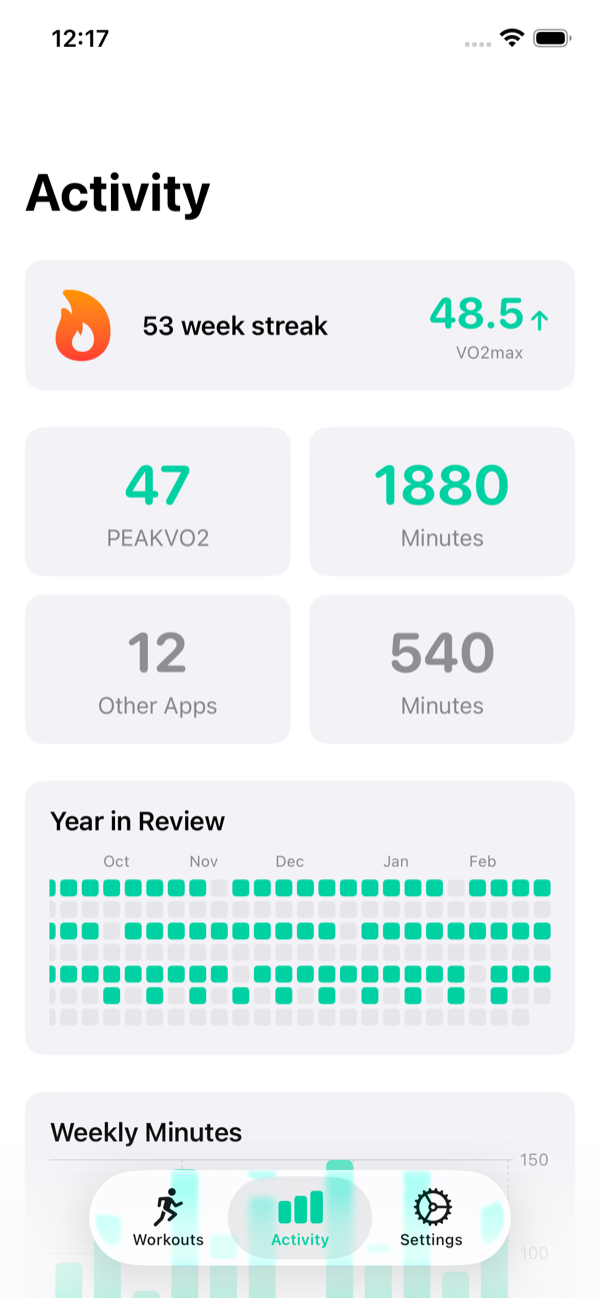
On iOS and Apple Watch, it guides zone 2 and interval protocols with automatic phase transitions, a haptic tap at your wrist at every transition, the target heart rate zone shown for the current phase, and your VO2 max tracked over time.
Endurance for Your Sport
The aerobic engine is shared, so the base you build transfers across sports. What changes is the specific movement and the workouts that develop it.
Running. The most common entry point, and the one with the most to get wrong on pacing. The full method, with exact heart rate targets, a run/walk on-ramp, and a distance progression, is in the deep-dive spoke: how to build endurance for running.
Cycling, rowing, and team sports. The same 80/20 logic applies: mostly easy volume, a little hard interval work. A cyclist builds the base with long easy rides, a rower with steady aerobic pieces, a soccer or basketball player with the running volume under their sport. Because the engine is shared, training one aerobic activity raises your capacity for the others, which is why cross-training builds real fitness rather than just spreading it thin.
This guide is the method, not the session catalog. For ten ready-to-run aerobic sessions across easy and hard efforts, see endurance training workouts. One thing worth separating out: muscular endurance, the ability of a specific muscle to repeat contractions, is a distinct quality trained with reps rather than aerobic volume, and it is covered in muscular endurance training.
Common Mistakes
Training too hard on easy days. The single biggest error. If your easy sessions drift into a medium-hard effort, you get the fatigue of hard training without the recovery of easy training, and you stall in the middle. Hold the zone 2 ceiling even when it feels slow.
No progression. Doing the same session at the same effort for months stops working after the first few weeks. The body adapts to what it has already met. Add a little volume, or a little intensity to the hard days, over time.
Chasing one session over consistency. A single heroic effort followed by a week off builds less than three steady sessions a week for two months. The aerobic base is built by repetition, not by any single workout.
Ignoring recovery. The hard 20% only pays off on a recovered body. Skipping easy weeks, cutting sleep, and stacking hard days back to back turn training stimulus into accumulated fatigue, and the number stops climbing.
PEAKVO2. The interval app for your cardio fitness.
Build your aerobic base and run the interval sessions on iPhone and Apple Watch, with your target heart rate zone each phase and your VO2 max tracked over time.
Download PEAKVO2Frequently Asked Questions
What's the difference between stamina and endurance?
Endurance is sustaining a submaximal effort over time, like holding an easy pace for an hour, and is limited mainly by how well your body delivers and uses oxygen. Stamina is sustaining a near-maximal output and resisting fatigue, like holding hard effort in the final minutes. Both rest on the same aerobic engine, measured as VO2 max, so a single program that grows that engine improves both at once.
How long does it take to build endurance and stamina?
You will feel a clear difference in 3 to 4 weeks of consistent training: the same easy effort feels easier and you can go longer before stopping. Substantial gains come by 8 to 12 weeks. In one study, previously untrained men raised their VO2 max by about 21.5% over 12 weeks of structured running. Consistency matters more than any single hard session.
Can you build endurance and stamina at the same time?
Yes. They share one foundation, the aerobic engine measured as VO2 max, so you do not need separate programs. The 80/20 method builds both at once: mostly easy aerobic volume raises your endurance floor, and a small share of high-intensity interval work raises your stamina ceiling. A bigger engine makes easy efforts cheaper and hard efforts holdable for longer.
How often should I train to build endurance and stamina?
Three to five sessions a week works well for most people. Keep the majority genuinely easy and add one or two high-intensity interval sessions on nonconsecutive days. That follows the 80/20 split used by endurance athletes: about 80% of your training at low intensity and 20% hard. Keeping the easy days easy is what lets you train often enough for the base to compound.
Is walking enough to build endurance?
Walking builds real aerobic fitness if you are starting from a low base or returning after time off, especially brisk walking that lifts your heart rate. As you get fitter, walking alone stops being enough stimulus to keep improving, because your body adapts to it. At that point you add easy jogging or run/walk intervals, then eventually a little interval work, to keep the number climbing.
How do I measure my endurance?
VO2 max is the best single measure, the maximum rate at which your body can use oxygen. A lab test is the gold standard, but an Apple Watch estimates the same quantity as its cardio fitness score, so you can track it for free over weeks and months. Watch the four-week and twelve-week trend rather than day-to-day readings, which are noisy from sleep, heat, and stress.
How can I increase my stamina?
Add high-intensity interval training to a base of easy aerobic work. Two to three interval sessions a week, such as the Norwegian 4x4 (four 4-minute efforts at 90 to 95 percent of max heart rate with 3-minute recoveries), raise the aerobic ceiling that stamina depends on, while easy zone 2 volume on the other days lets you recover and train often. Most people feel more stamina within 3 to 4 weeks and see measurable gains by 8 to 12 weeks.
How can I increase my endurance?
Build your easy aerobic base first, then add a little intensity. Around 80 percent of your training should be easy zone 2 work, which grows the mitochondria and capillaries behind endurance, and the remaining 20 percent high-intensity intervals that lift your VO2 max. This 80/20 split increases how long you can sustain effort. Consistency, three to five sessions a week, matters more than any single hard workout.
Keep Reading
- Zone 2 Training: The Complete Guide to Building Your Aerobic Base
- Norwegian 4x4 Protocol: Proven HIIT to Raise VO2 Max
- Interval Training for Beginners: What It Is and How to Start
- How to Build Endurance for Running: The 80/20 Method with Heart Rate Targets
- Endurance Training Workouts: 10 Sessions to Build Lasting Fitness
- Training for Muscular Endurance: Exercises, Programs, and the Science
- VO2 Max by Age: Chart of Normative Scores and What's Good
- How to Improve Your Apple Watch Cardio Fitness Score (VO2 Max)
References
- Seiler S. What is best practice for training intensity and duration distribution in endurance athletes? Int J Sports Physiol Perform. 2010;5(3):276-291. PubMed
- Helgerud J, Høydal K, Wang E, et al. Aerobic high-intensity intervals improve VO2max more than moderate training. Med Sci Sports Exerc. 2007;39(4):665-671. PubMed
- Milanović Z, Sporiš G, Weston M. Effectiveness of High-Intensity Interval Training (HIT) and Continuous Endurance Training for VO2max Improvements: A Systematic Review and Meta-Analysis of Controlled Trials. Sports Med. 2015;45(10):1469-1481. PubMed
- Bacon AP, Carter RE, Ogle EA, Joyner MJ. VO2max Trainability and High Intensity Interval Training in Humans: A Meta-Analysis. PLoS One. 2013;8(9):e73182. PubMed
- Milanović Z, Pantelić S, Sporiš G, et al. Health-related physical fitness in healthy untrained men: effects on VO2max, jump performance and flexibility of soccer and moderate-intensity continuous running. PLoS One. 2015;10(8):e0135319. PubMed
- Mandsager K, Harb S, Cremer P, et al. Association of Cardiorespiratory Fitness With Long-term Mortality Among Adults Undergoing Exercise Treadmill Testing. JAMA Netw Open. 2018;1(6):e183605. PubMed