How to Build Endurance for Running: The 80/20 Method with Heart Rate Targets

 Run these workouts on your iPhone, or hands-free on Apple Watch. Get PEAKVO2
 To build running endurance, run more total time each week with most of it genuinely easy: about 80% at a conversational zone 2 pace (60 to 70% of your max heart rate) and a small share hard. Add distance gradually, and avoid big weekly jumps. Expect noticeably easier breathing in 3 to 4 weeks and large gains by 8 to 12.
Why You Run Out of Breath
Endurance is your body's ability to deliver oxygen to working muscles and use it to produce energy. When you gas out early, the limit is usually not your legs but that oxygen delivery system: the heart, lungs, blood, and the aerobic machinery inside your muscle cells. The good news is that every part of it responds to training, and you can measure the result. VO2 max, the maximum rate at which your body can use oxygen, is the single best number for tracking it, and your Apple Watch estimates the same quantity as its cardio fitness score.
Structured aerobic running moves that number a lot in people who are new to it. In one 12 week study, previously untrained men who ran moderate continuous sessions raised their relative VO2 max by about 21.5% (Milanović et al., 2015). So the feeling of running out of breath is not a fixed ceiling. It is a trainable score that climbs as your aerobic base grows. If you want to see where you stand today, start with what is a good VO2 max and how to read your Apple Watch cardio fitness.
The 80/20 Rule: Run Mostly Easy
The most common mistake in new runners is running every run at the same medium hard pace. It feels productive because it feels like work, but it leaves you too tired to run often and too fresh at the top end to raise your ceiling. You end up stuck in the middle.
The fix is intensity distribution. When researchers looked at how elite endurance athletes actually train, the pattern was consistent: roughly 80% of sessions at low intensity and about 20% at high intensity (Seiler, 2010). That split is the backbone of endurance training. The large easy volume builds the aerobic base, the plumbing that delivers oxygen, while keeping fatigue low enough to run consistently. The small hard share sharpens the top end.
For a beginner running three days a week, 80/20 is simple in practice: two runs stay genuinely easy and one carries a harder effort, or in the early weeks all three stay easy while you build the habit. The hard part is not the hard days. It is keeping the easy days easy, which is where heart rate comes in. The full case for easy aerobic volume lives in zone 2 training.
How Easy Is Easy? Your Heart Rate Zones for Running
Easy has to be genuinely easy, and most people run their easy days too hard. A heart rate ceiling turns "easy" from a guess into a number.
Start with your estimated max heart rate using the Tanaka formula:
Max HR = 208 minus (0.7 times your age)
For a 40 year old, that is 208 minus 28, or 180 bpm. Your easy zone 2 runs sit at 60 to 70% of that, which is 108 to 126 bpm for our 40 year old. That will feel almost too slow at first. That slowness is the point: it lets you accumulate the volume that builds endurance without digging a fatigue hole.
Coaches split effort into five zones. Here is what a run in each one does.
| Zone | % of Max HR | What a Run There Does |
|---|---|---|
| Zone 1 | 50-60% | Recovery and warm up; very light effort |
| Zone 2 | 60-70% | Builds the aerobic base; your easy runs live here |
| Zone 3 | 70-80% | Steady tempo; useful but easy to overuse |
| Zone 4 | 80-90% | Threshold work; hard but sustainable for minutes |
| Zone 5 | 90-100% | VO2 max intervals; run these at 90-95% in short bursts |
No chest strap or watch? Use the talk test. In zone 2 you should be able to speak a full sentence out loud without gasping between words. The moment you can only get out a few words at a time, you have drifted into zone 3 and the run is no longer easy. The complete per zone breakdown, with targets for every workout type, is in heart rate zones explained.
Run/Walk: The On-Ramp That Actually Works
If running continuously for more than a few minutes leaves you gasping, do not force it. Timed run/walk intervals let you accumulate real running minutes while your aerobic base catches up, and they keep your heart rate from spiking straight into zone 4.
The structure is simple: run for a set time, walk for a set time, repeat. A common starting point is 1 minute of easy running followed by 2 minutes of walking, repeated 8 times, for a session of 24 minutes plus a warm up. As your base grows over the following weeks, extend the run and shrink the walk: 1 minute run and 1 minute walk, then 2 minutes run and 1 minute walk, until you are running continuously.
Because run/walk is an interval structure, a timer that changes phase for you keeps you honest instead of glancing at a clock mid stride. Our free browser timer takes the run time, walk time, and number of intervals right in the link:
Run/walk preset: 1 min run, 2 min walk, 8 rounds
That link reads as work=60 (the 60 second run), rest=120 (the 120 second walk), rounds=8 (eight run intervals), and countdown=5 (a 5 second lead in before the first run). Change the numbers to match your own progression: for 1 minute run and 1 minute walk, use work=60&rest=60.
Add the Hard Sessions Once Your Base Holds
Once you can run easy for 30 minutes without falling apart, add one, and later two, harder sessions a week. This is the 20% end of the 80/20 split. Keep it small, because the hard work is only useful on top of a solid easy base.
Good options are easy strides, short 30/30 intervals, or the Norwegian 4x4 for the aerobic ceiling. The 4x4 in particular is one of the most efficient ways to raise VO2 max: in trained subjects it lifted VO2 max by 7.2% in eight weeks, more than moderate continuous training over the same period (Helgerud et al., 2007). Run those intervals at 90 to 95% of max heart rate, which is 162 to 171 bpm for our 40 year old example.
This article is the method, not the session catalog. For the actual workouts, paces, and how to slot them into a week, see interval training for running and the Norwegian 4x4 protocol. For a broader menu of aerobic sessions, endurance training workouts has ten ready to run options.
How Fast to Add Distance
More volume builds endurance, but adding it too fast is how new runners get hurt and stall. The advice you will hear everywhere is the "10% rule": never increase weekly mileage by more than 10%. It is reasonable as a nudge toward caution, but it is worth knowing that the evidence does not support that specific number.
A randomized controlled trial built a novice program around the 10% rule and compared it to a standard program. It did not reduce injuries: 20.8% of runners in the graded group were injured versus 20.3% in the control group (Buist et al., 2008). A later study found the real risk signal sits much higher up: novice runners who increased weekly distance by more than 30% had an elevated rate of certain injuries compared with those who increased by less than 10%, while increases in the 10 to 30% range showed no clear excess risk (Nielsen et al., 2014).
The practical takeaway is not a precise percentage to obsess over. Increase gradually, avoid big weekly jumps, and every third or fourth week hold volume flat or drop it to let your body absorb the work. Progress your time on feet, and let 10% be a rough guide rather than a rule.
A Realistic Timeline
Endurance builds faster than most people expect, then keeps building for months. Here is what to expect if you run consistently and keep the easy days easy.
Weeks 1 to 2. Little visible change, and possibly some fatigue as your body adjusts to the new habit. The win here is consistency, not performance. Your run/walk ratio starts to shift toward more running.
Weeks 3 to 4. The first clear signal: the same easy pace feels easier, your breathing settles sooner, and you can run longer before wanting to stop. This is your aerobic base taking hold.
Weeks 8 to 12. Substantial gains. Distances that felt long become routine, and your VO2 max or Apple Watch cardio fitness score should show a measurable climb. Recall that untrained men added roughly 21.5% to their VO2 max over 12 weeks of structured running (Milanović et al., 2015). Watching that trend line rise is the clearest proof the plan is working.
How to Time and Track Your Runs
Run/walk intervals and hard sessions both need timing, and glancing at a phone mid run breaks your rhythm. The free interval timer runs in any browser and takes your work, rest, and round counts directly in the URL, which is how the run/walk preset above works. It is the no app option: set your phone somewhere audible, press start, and the beeps carry you through the session.
Build Endurance with PEAKVO2 on Apple Watch
The 80/20 method has three moving parts: run easy sessions in the right zone, run the occasional hard interval session, and watch your VO2 max climb over the weeks. PEAKVO2 handles all three on iOS and Apple Watch, hands free, so you can keep your eyes on the road instead of a screen. Here is the loop.
Pick your session
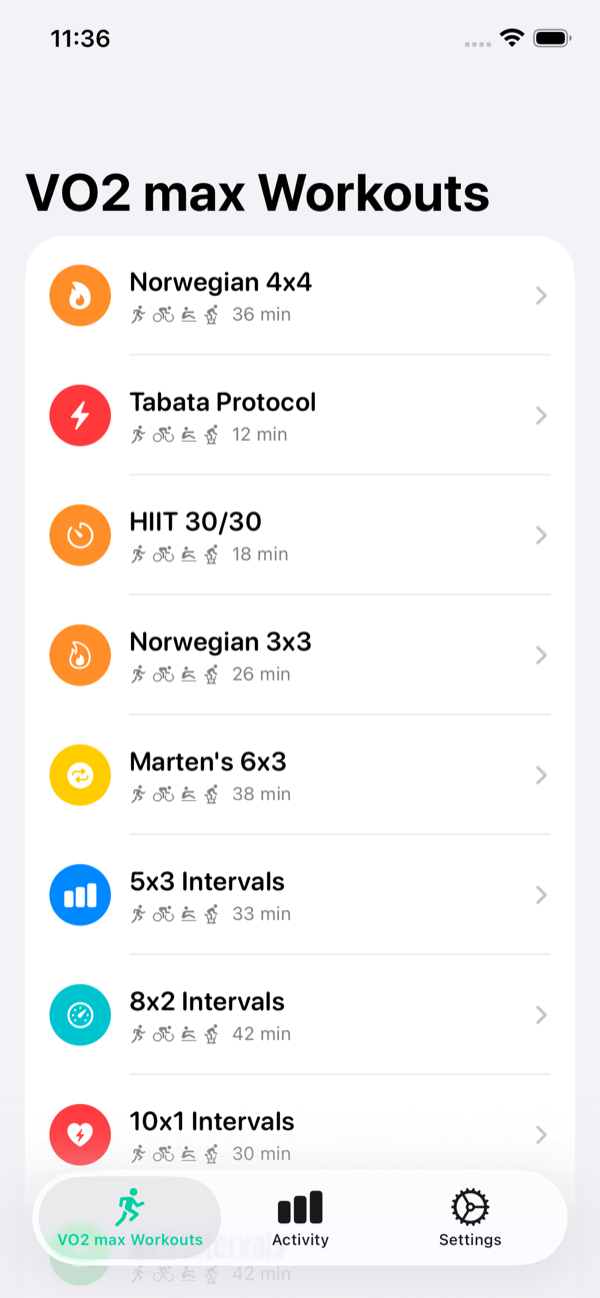
Open the VO2 max Workouts tab and choose what today calls for. For your easy 80%, start a zone 2 session and hold the aerobic ceiling. For your hard 20%, pick the Norwegian 4x4 or a shorter interval protocol. Each one has built-in warm-up, work, recovery, and cooldown phases, so the structure is set before you start.
Run it hands free
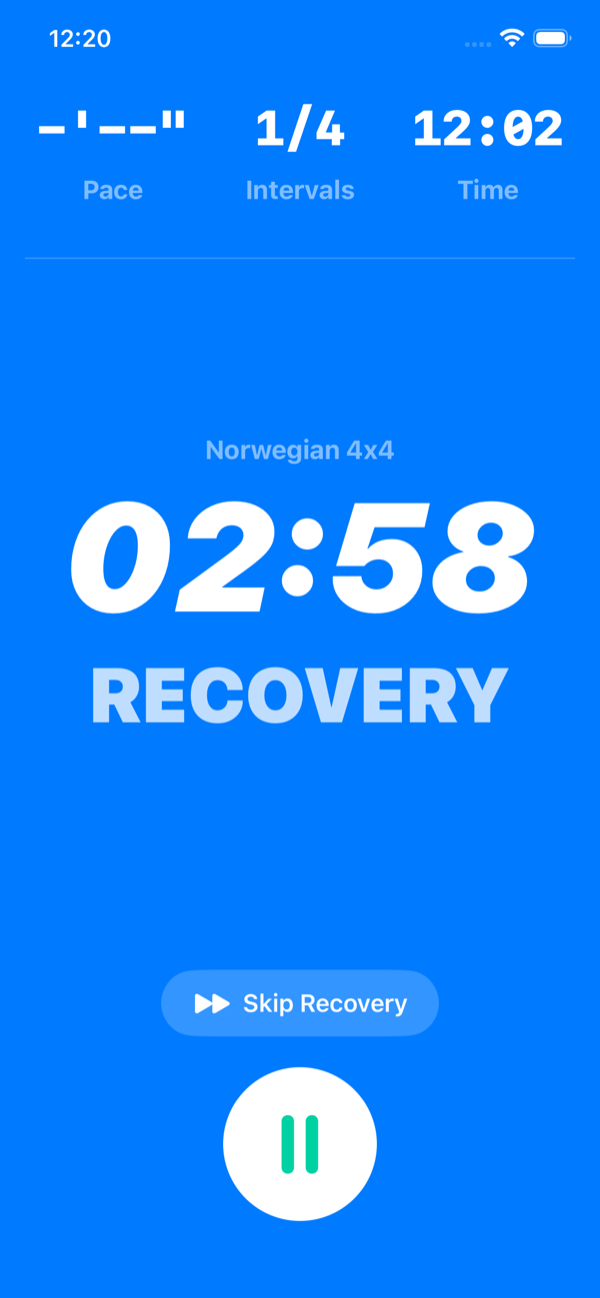
With your Apple Watch paired, the session runs on your wrist. The phase color tells you what to do without reading a number, the countdown sits in the center, and a haptic taps your wrist at every transition so you never have to look down mid stride. Continuous heart rate from the watch shows whether you are actually holding your target zone, which is the whole point of running easy days easy.
Watch the number climb
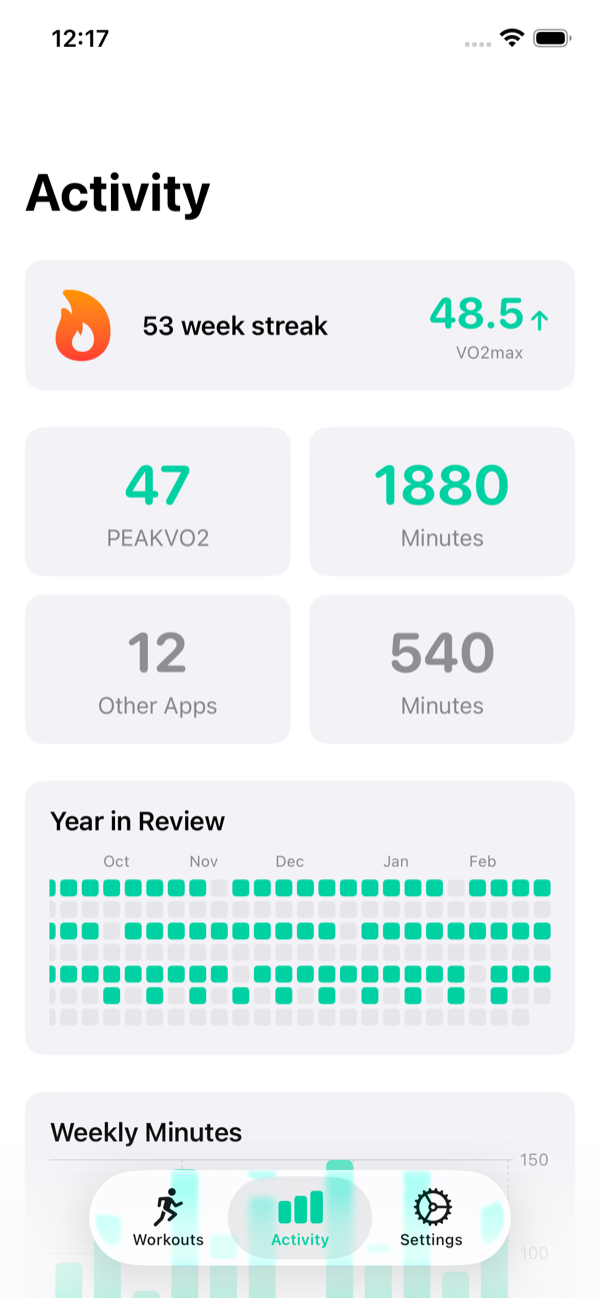
Endurance is a trainable score, and the Activity tab is where you see it move. It tracks your estimated VO2 max trend and your session streak over weeks and months. Comparing single runs is noisy; the 4-week and 12-week trend line is the honest proof that the plan is working.
PEAKVO2. The interval app for your cardio fitness.
PEAKVO2 runs your run/walk and interval sessions on Apple Watch with automatic phase changes, a haptic tap at every transition, and your target heart rate zone on the same wrist.
Download PEAKVO2Common Mistakes
Running easy days too hard. The single biggest one. If your easy runs sit in zone 3, you get the fatigue of hard training without the recovery of easy training. Hold the zone 2 ceiling even when it feels slow.
Adding mileage too fast. Big weekly jumps invite injury and burnout. Increase gradually and take easier weeks.
Chasing pace instead of time on feet. Early endurance is built by minutes spent running easy, not by hitting a faster split. Track duration first and let pace improve on its own.
Skipping consistency. Three steady runs a week for two months beats a heroic long run followed by a week off. The aerobic base is built by repetition.
Frequently Asked Questions
How long does it take to build running endurance?
You will feel a clear difference in 3 to 4 weeks of consistent running: the same easy pace feels easier and you can go longer before wanting to stop. Substantial gains come by 8 to 12 weeks. In one study, untrained men raised their VO2 max by about 21.5% over 12 weeks of structured running. Consistency matters more than any single hard session.
How do I run without getting tired or stopping?
Slow down. Most new runners run their easy runs too hard, which burns them out early. Keep your heart rate at 60 to 70% of your max, a pace at which you can speak a full sentence without gasping. If continuous running still leaves you gasping, use run/walk intervals, running 1 minute and walking 1 to 2 minutes, and build the running share over the weeks.
Is it better to run longer or faster to build endurance?
Longer, mostly. Endurance is built by accumulating easy aerobic volume, so most of your running should be slow and long rather than fast. The proven split is about 80% easy and 20% hard. Add speed in small doses through one or two hard sessions a week only once your easy base is solid. Chasing pace on every run stalls progress.
How often should a beginner run?
Three days a week on nonconsecutive days is a solid start. It gives enough stimulus to build endurance while leaving recovery days that protect against injury. Keep the runs easy at first, or use run/walk intervals, and add a fourth day only once three feels comfortable.
Does walking build running endurance?
Yes, especially early on. Timed run/walk intervals let you accumulate real running minutes while keeping your heart rate out of the red, which builds your aerobic base without the fatigue and injury risk of forcing continuous running. As your base grows, you shrink the walk and extend the run until you are running continuously.
What heart rate should I run at?
For easy endurance runs, 60 to 70% of your max heart rate. Estimate your max as 208 minus 0.7 times your age, so a 40 year old has a max near 180 bpm and an easy zone of about 108 to 126 bpm. Save 90 to 95% of max for short interval sessions, which should make up only a small share of your weekly running.
Keep Reading
- How to Build Endurance and Stamina: The Complete Guide
- Zone 2 Training: The Complete Guide to Building Your Aerobic Base
- Heart Rate Zones Explained: What Your Heart Rate Should Be in Each Workout
- Interval Training for Running: Workouts, Programs, and Plans
- Endurance Training Workouts: 10 Sessions to Build Lasting Fitness
- Norwegian 4x4 Protocol: Proven HIIT to Raise VO2 Max
- How to Improve VO2 Max: The Complete Evidence-Based Guide
- VO2 Max by Age: Chart of Normative Scores and What's Good
- How to Improve Your Apple Watch Cardio Fitness Score (VO2 Max)
References
- Seiler S. What is best practice for training intensity and duration distribution in endurance athletes? Int J Sports Physiol Perform. 2010;5(3):276-291. PubMed
- Helgerud J, Høydal K, Wang E, et al. Aerobic high-intensity intervals improve VO2max more than moderate training. Med Sci Sports Exerc. 2007;39(4):665-671. PubMed
- Milanović Z, Pantelić S, Sporiš G, et al. Health-related physical fitness in healthy untrained men: effects on VO2max, jump performance and flexibility of soccer and moderate-intensity continuous running. PLoS One. 2015;10(8):e0135319. PubMed
- Nielsen RO, Parner ET, Nohr EA, et al. Excessive progression in weekly running distance and risk of running-related injuries: an association which varies according to type of injury. J Orthop Sports Phys Ther. 2014;44(10):739-747. PubMed
- Buist I, Bredeweg SW, van Mechelen W, et al. No effect of a graded training program on the number of running-related injuries in novice runners: a randomized controlled trial. Am J Sports Med. 2008;36(1):33-39. PubMed