Rowing Machine Workout: 7 Sessions With Splits, Stroke Rate, and Heart Rate Targets
 Run these workouts on your iPhone, or hands-free on Apple Watch. Get PEAKVO2
 A good rowing machine workout is 20 to 30 minutes on a damper setting of 3 to 5, at 24 to 30 strokes per minute, with hard pieces at 85 to 95 percent of your maximum heart rate. In studies, 4 to 8 weeks of interval rowing raised VO2 max by 7 to 15 percent. The seven sessions below run from a 20 minute steady row to Norwegian 4x4 intervals, each with its split per 500 m, stroke rate, heart rate target and timer setup.
Most rowing workouts online say "row hard for a minute" and leave out the numbers on the monitor that define the effort. This guide gives you those numbers for each session, plus the stroke, the damper, the monitor, and what the research says rowing does for your fitness.
Contents: The stroke · Damper · The monitor · Pace by level · 7 workouts · Which workout · Fitness benefits · Calories · FAQ
How Do You Row on a Rowing Machine Correctly?
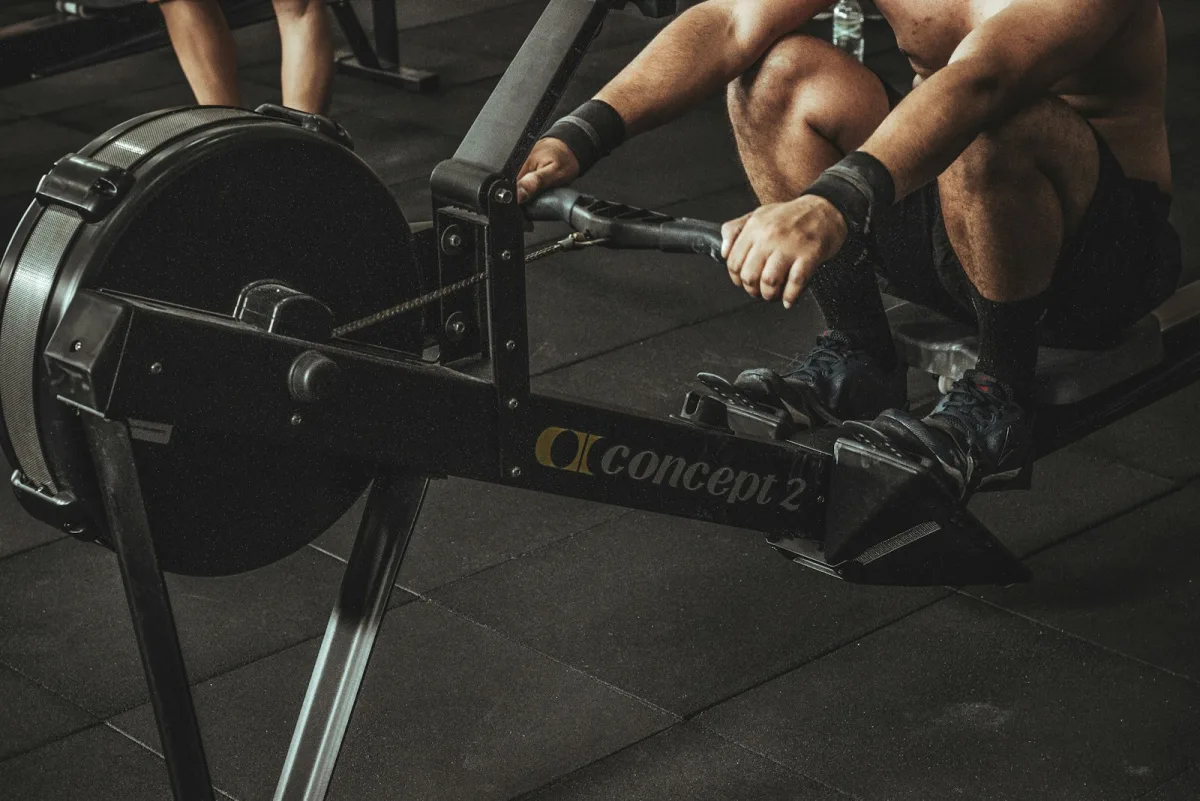
The stroke has two halves. The drive is the work, the recovery is the rest that sets up the next drive. Concept2's technique guide describes the drive as: "Start the drive by pressing with your legs, and then swing the back through the vertical position before finally adding the arm pull." The recovery is the exact reverse: arms straighten first, then you lean from the hips toward the flywheel, then the knees bend and the seat slides forward.
| Position | What it looks like |
|---|---|
| Catch | Arms straight, shoulders level, shins vertical or close to it, never past vertical |
| Drive | Legs push first, then the back swings past vertical, then the arms pull |
| Finish | Legs extended, slight lean back, handle held lightly below the ribs |
| Recovery | Arms away, then body over, then knees bend; handle clears the knees before they rise |
The three mistakes Concept2 lists first, and the ones you will see in any gym:
- Pulling with the arms too early. The big muscles are in the legs. If the arms bend before the legs are nearly straight, you lose the strongest part of the stroke.
- Lifting with the back. Shoulders and legs should start the stroke together. Opening the back before the legs push loads the lower back and does nothing for speed.
- Bending the knees early on the recovery. Hands have to clear the knees before the knees come up. Early knees force the handle up and over them and wreck the rhythm.
Concept2's advice for beginners is to not pull hard until the sequence is comfortable. Two weeks of easy rowing at 20 to 24 strokes per minute beats any interval session on a broken stroke.
What Damper Setting Should You Use?
The damper lever (1 to 10) controls how much air enters the flywheel housing. More air means the flywheel slows down faster between strokes, which the monitor measures as the drag factor. In Concept2's words, at a damper of 1 to 4 the machine "feels like a sleek racing shell; at the higher numbers, the indoor rower feels like a slow rowboat."
Two things follow from that:
- A high damper is not a harder workout. It changes how the stroke feels, not how much work you do. Watts and split measure the work. Concept2 recommends starting at 3 to 5 and warns that too high a setting "can exhaust your muscles before you reap the full cardiovascular benefit rowing provides."
- Compare drag factor, not damper numbers. A new Concept2 RowErg reads a drag factor of 90 or less at damper 1 and 200 or more at damper 10, but dust in the housing and altitude move those numbers, so a "5" on one machine is a "4" on another. The PM5 shows drag factor under More Options. Olympic champions interviewed by Concept2 row at 112 to 130 and call 120 to 135 the normal range.
Set damper 3 to 5, check that drag factor sits between about 100 and 135, and leave it there for every session below.
How Do You Read the Rowing Machine Monitor?
Three numbers matter:
- Split (/500m). The time it would take to row 500 m at your current pace. Lower is faster. A 2:00 split is 1,000 m in 4 minutes.
- Stroke rate (spm). Strokes per minute. Concept2 calls 24 to 28 comfortable for steady state and 30 to 36 right for intervals and racing distances up to 2,000 m. Their key sentence: "the intensity of your workout isn't determined by how high your cadence is; it's based on how hard you're pulling."
- Watts. Power per stroke, independent of stroke rate. Concept2's monitor converts with the formula watts = 2.80 / pace³, where pace is seconds per meter. A 2:05 split equals 179 watts.
Because split and watts are tied to each other by that formula, you can translate between them:
| Watts | Split per 500 m | Compendium intensity label |
|---|---|---|
| 75 | 2:47 | moderate (below 100 W) |
| 100 | 2:32 | vigorous |
| 125 | 2:21 | vigorous |
| 150 | 2:13 | vigorous |
| 175 | 2:06 | vigorous |
| 200 | 2:00 | very vigorous |
| 250 | 1:52 | very vigorous |
| 300 | 1:45 | very vigorous |
Splits are computed from the Concept2 formula; labels follow the 2024 Compendium of Physical Activities (Herrmann et al., 2024).
What Split Should You Row by Level?
Pace on a rower is personal. The honest anchor is your own 2,000 m test split, which is why rowing coaches prescribe interval paces relative to it. If you have never done a 2k, use heart rate and the bands below, then test after four weeks.
| Level | Hard interval split | Easy or recovery split | Steady state split |
|---|---|---|---|
| Beginner | 2:16 to 2:32 (about 100 to 140 W) | 2:50 or slower | 2:35 to 2:50 |
| Intermediate | 2:00 to 2:13 (about 150 to 200 W) | 2:35 or slower | 2:15 to 2:30 |
| Advanced | 1:45 to 2:00 (about 200 to 300 W) | 2:20 or slower | 2:00 to 2:12 |
The watt ranges are the Compendium's vigorous and very vigorous bands converted to splits; the level labels are a starting point. The test of a correct hard split is that you hold it on the last interval. If you fade, add 5 seconds per 500 m next time.
Heart rate targets below are percentages of your maximum. Estimate it as 208 minus 0.7 times your age (Tanaka et al., 2001) or use the target heart rate calculator. One rowing-specific caveat: in a lab comparison of 15 older men, maximal heart rate was 171 bpm on the rowing ergometer versus 177 bpm on the treadmill, and 151 versus 160 bpm at the same lactate level, even though oxygen uptake was higher while rowing (Yoshiga et al., 2003). If your zones come from running, expect to sit a few beats lower on the rower at the same effort.
The 7 Rowing Machine Workouts
Every session assumes a 5 minute warm-up at 20 to 22 spm building from easy to steady pace, and a 3 minute cooldown at easy pace. Program the work and rest in the free interval timer so your eyes stay on the split and not the clock.
1. Steady State Row (Beginner, Aerobic Base)
The foundation session, and the one to do most often. It builds the aerobic base that makes the hard sessions below productive, in the same way zone 2 training does for runners.
| Phase | Stroke rate | Split guidance | Heart rate | Duration |
|---|---|---|---|---|
| Steady row | 22 to 26 spm | Steady state split for your level | 65 to 75% HRmax | 20 to 30 minutes |
Rounds: 1 Total time: 20 to 30 minutes Timer setup: Set the interval timer to one 20 to 30 minute work block, or use 5 minute blocks as a reminder to check split and posture.
You should be able to speak in full sentences throughout. Add 5 minutes a week up to 40, then lower the split at the same heart rate.
2. One On, One Off (Beginner Intervals)
The first interval session. One minute gives you time to settle into a rhythm, and the full minute of easy rowing lets heart rate drop before the next piece.
| Phase | Stroke rate | Split guidance | Heart rate | Duration |
|---|---|---|---|---|
| Hard | 26 to 28 spm | Hard interval split, upper end of your band | 75 to 85% HRmax | 60 seconds |
| Easy | 20 to 22 spm | Easy split | below 70% HRmax | 60 seconds |
Rounds: 10 Total time: 20 minutes Timer setup: 60 seconds work, 60 seconds rest, 10 rounds.
Row the easy minute; do not stop, because restarting the flywheel wastes the first strokes of every piece. Once all 10 hard minutes land within 3 seconds of each other, move to workout 3. See also interval training for beginners.
3. The 30/30 Row (Intermediate)
Equal work and rest, the most versatile interval format on any machine. Thirty seconds is long enough to reach a real split and short enough to repeat 20 times. The 30/30 format is a staple for a reason.
| Phase | Stroke rate | Split guidance | Heart rate | Duration |
|---|---|---|---|---|
| Hard | 28 to 32 spm | Hard interval split, 3 to 5 s faster than workout 2 | 85 to 92% HRmax | 30 seconds |
| Easy | 20 to 22 spm | Easy split | recovering | 30 seconds |
Rounds: 16 to 20 Total time: 16 to 20 minutes Timer setup: 30 seconds work, 30 seconds rest, 16 to 20 rounds.
Heart rate lags on 30 second pieces and plateaus after about five rounds, so judge the early rounds by split and the later rounds by heart rate.
4. Tabata Row, 20/10 (Intermediate to Advanced, Short Sprints)
Eight rounds of 20 seconds all-out with 10 seconds off takes 4 minutes. On the rower the 10 seconds is barely enough to let the handle come to rest, which is the point. Two blocks with a full recovery between them is a complete Tabata session.
| Phase | Stroke rate | Split guidance | Heart rate | Duration |
|---|---|---|---|---|
| All-out | 32 to 36 spm | As fast as you can hold for 20 s; expect 10 to 15 s faster than your hard interval split | climbing to 90%+ HRmax by round 5 | 20 seconds |
| Off | paddle or rest | none | recovering | 10 seconds |
| Between blocks | 20 spm | Easy split | below 70% HRmax | 4 minutes |
Rounds: 8 per block, 2 blocks Total time: 12 minutes (two 4 minute blocks plus 4 minutes between) Timer setup: 20 seconds work, 10 seconds rest, 8 rounds; repeat once after a 4 minute break.
Keep the stroke sequence even when sprinting; rushing the slide and pulling with the arms is where Tabata on a rower goes wrong.
5. Norwegian 4x4 Row (VO2 Max)
Four minutes hard, three minutes easy, four times. This protocol improved VO2 max by 7.2 percent in 8 weeks in the original running study, against 5.5 percent for 15/15 intervals matched for total work (Helgerud et al., 2007). The full method is in the Norwegian 4x4 protocol guide.
| Phase | Stroke rate | Split guidance | Heart rate | Duration |
|---|---|---|---|---|
| Hard | 26 to 30 spm | Hard interval split, the pace you can hold 4 times; roughly your 2k split plus 8 to 12 s | 85 to 95% HRmax, reached by minute 2 | 4 minutes |
| Easy | 20 to 22 spm | Easy split | about 70% HRmax | 3 minutes |
Rounds: 4 Total time: 28 minutes (25 minutes if you shorten the last recovery) Timer setup: 4 minutes work, 3 minutes rest, 4 rounds.
Heart rate, not split, decides whether the interval counted: you want the last two minutes of each piece above 85 percent. If you hit 95 percent in minute one, the split is too fast. Hold the first interval 3 seconds slower than you think you should. For easier versions, see Norwegian 4x4 for beginners.
6. The Pyramid, 1-2-3-4-3-2-1 (Advanced)
Work pieces grow to four minutes and shrink again, with short rests after the short pieces and longer rests after the long ones, so the structure forces pacing. Sixteen minutes of hard rowing in total.
| Phase | Stroke rate | Split guidance | Heart rate | Duration |
|---|---|---|---|---|
| 1 min piece | 30 to 32 spm | Hard interval split minus 3 to 5 s | 85 to 90% HRmax | 1 minute |
| 2 min piece | 28 to 30 spm | Hard interval split | 88 to 92% HRmax | 2 minutes |
| 3 min piece | 26 to 28 spm | Hard interval split plus 2 to 3 s | 90 to 93% HRmax | 3 minutes |
| 4 min piece | 26 to 28 spm | 4x4 split | 90 to 95% HRmax | 4 minutes |
| Rest | 20 spm | Easy split | recovering | 1 min after the 1 and 2 min pieces, 2 min after the 3 and 4 min pieces |
Rounds: 7 pieces (1, 2, 3, 4, 3, 2, 1 minutes) Total time: 25 minutes Timer setup: The interval timer supports custom sequences: enter the seven work blocks with their rests in order.
7. Eight by 2.5 Minutes (Advanced, Studied in Rowers)
This is the session from the rowing studies. Competitive rowers who did 8 intervals of 2.5 minutes at 90 percent of the speed at VO2 peak, with recovery until heart rate fell to 70 percent of maximum, improved relative VO2 peak by 7.0 percent and 2,000 m time by 1.9 percent in 4 weeks and 7 sessions (Driller et al., 2009). An 8 week study used 6 to 8 by 2.5 minutes at 100 percent of peak power with the same recovery rule and found greater gains in VO2 max and lactate threshold power than high-volume training (Ní Chéilleachair et al., 2017).
| Phase | Stroke rate | Split guidance | Heart rate | Duration |
|---|---|---|---|---|
| Hard | 28 to 32 spm | Close to your 2k split; roughly 2k plus 2 to 5 s | 90 to 95% HRmax | 2 minutes 30 seconds |
| Recovery | 18 to 20 spm | Easy split | row until HR drops to 70% HRmax (usually 2 to 3 minutes) | variable |
Rounds: 6 to 8 Total time: 28 to 40 minutes Timer setup: 2:30 work, 2:30 rest, 6 to 8 rounds; extend a rest if your heart rate has not reached 70 percent when the beep sounds.
The heart rate based recovery is the detail that makes this work, and the reason it needs a chest strap or watch. PEAKVO2 runs this kind of session on Apple Watch with the target heart rate for each phase on screen.
Which Rowing Workout for Which Goal?
| Goal | Workout | How often |
|---|---|---|
| Learn to row, build a base | 1 (steady state) | 3 times a week |
| First intervals, general fitness | 2 (one on, one off) | 1 to 2 times, plus 1 steady row |
| Fitness in little time | 3 (30/30) or 4 (Tabata) | 2 times, plus 1 steady row |
| Raise VO2 max | 5 (Norwegian 4x4) or 7 (8 by 2.5 min) | 2 times, plus 1 or 2 steady rows |
| Pacing and mental toughness | 6 (pyramid) | 1 time, in place of a 4x4 |
| Faster 2,000 m | 7, with 5 as the second hard session | 2 hard sessions a week, 6 to 8 weeks |
| Hyrox or race prep | 3 and 6, then transition to running off the rower | see Hyrox training |
Two hard sessions a week is the ceiling for most people. The rowers in the 2017 study did 2 interval sessions and 8 easy sessions a week.
What Does Rowing Do for Your Fitness?
Rowing "involves almost all muscles during the stroke" and competitive rowing "requires a large oxygen uptake", which is how a comprehensive review of rowing physiology sums it up (Volianitis et al., 2020). That is the reason rowing is the strongest choice for raising VO2 max without running: more working muscle demands more oxygen per minute.
The training studies back it up:
- Trained rowers, 4 weeks: 7 sessions of 8 by 2.5 minutes raised relative VO2 peak by 7.0 percent and 2,000 m power by 5.8 percent, more than traditional training (Driller et al., 2009).
- Trained rowers, 8 weeks: two HIIT sessions a week in place of two aerobic sessions produced greater gains in VO2 max (effect size 0.95) and lactate threshold power (effect size 1.15) (Ní Chéilleachair et al., 2017).
- Men with obesity and type 2 diabetes, 8 weeks: three weekly interval sessions alternating rowing and cycling raised VO2 max by 8 to 15 percent, improved insulin sensitivity by 30 to 40 percent, reduced fat mass and increased lean mass, with adherence above 95 percent and no injuries (Petersen et al., 2022).
- Rowing versus the bike for all-out sprints: in 20 active adults doing three 20 second all-out sprints, rowing reached the same peak heart rate as cycling (98 versus 95 percent of maximum) with lower blood lactate, lower perceived exertion and higher enjoyment (Clausen and Astorino, 2026). If REHIT on a bike feels miserable, try it on the rower.
The gains match what HIIT on a treadmill delivers, without the impact.
How Many Calories Does Rowing Burn?
The 2024 Adult Compendium of Physical Activities assigns stationary rowing 5.0 METs below 100 watts, 7.5 METs at 100 to 149 watts, 11.0 METs at 150 to 199 watts, and 14.0 METs at 200 watts or more (Herrmann et al., 2024). One MET is 3.5 mL of oxygen per kg per minute, which converts to about MET x 3.5 x body weight in kg / 200 kcal per minute.
| Average watts (split) | METs | 30 minutes at 135 lb (61 kg) | 30 minutes at 165 lb (75 kg) | 30 minutes at 200 lb (91 kg) |
|---|---|---|---|---|
| below 100 W (slower than 2:32) | 5.0 | 160 kcal | 197 kcal | 239 kcal |
| 100 to 149 W (2:32 to 2:13) | 7.5 | 240 kcal | 295 kcal | 358 kcal |
| 150 to 199 W (2:13 to 2:00) | 11.0 | 352 kcal | 433 kcal | 525 kcal |
| 200 W or more (2:00 or faster) | 14.0 | 448 kcal | 551 kcal | 669 kcal |
Use the average watts for the whole session including rest, so an interval session with a 1:55 hard split usually lands in the 150 to 199 W row.
Row the 4x4 with your heart rate on screen
PEAKVO2 runs Norwegian 4x4, 30/30, Tabata and your own rowing intervals on iPhone and Apple Watch, with the target heart rate for each phase in front of you and your VO2 max tracked over time. Get fitter in fewer sessions and see it in the numbers.
Get PEAKVO2 freeFrequently Asked Questions
How long should a rowing machine workout be?
20 to 35 minutes. A steady row of 20 to 30 minutes builds the base; an interval session needs 15 to 25 minutes of work plus warm-up and cooldown. The Norwegian 4x4 takes 25 to 28 minutes including recoveries.
What damper setting should I use on a rowing machine?
3 to 5, per Concept2. A higher damper feels like a heavier boat, not a harder workout, and tires your muscles before your heart and lungs are fully worked. Olympic rowers describe a drag factor of 120 to 135 as normal.
What is a good stroke rate on a rowing machine?
24 to 28 spm for steady rowing and 30 to 36 for intervals and racing distances up to 2,000 m. Intensity comes from the force of each stroke, so beginners should hold 22 to 26 until the sequence is automatic.
Is rowing good for VO2 max?
Yes. Rowing uses nearly every major muscle group. Trained rowers gained 7 percent VO2 peak in 4 weeks of 8 by 2.5 minute intervals, and men with obesity and type 2 diabetes gained 8 to 15 percent in 8 weeks of rowing and cycling intervals.
How many calories does a rowing machine burn?
Roughly 295 kcal per 30 minutes at 100 to 149 watts, 430 at 150 to 199 watts and 550 at 200 watts or more for a 165 lb person, using the 2024 Compendium MET values.
Should my heart rate be lower on the rower than when running?
Often, yes. In a lab comparison, maximal heart rate was 171 bpm rowing versus 177 bpm running, with higher oxygen uptake while rowing. Running-derived zones sit a few beats high on the rower.
Can beginners do rowing machine intervals?
Yes, once the stroke is in order: legs, body, arms on the drive and the reverse on the recovery. Start with one minute on, one minute off at a damper of 3 to 5 and 22 to 26 spm, then progress to 30/30 and the 4x4.
References
- Driller MW, Fell JW, Gregory JR, Shing CM, Williams AD. The effects of high-intensity interval training in well-trained rowers. Int J Sports Physiol Perform. 2009;4(1):110-121. PubMed
- Ní Chéilleachair NJ, Harrison AJ, Warrington GD. HIIT enhances endurance performance and aerobic characteristics more than high-volume training in trained rowers. J Sports Sci. 2017;35(11):1052-1058. PubMed
- Petersen MH, de Almeida ME, Wentorf EK, et al. High-intensity interval training combining rowing and cycling efficiently improves insulin sensitivity, body composition and VO2max in men with obesity and type 2 diabetes. Front Endocrinol. 2022;13:1032235. PubMed
- Volianitis S, Yoshiga CC, Secher NH. The physiology of rowing with perspective on training and health. Eur J Appl Physiol. 2020;120(9):1943-1963. PubMed
- Yoshiga CC, Higuchi M, Oka J. Lower heart rate response to ergometry rowing than to treadmill running in older men. Clin Physiol Funct Imaging. 2003;23(1):58-61. PubMed
- Helgerud J, Høydal K, Wang E, et al. Aerobic high-intensity intervals improve VO2max more than moderate training. Med Sci Sports Exerc. 2007;39(4):665-671. PubMed
- Clausen RD, Astorino TA. Lower blood lactate concentration and more positive affective valence in response to reduced exertion high intensity training (REHIT) on the rowing ergometer compared to cycle ergometry. Percept Mot Skills. 2026;133(2):495-509. PubMed
- Herrmann SD, Willis EA, Ainsworth BE, et al. 2024 Adult Compendium of Physical Activities: A third update of the energy costs of human activities. J Sport Health Sci. 2024;13(1):6-12. PubMed
- Tanaka H, Monahan KD, Seals DR. Age-predicted maximal heart rate revisited. J Am Coll Cardiol. 2001;37(1):153-156. PubMed
- Concept2. Damper Setting 101; Understanding Stroke Rate; Rowing Technique; Common Technique Errors; The Damper and Drag of Olympians; Watts Calculator. concept2.com