How to Increase VO2 Max Without Running
 Run these workouts on your iPhone, or hands-free on Apple Watch. Get PEAKVO2
 You do not need to run to raise your VO2 max. VO2 max improves through intensity, not through any one activity, so cycling, rowing, the stair machine, swimming, and the elliptical all build it, as long as you push your heart and lungs hard enough. Some of them, rowing in particular, carry an even higher ceiling than running because they recruit more total muscle mass.
This matters for the many people who cannot or would rather not run: bad knees, hips, or ankles, recovery from injury, high body weight where running pounds the joints, or simple preference. The good news from the research is that the training principle transfers cleanly. What raises VO2 max is time spent near your maximum, and every machine below can deliver that.
What Actually Drives VO2 Max
VO2 max is the most oxygen your body can take in and use during hard effort. It rises when you repeatedly ask your cardiovascular system to work near its limit, which forces the heart to pump more per beat and the muscles to extract more oxygen. Those adaptations respond to the intensity of the effort, not to the specific movement that produced it.
That is why a systematic review of interval training found large VO2 max gains across a range of modes and protocols (Milanović et al., 2015), and why the two most cited VO2 max protocols in the literature were tested on machines rather than the road: the Norwegian 4x4 works on any modality, and REHIT was studied on a stationary bike (Metcalfe et al., 2012). Pick the tool that lets you go hard without breaking down, then go hard.
The Best Non-Running Options
Cycling and the stationary bike
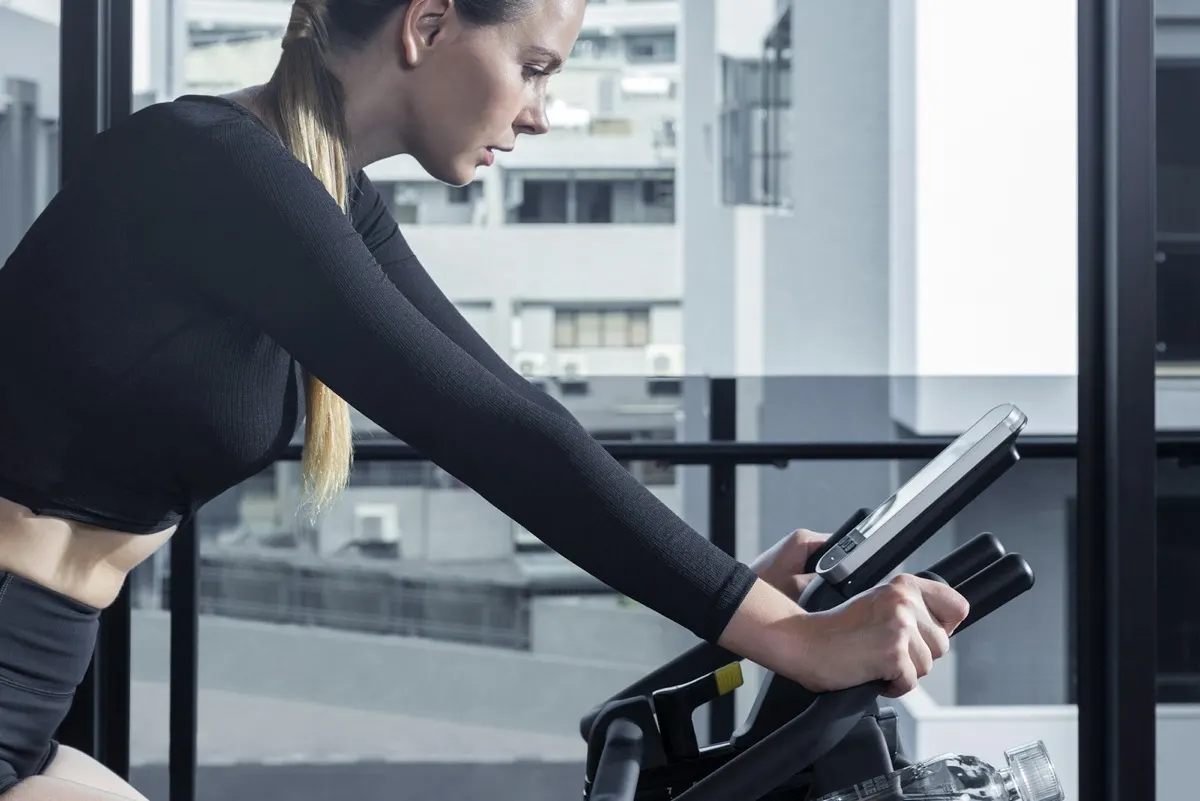
Cycling is the most studied non-running way to raise VO2 max and the easiest to control. Resistance and cadence set your intensity precisely, there is no impact on the joints, and an indoor bike removes traffic, weather, and coasting. It is the natural home of short all-out sprint work because you reach full power in a second or two and safely, which is exactly why REHIT was designed on a bike. If you have one piece of equipment, this is the most versatile.
Rowing
Rowing is the strongest option for a reason that surprises people: it uses your legs, back, and arms together, so it recruits more total muscle mass than running or cycling. More working muscle means a larger oxygen demand, which is why rowers and cross-country skiers record some of the highest VO2 max values ever measured. A rowing erg lets you drive your heart rate as high as any modality can. The catch is technique; sloppy form limits how hard you can push and risks your lower back, so learn the stroke before you chase intervals on it.
The stair climber and incline treadmill walking
Climbing is deceptively powerful. A stair machine, or steep incline walking on a treadmill, drives heart rate high while your feet stay in contact with the surface, so there is far less impact than running. This is often the best bridge for someone carrying extra weight or returning from a lower-body injury: you get running-level cardiovascular demand at walking-level joint stress. Incline intervals, hard uphill followed by easy flat, map perfectly onto the 4x4 structure.
Swimming
Swimming builds VO2 max with zero impact and is the obvious choice if joints are the limiting factor. Two honest caveats. First, technique gates intensity even more than on the rower; if your stroke is inefficient, you will gas out before your cardiovascular system is truly taxed. Second, VO2 max measured while swimming tends to be lower than on land for the same person, because you are horizontal and using a different muscle balance. It still improves your central fitness; just do not compare the pool number to a running number.
The elliptical and cross-trainer
The elliptical is the gentlest on joints and the easiest to sustain, which is its strength and its weakness. It is genuinely useful for building an aerobic base and for hard intervals if you are willing to push, but it is also the easiest machine to coast on without noticing. If you use it, be deliberate about hitting real intensity rather than gliding.
The Protocols That Work on Any of Them
The machine is the vehicle; the protocol is the training. All three of these transfer directly to a bike, rower, stair machine, or elliptical.
| Protocol | Structure | Best on |
|---|---|---|
| Norwegian 4x4 | 4 rounds of 4 minutes hard at 90 to 95% max HR, 3 minutes easy between | Bike, rower, stair machine, incline |
| REHIT | 2 all-out 20-second sprints inside a 10-minute easy session | Bike, rower |
| Zone 2 base | Long easy efforts at 60 to 70% max HR | Any, especially elliptical and bike |
The 4x4 delivers the biggest documented stimulus and works anywhere you can hold a hard effort for four minutes. REHIT is the time-minimalist and suits the bike and rower where all-out sprints are safe. Underneath both, easy zone 2 work builds the aerobic base that makes the hard sessions productive. To run any of them precisely, you need your target heart rate zones; the max heart rate calculator gives you the bpm bands, and the interval timer paces the work and rest for you on whatever machine you are on.
How Hard Is Hard Enough
The single mistake that stalls non-running VO2 max training is going too easy because a machine feels comfortable. For the hard intervals, you want 90 to 95 percent of your maximum heart rate by the end of each work bout, the point where holding a conversation is impossible and you are counting down the seconds. Check your number against the heart rate zones rather than guessing. If you finish a set of intervals thinking you could have done many more, they were not hard enough to move your VO2 max.
PEAKVO2. The interval app for your cardio fitness.
Run the Norwegian 4x4, REHIT, and Tabata on any machine, guided on iPhone and Apple Watch, with automatic phases and heart rate targets. No running required, all the stimulus.
Download PEAKVO2Frequently Asked Questions
Can you increase VO2 max without running?
Yes. VO2 max responds to intensity, not to running specifically, so cycling, rowing, the stair machine, swimming, and the elliptical all raise it when you train hard enough. The same interval protocols that work for runners transfer directly to any of these machines.
What is the best non-running exercise for VO2 max?
Rowing carries the highest ceiling because it recruits your legs, back, and arms together, demanding more oxygen than running or cycling. The stationary bike is the most versatile and controllable, and the safest place for all-out sprint intervals. The best choice is the one you can push hardest on without breaking down.
Does cycling improve VO2 max as much as running?
Yes, when the intensity matches. The landmark interval protocols were tested on bikes and machines, and reviews show comparable VO2 max gains across modes. Cycling has the added advantage of no impact and precise resistance control, which makes it easier to hit real intensity consistently.
Can walking increase VO2 max?
Flat, easy walking does little for VO2 max in already-active people, but steep incline walking or a stair machine is different: it drives heart rate to interval intensity while keeping impact low. Incline intervals are one of the best low-impact ways to raise VO2 max.
Is swimming good for VO2 max?
Swimming builds central cardiovascular fitness with zero joint impact, which makes it excellent if injuries limit you. Two caveats: technique limits how hard you can push more than on other modes, and VO2 max measured in the pool reads lower than on land, so do not compare the two numbers directly.
What heart rate should I train at to raise VO2 max without running?
For the hard intervals, aim for 90 to 95 percent of your maximum heart rate by the end of each work bout. For the easy base work underneath, stay at 60 to 70 percent. Calculate your personal bpm bands rather than guessing, since going too easy on a comfortable machine is the most common reason progress stalls.
Keep Reading
- Norwegian 4x4 Protocol: Proven HIIT to Raise VO2 Max
- REHIT Workout: The 10-Minute Protocol That Raises VO2 Max
- How to Improve Your VO2 Max: The Complete Guide
- Zone 2 Training: The Easy Base That Makes Hard Work Pay
- How Long Does It Take to Improve VO2 Max?
References
- Milanović Z, Sporiš G, Weston M. Effectiveness of High-Intensity Interval Training (HIT) and Continuous Endurance Training for VO2max Improvements: A Systematic Review and Meta-Analysis of Controlled Trials. Sports Med. 2015;45(10):1469-1481. PubMed
- Metcalfe RS, Babraj JA, Fawkner SG, Vollaard NB. Towards the minimal amount of exercise for improving metabolic health: beneficial effects of reduced-exertion high-intensity interval training. Eur J Appl Physiol. 2012;112(7):2767-2775. PubMed
- Helgerud J, Høydal K, Wang E, et al. Aerobic high-intensity intervals improve VO2max more than moderate training. Med Sci Sports Exerc. 2007;39(4):665-671. PubMed