Why Did My VO2 Max Drop? 6 Reasons and How to Get It Back

 Run these workouts on your iPhone, or hands-free on Apple Watch. Get PEAKVO2
 The most common reasons a VO2 max drops are detraining after missed weeks, measurement noise from a wearable, illness or poor sleep, weight gain, aging, and overtraining. Most drops are reversible, and some are not real fitness loss at all. The sections below work through each cause in order of how often it explains a sudden decline.
Seeing the number fall is unsettling, especially when it arrives as a "Cardio Fitness" change on an Apple Watch or a Garmin estimate that ticked down without warning. This guide is specifically about a VO2 max that dropped from a higher level you had before. If your score has simply always sat low rather than declined, the fix is different, and our guide to improving a low Apple Watch cardio fitness score is the better starting point. Here we stay on the decline: why it happens, when to worry, and how to reverse it.
First: Is the Drop Even Real? Wearable Measurement Noise
Before you assume you have lost fitness, rule out the most common and most reassuring explanation. Your watch does not measure VO2 max directly. It estimates it from the relationship between your heart rate and your pace during outdoor walks and runs, then feeds that through your age, sex, height, and weight. Every step of that chain carries error, so the number wobbles even when your fitness is flat.
The error is not trivial. A 2025 validation study put the Apple Watch against laboratory testing and found it underestimated VO2 max by a mean of 6.07 ml/kg/min, with a mean absolute percentage error of 13.3% (Lambe et al., 2025). Against a spread that wide, a one or two point move between readings is well inside the noise band. It tells you almost nothing about whether your heart and lungs changed.
What this means in practice:
- Read the trend, not the reading. A single number is a rough sample. Look at the direction across four to six weeks. A line that drifts down week after week is a signal; a jagged line that dips one week and recovers the next is noise.
- Feed the estimate clean data. The algorithm needs outdoor walks or runs with good GPS and a steady, elevated effort. A stop-start run through traffic lights, a hilly trail, a loose watch band, or a session that was mostly indoors can all produce a low reading that has nothing to do with your fitness.
- Check your profile. If your weight was updated in Apple Health, the estimate recalculates on the spot, which can look like a fitness change when it is arithmetic (more on that below).
If the drop survives all of that and the multi-week trend still points down, it is more likely real. The rest of this article covers why.
Detraining: The Real One
When a VO2 max genuinely falls, the usual cause is straightforward: you stopped training, or trained much less, for a stretch of weeks. This is called detraining, and it is the best documented true cause of a declining VO2 max.
The classic study followed endurance athletes who stopped training completely. VO2 max fell about 7% in the first 21 days, then continued down more slowly, stabilizing roughly 16% below the trained value by day 56 (Coyle et al., 1984). The early drop is steep because the first thing to fade is blood plasma volume, which cuts the amount of blood your heart moves per beat. A later review of detraining across many studies confirmed the pattern: highly trained athletes show a rapid early decline in VO2 max and blood volume once the training stimulus is removed (Mujika and Padilla, 2000).
Two weeks off for a work deadline, an injury, a vacation, or a bout of low motivation is enough to register. If your drop lines up with a gap in training, you have almost certainly found the reason.
The reassuring part: it comes back, and it usually comes back faster than it took to build the first time. The muscle memory of endurance sits in capillary density, mitochondria, and the heart's stroke volume, and re-training rebuilds those adaptations on a shorter timeline than starting from untrained. A few consistent weeks of aerobic work plus a couple of harder sessions typically recovers most of what a short layoff cost.
Illness, Sleep, and Stress
A drop that appears right after a rough patch of life is often temporary and not structural. Acute illness, a run of poor sleep, and sustained psychological stress all raise your heart rate at any given pace. Because your watch reads a higher heart rate for the same speed, it concludes your fitness fell, even when nothing about your heart or lungs has actually changed.
A cold, a fever, or a few nights of broken sleep elevates resting and working heart rate for days. Train or even just walk during that window and the wearable logs a worse heart-rate-to-pace ratio, and the estimate slips. High stress does the same through elevated sympathetic drive. None of this is permanent. As you recover and sleep normalizes, heart rate settles back and the estimate rebounds on its own, usually within a week or two.
The practical move is to not overreact. If a dip lines up with a cold or a stressful stretch, note it and wait. Do not pile on hard training to "fix" a number while you are still run down, which risks turning a temporary dip into the overtraining problem described later.
Weight Change
VO2 max is not a raw measure of oxygen. It is oxygen use per kilogram of body weight, expressed in milliliters of oxygen per kilogram per minute (ml/kg/min). Body weight sits in the denominator, so the number moves when your weight moves, even if your heart and lungs are unchanged.
The math is simple. Say your body uses 3,500 ml of oxygen per minute at max. At 70 kg, that is 3,500 divided by 70, which is 50 ml/kg/min. Gain 5 kg to 75 kg with the same oxygen capacity and it becomes 3,500 divided by 75, or about 46.7 ml/kg/min. Nothing about your cardiovascular system changed, yet the score fell more than three points purely from the extra mass in the denominator. Lose weight and the same effect runs in reverse, nudging the number up.
This cuts both ways as an explanation. If your VO2 max dropped and you have gained weight, part or all of the change may be denominator arithmetic rather than lost fitness. And because the wearable recalculates the moment you update your weight in Health, a correction to a stale profile can show up as a sudden step down. Worth checking before you conclude your engine got weaker.
Aging
Aging lowers VO2 max, but it is a slow cause, not an explanation for a change you noticed over a few weeks. It matters over years, and it is worth understanding honestly because the popular "10% per decade" shorthand is wrong.
The decline accelerates with age rather than holding a flat rate. A large longitudinal study found peak VO2 falling by 3 to 6% per decade through the 20s and 30s, with the rate climbing steadily so that people in their 70s and beyond lose more than 20% per decade (Fleg et al., 2005). So a year-over-year decline in a healthy 30-year-old is small, while the same span means much more later in life.
The important qualifier is that training strongly blunts this. The age-related slope is steepest in people who become sedentary, and staying active flattens it substantially. Aging sets the long-term direction, but your training decides how steep the line is, and it is never the reason a number fell over a single month.
Overtraining
The counterintuitive cause: too much hard training without enough recovery can lower VO2 max and performance rather than raise them. If your drop came during a heavy training block rather than a lull, this is the one to consider.
When training load outruns recovery for long enough, the body shifts into a state where heart rate, hormones, and performance all move the wrong way. VO2 max and race times stall or slide, resting heart rate often creeps up, sleep and mood suffer, and easy efforts feel hard. Pushing harder in response makes it worse, because the problem is a recovery deficit, not a fitness deficit.
The fix is to back off before you rebuild. Take several easy days or a lighter week, prioritize sleep, and let heart rate and energy return to normal. Then resume with more recovery built into the plan. Fitness usually rebounds quickly once the accumulated fatigue clears, and often lands higher than before, which is the whole point of a planned recovery week.
How to Get Your VO2 Max Back
For a drop caused by detraining, illness, or a training gap, recovery follows the same path that built the fitness in the first place: a consistent aerobic base with a small dose of high-intensity work on top. You do not need a complicated plan.
- Rebuild the base. Most of your weekly volume should be easy aerobic work in zone 2, roughly 60 to 70% of your maximum heart rate. This restores the plasma volume and mitochondrial capacity that fade first during a layoff.
- Add 1 to 2 interval sessions per week. Time spent near 90 to 95% of max heart rate is what drives VO2 max upward fastest. The Norwegian 4x4 protocol is the most proven format for this.
- Be consistent for a few weeks. Re-training recovers lost VO2 max faster than the original build, but wearables still need four to six weeks of clean outdoor data before the trend clearly turns back up.
That is the short version. The full method, including how to structure a week and progress it, is in our guide to how to improve your VO2 max.
Track It Properly with PEAKVO2
The single most useful thing you can do with a dropping number is watch the trend instead of reacting to one reading. PEAKVO2 tracks your VO2 max over time so a real, multi-week decline is easy to tell apart from a one-day wobble, and it runs the guided interval sessions that rebuild it when the decline is real.
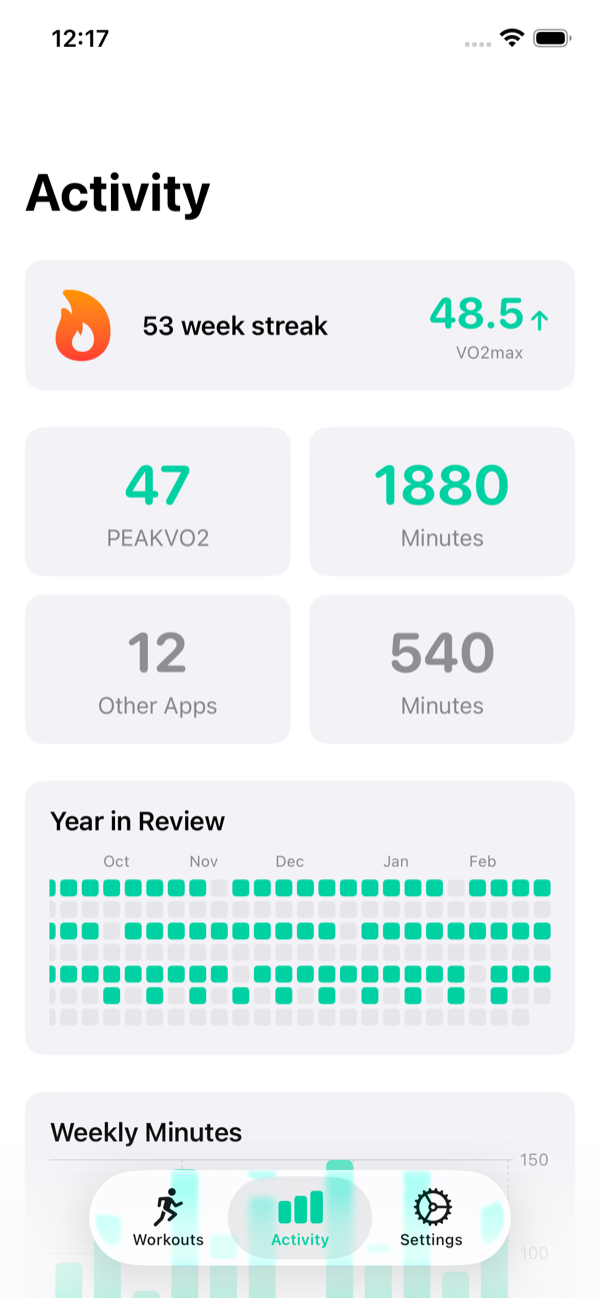
PEAKVO2 runs on iPhone and Apple Watch, tracks your VO2 max over time, and guides interval and zone 2 protocols with automatic phase transitions, haptic cues on your wrist, and the target heart rate zone for each phase.
PEAKVO2. The interval app for your cardio fitness.
Track your VO2 max trend over weeks and rebuild it with guided interval sessions on iPhone and Apple Watch.
Download PEAKVO2Frequently Asked Questions
Why did my Apple Watch VO2 max drop?
The most common reasons are measurement noise and detraining. Apple Watch estimates VO2 max from your heart rate and pace during outdoor runs and walks, and that estimate carries real error, so a one or two point move is often noise rather than lost fitness. If the decline holds across four to six weeks, the likeliest true cause is a gap in training. Illness, poor sleep, high stress, and weight gain can also lower the reading.
Is a VO2 max drop permanent?
Usually not. Drops from detraining, illness, poor sleep, or stress are reversible and typically rebound within weeks of returning to consistent training and normal recovery. Weight-driven drops reverse if you lose the added weight. The one slow, structural cause is aging, and even that is strongly blunted by staying active. Most drops people notice are temporary.
How fast does VO2 max decline without training?
Quickly at first. In endurance athletes who stopped training completely, VO2 max fell about 7% in the first 21 days and stabilized around 16% below the trained value by day 56. The early loss is driven mainly by a drop in blood plasma volume. Reducing rather than fully stopping training slows this considerably.
Can being sick lower my VO2 max?
Yes, temporarily. Illness raises your heart rate at a given pace, so a wearable reads a worse heart-rate-to-pace ratio and lowers its VO2 max estimate. This is usually not a real loss of cardiovascular capacity, and the number rebounds within a week or two as you recover. Avoid hard training while still run down, which can turn a short dip into a longer setback.
Does weight affect VO2 max?
Yes, directly. VO2 max is measured per kilogram of body weight, in ml/kg/min, so weight sits in the denominator. Gaining weight lowers the number even if your heart and lungs are unchanged, and losing weight raises it. For example, the same oxygen capacity that gives 50 ml/kg/min at 70 kg gives about 46.7 ml/kg/min at 75 kg. A weight update in your health profile can therefore look like a fitness change.
How do I get my VO2 max back up?
Return to a consistent aerobic base of easy zone 2 work at 60 to 70% of max heart rate, and add one to two interval sessions per week near 90 to 95% of max, such as the Norwegian 4x4. Re-training recovers lost VO2 max faster than the original build, though a wearable needs four to six weeks of clean outdoor data before the trend clearly turns back up.
Keep Reading
- How to Improve Your Apple Watch Cardio Fitness Score (VO2 Max)
- How to Improve Your VO2 Max: The Complete Guide
- Norwegian 4x4 Protocol: Proven HIIT to Raise VO2 Max
- Zone 2 Training: The Complete Guide to Building Your Aerobic Base
- Heart Rate Zones Explained: What Your Heart Rate Should Be in Each Workout
- VO2 Max by Age: Chart of Normative Scores and What's Good
References
- Coyle EF, Martin WH 3rd, Sinacore DR, et al. Time course of loss of adaptations after stopping prolonged intense endurance training. J Appl Physiol Respir Environ Exerc Physiol. 1984;57(6):1857-1864. PubMed
- Mujika I, Padilla S. Detraining: loss of training-induced physiological and performance adaptations. Part I: short term insufficient training stimulus. Sports Med. 2000;30(2):79-87. PubMed
- Fleg JL, Morrell CH, Bos AG, et al. Accelerated longitudinal decline of aerobic capacity in healthy older adults. Circulation. 2005;112(5):674-682. PubMed
- Lambe R, O'Grady B, Baldwin M, et al. Investigating the accuracy of Apple Watch VO2 max measurements: A validation study. PLoS One. 2025;20(5):e0323741. PubMed