Whoop VO2 Max: How It Works, How Accurate It Is, and My Own Data
I wear a Whoop daily and used it to track my VO2 max from 41 to 51. Here is how its estimate works, how far to trust it, and the real screens from my own account.
 Run these workouts on your iPhone, or hands-free on Apple Watch. Get PEAKVO2
 Whoop estimates your VO2 max passively from 24/7 heart rate, respiration, and activity data, updates it weekly, and shows it with a trend and an age-and-sex percentile in the app's Health section. Whoop's own testing puts the error at 3.3 to 3.7 ml/kg/min against lab values; independent field comparisons suggest a wider 5 to 8 ml/kg/min, with a tendency to underestimate very fit athletes. The trend is reliable; treat the absolute number as an estimate.
I can add something most articles on this cannot: my own data. I wear a Whoop daily, and its VO2 max estimate is the number I used to track my way from 41 to 51 over a year of structured interval training. The screenshots in this article are from my account.
Where to Find VO2 Max on Whoop
Whoop added the VO2 max estimate in 2024. You will find it in the app's Health section, alongside your other cardiovascular metrics, with a weekly updated value, a trend view, and your percentile for age and sex. It also feeds Healthspan: VO2 max is one of the nine metrics behind Whoop Age, because of how strongly it predicts long-term health (Mandsager et al., 2018). On the current membership structure, the longevity features including Whoop Age ship with the Peak and Life tiers.
How Whoop Calculates VO2 Max
Whoop has no screen and, in the band itself, no GPS, so its approach differs from a running watch. The algorithm works in three tiers of increasing precision:
- Passive model. Built purely from what the band sees around the clock: resting heart rate, heart rate variability, respiration rate, recovery, and how much time you spend in each heart rate zone. You get an estimate without ever logging a workout.
- GPS-augmented model. If you record outdoor runs with your phone's GPS, Whoop adds the pace-to-heart-rate relationship, the same signal Garmin and Apple Watch lean on, and the estimate tightens.
- Calibrated estimate. If you know your real value from a lab test or a field test, you can calibrate, and Whoop adjusts its model around that anchor.
The estimate updates weekly rather than after every workout, which fits how VO2 max actually changes: slowly, over weeks of training, and the weekly cadence keeps the trend readable instead of noisy.
How Accurate Is Whoop's VO2 Max?
Two sets of numbers exist, and the honest answer lives between them.
Whoop's own validation: a mean absolute error of 3.7 ml/kg/min for the passive model and 3.3 ml/kg/min with GPS runs, roughly 7 to 8 percent error against laboratory measurement. Those figures come from Whoop's internal cross-validation, not from an independent lab, and no peer-reviewed independent validation of the feature has been published yet.
Independent field comparisons are less flattering: errors of roughly 5 to 8 ml/kg/min against lab values, a bit wider than Garmin or Apple Watch in head-to-head tests, with a systematic tendency to underestimate well-trained athletes, especially runners above roughly 55 ml/kg/min. The likely reason: the passive model leans heavily on resting heart rate, and fit people with naturally higher resting heart rates get shortchanged.
The practical reading is the same one that applies to Fitbit and every other wrist estimate: the absolute number carries a few points of uncertainty, the trend is trustworthy. When your Whoop VO2 max climbs by three points across two months, that reflects a real change in your fitness, whatever the exact starting point was. If you want to pin down your true number, run a Cooper test and put the result into our VO2 max calculator, then use Whoop's calibration to anchor its estimate.
PEAKVO2. The interval app for your cardio fitness.
Guided Norwegian 4x4, Tabata, and HIIT sessions on iPhone and Apple Watch, with your target heart rate zone each phase. Your Whoop tracks the trend; PEAKVO2 runs the training that moves it.
Download PEAKVO2My Own Whoop VO2 Max, Honestly
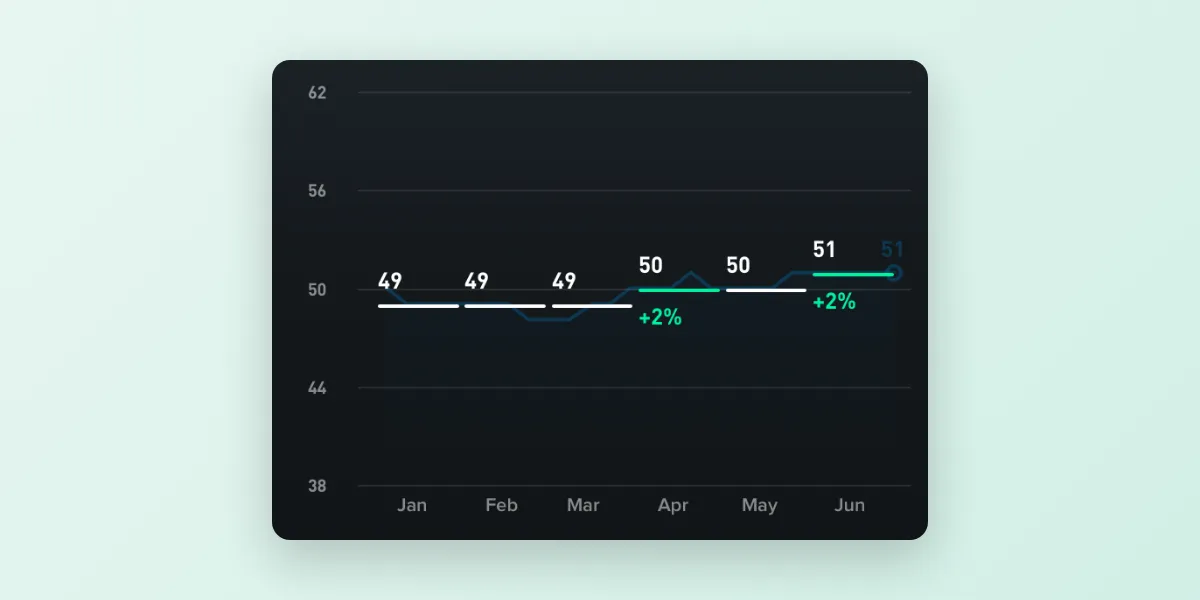
I started interval training in early 2025 with an Apple Watch estimate of about 41. Today my Whoop reads 51, which it rates Excellent and top 9 percent for my age and sex. The climb came from blocks of twice-weekly Norwegian 4x4 sessions, first running, later on the bike, inside an otherwise mixed training year.
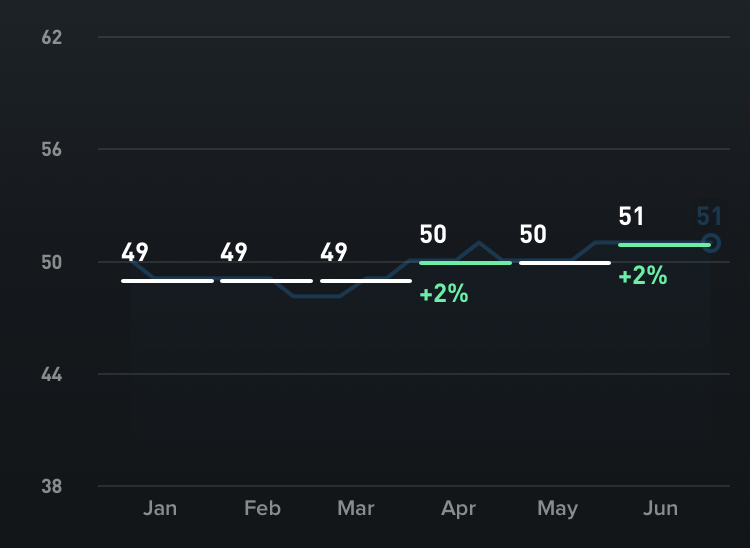
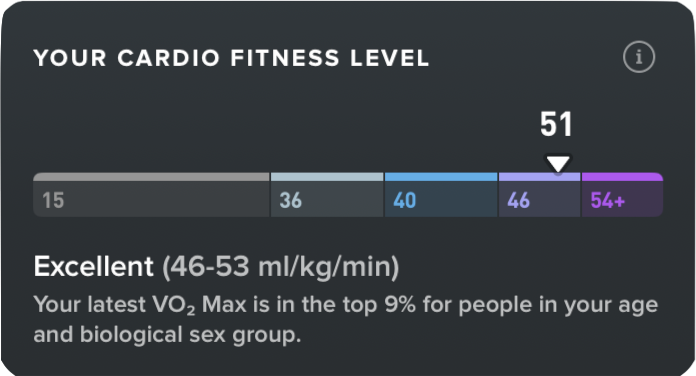
Two honest notes on this data. I switched devices along the way (the 41 is from Apple Health in January 2025, the recent trend is Whoop), and these are wearable estimates, not lab tests. But the shape of the curve is exactly what VO2 max training looks like in a wearable: flat during strength blocks, climbing during interval blocks, a point or two at a time. The full story, including every screenshot and what I would do differently, is in the Norwegian 4x4 article.
Whoop 5.0, MG, and What It Costs in 2026
The current hardware generation launched in May 2025: Whoop 5.0 (14-day battery, roughly triple the 4.0) and Whoop MG, the same sensor package plus a metal clasp for ECG readings. Whoop remains subscription-only: One at $199 a year with the 5.0 included, Peak at $239 adding the longevity suite (Whoop Age, Healthspan, stress monitor), and Life at $359 with the MG.
That model is exactly what Google went after in May 2026 with the screenless, $99, no-subscription Fitbit Air. If you mainly want a passive VO2 max trend without a screen, both now do it; the Air does it for a one-time payment, while Whoop's recovery analytics and community remain the deeper product. Our fitness tracker comparison puts all six major options side by side.
How to Raise the Number Whoop Shows You
Whoop watches; it does not coach the workout that moves this metric. The evidence points at high-intensity intervals: two weekly 4x4 sessions raised VO2 max by 7.2 percent in eight weeks in a controlled trial (Helgerud et al., 2007), and that is the protocol behind my own 41 to 51. The method is in how to improve your VO2 max, and you can try one 4x4 in the browser right now.
Since the band has no display, the training itself runs off your phone, and that is exactly the pairing I use: PEAKVO2 on the iPhone guides the intervals with automatic phase transitions and my target heart rate zone for each phase, and Whoop scores the recovery and tracks the VO2 max trend afterwards.
Frequently Asked Questions
Does Whoop track VO2 max?
Yes, since 2024. Whoop estimates VO2 max from 24/7 heart rate, HRV, respiration, and activity data, updates it weekly, and shows it with a trend and an age-and-sex percentile in the app's Health section. It is also one of the nine metrics behind Whoop Age.
How does Whoop calculate VO2 max without GPS?
The passive model estimates it from resting heart rate, heart rate variability, respiration rate, and time in heart rate zones, collected around the clock. If you record outdoor runs with your phone's GPS, Whoop adds the pace-to-heart-rate relationship for a tighter estimate, and you can calibrate with a known lab or field test value.
How accurate is Whoop's VO2 max?
Whoop's internal validation reports 3.3 to 3.7 ml/kg/min of error against lab measurement; independent field comparisons suggest roughly 5 to 8 ml/kg/min, slightly wider than Garmin or Apple Watch. There is no peer-reviewed independent validation yet. The trend over weeks is reliable; the absolute number is an estimate.
Why is my Whoop VO2 max lower than my Garmin or Apple Watch?
Whoop's passive model leans heavily on resting heart rate and tends to underestimate well-trained athletes, especially above roughly 55 ml/kg/min. Different algorithms also simply disagree by a few points. Compare trends within one device rather than absolute numbers across devices, or calibrate Whoop with a field test result.
How often does Whoop update VO2 max?
Weekly. That cadence matches the physiology: VO2 max changes over weeks of consistent training rather than day to day, so a weekly value keeps the trend readable instead of noisy.
How do I increase my Whoop VO2 max?
Structured high-intensity intervals move it fastest: in a controlled trial, two weekly Norwegian 4x4 sessions (4 minutes at 90 to 95 percent of max heart rate, 3 minutes easy, 4 rounds) raised VO2 max 7.2 percent in eight weeks. Consistency over 8 to 12 weeks shows up clearly in Whoop's weekly estimate.
Keep Reading
- Best Fitness Tracker for VO2 Max: 6 Devices Compared
- Whoop vs Garmin: Which Is Better for VO2 Max and Training?
- Fitbit VO2 Max: Where to Find It, How Accurate It Is, by Model
- Fitbit Air VO2 Max: Does It Track It, and How to See Your Score
- Oura VO2 Max: How Cardio Capacity Works and How Accurate It Is
- Norwegian 4x4 Protocol: Proven HIIT to Raise VO2 Max
- VO2 Max by Age: Chart of Normative Scores
- How to Improve Your VO2 Max
- Why Did My VO2 Max Drop?
References
- Whoop. How Accurate Is WHOOP VO2 Max? Inside the Algorithm. whoop.com
- Helgerud J, Høydal K, Wang E, et al. Aerobic high-intensity intervals improve VO2max more than moderate training. Med Sci Sports Exerc. 2007;39(4):665-671. PubMed
- Mandsager K, Harb S, Cremer P, et al. Association of cardiorespiratory fitness with long-term mortality among adults undergoing exercise treadmill testing. JAMA Netw Open. 2018;1(6):e183605. PubMed