
VO2 Max Test: What to Expect, How to Prepare, and Is It Worth the Cost?
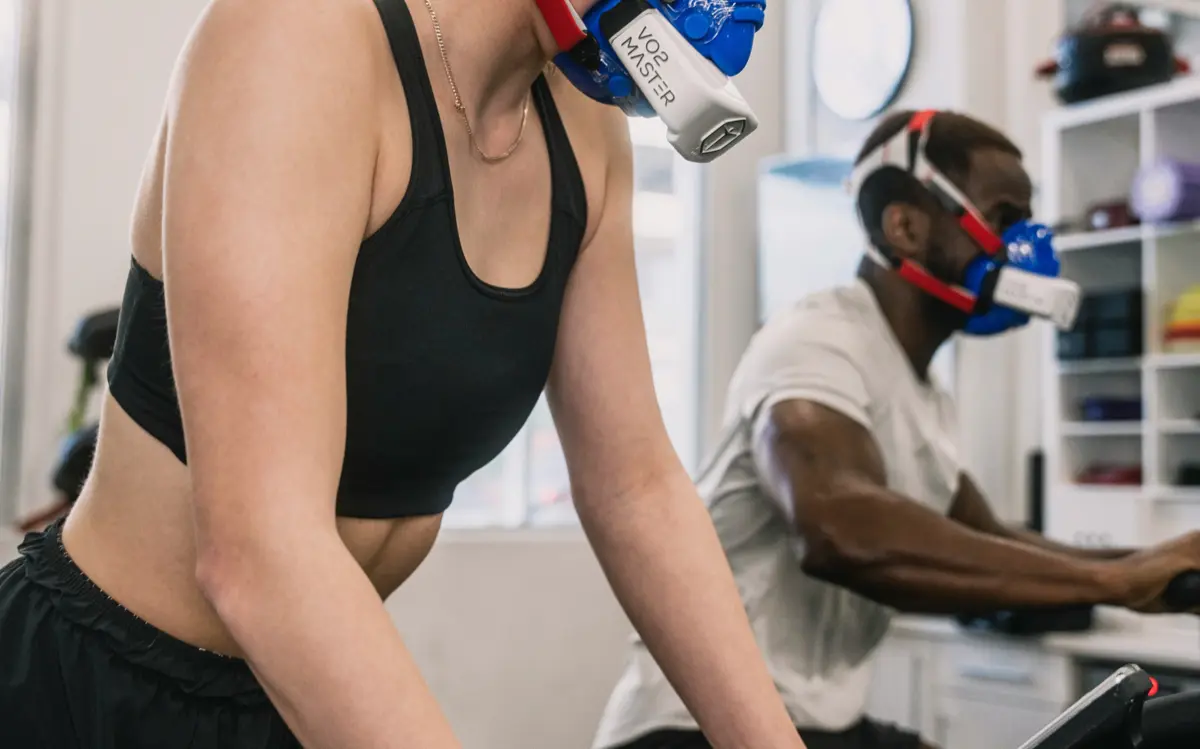
A VO2 max test measures the maximum amount of oxygen your body can consume during exercise, using direct gas exchange analysis while you run on a treadmill or cycle on an ergometer. It is the gold standard measurement of cardiovascular fitness and typically costs $150-300 at a testing lab near you.
Your VO2 max score is the single strongest predictor of longevity, stronger than smoking status, blood pressure, or diabetes as a risk factor. Knowing your exact number gives you a precise starting point for training and a way to measure whether your program is working. An Apple Watch or Garmin can estimate your VO2 max, but a lab test removes the guesswork.
This guide covers exactly what happens during a VO2 max test, how to prepare, what the results mean, and whether the cost is worth it.
What Is a VO2 Max Test?
A VO2 max test (also called a CPET, cardiopulmonary exercise test, or maximal graded exercise test) measures how much oxygen your body consumes as exercise intensity increases to your absolute limit. You wear a mask or mouthpiece connected to a metabolic cart that analyzes every breath, measuring precisely how much oxygen you inhale and how much carbon dioxide you exhale.
The test uses a ramp protocol: intensity starts easy and increases steadily every 1-2 minutes until you physically cannot continue. The point at which your oxygen consumption plateaus despite increasing effort is your VO2 max.
Labs typically offer two modalities:
- Treadmill: Speed and/or incline increase progressively. Treadmill tests generally produce 5-10% higher VO2 max values than cycling because running recruits more total muscle mass (Fairshter et al., 1983).
- Cycle ergometer: Resistance increases progressively. Preferred for people who are more comfortable cycling, those with joint issues, or athletes whose sport is cycling.
Both give valid results. Choose the one that matches your primary training activity.
What Happens During the Test: Step by Step
Before the test (15-20 minutes)
You'll arrive at the lab and fill out a health questionnaire and informed consent form. A technician will explain the protocol, fit the mask or mouthpiece, and attach a heart rate strap. Some labs also place a pulse oximeter on your finger. You'll have a chance to ask questions and get comfortable with the equipment.
Warm-up (3-5 minutes)
The test begins with easy walking (treadmill) or light pedaling (bike) to establish your baseline oxygen consumption and heart rate. This phase lets you settle into breathing through the mask, which feels unusual at first.
Ramp phase (8-15 minutes)
Intensity increases every 1-2 minutes. On a treadmill, speed and/or incline go up. On a bike, resistance increases. Modern labs typically use continuous ramp protocols rather than staged step protocols because they produce more uniform physiological responses and are better tolerated (Myers et al., 1991).
During this phase:
- Minutes 1-5: Feels comfortable. You can breathe easily through the mask. Heart rate climbs steadily.
- Minutes 5-8: Getting harder. Breathing becomes heavy. You start relying more on carbohydrates for fuel.
- Minutes 8-12: Very hard. You're gasping through the mask. Legs are burning. Your body is approaching its maximum oxygen consumption.
- Final 1-3 minutes: All-out effort. You continue until you physically cannot maintain the pace or cadence.
The total ramp phase typically lasts 8-15 minutes depending on your fitness level. Fitter individuals last longer because it takes more time to push them to their limit.
Recovery (3-5 minutes)
After reaching your maximum, the intensity drops immediately to easy walking or light pedaling. The technician will continue monitoring your heart rate and breathing for a few minutes as you recover. Some labs include a supramaximal verification bout (a short burst at an intensity above where you stopped) to confirm that you truly reached your maximum (Midgley & Carroll, 2009).
Results review (10-15 minutes)
Most labs will review your results with you immediately or within a few days. You'll receive a report showing your VO2 max value, heart rate zones, ventilatory thresholds, and sometimes body composition data.
Total time at the lab: approximately 45-60 minutes. The actual maximal effort portion is only 8-15 minutes.
How to Prepare for a VO2 Max Test
Preparation matters. These factors can affect your results:
| Factor | Recommendation | Why |
|---|---|---|
| Food | Eat a light meal 2-3 hours before. No heavy meals. | A full stomach diverts blood flow away from working muscles. |
| Caffeine | Avoid for 3-4 hours before, or use your normal amount. | Caffeine does not significantly alter VO2 max values but may affect perceived exertion and time to exhaustion (Brietzke et al., 2017). Be consistent between tests. |
| Exercise | No hard training for 24-48 hours before. | Fatigue from prior exercise reduces your ability to reach true max. |
| Sleep | Get 7-9 hours the night before. | Sleep deprivation impairs aerobic performance. |
| Hydration | Drink normally. Arrive well-hydrated. | Dehydration reduces blood volume and cardiac output. |
| Alcohol | None for 24 hours before. | Alcohol impairs cardiovascular function and recovery. |
| Clothing | Wear comfortable workout clothes and running shoes (or cycling shoes if using a bike). | You need to move freely and push to your absolute limit. |
How Much Does a VO2 Max Test Cost?
Prices vary by location and what's included:
| Type | Typical Cost | What's Included |
|---|---|---|
| VO2 max only | $100-200 | Maximal test, VO2 max number, heart rate zones |
| VO2 max + lactate | $200-350 | Above plus blood lactate measurements at each stage |
| Full metabolic panel | $300-500 | VO2 max, lactate, resting metabolic rate, body composition |
| University lab | $50-150 | Often cheaper but may have longer wait times |
Most health insurance does not cover VO2 max testing unless ordered by a physician for a medical indication (such as heart failure evaluation). For fitness purposes, it's an out-of-pocket expense.
Browse 160+ VO2 max testing labs to find one near you and compare what each offers.
Understanding Your Results
Your results report will include several numbers. Here's what matters:
VO2 max (ml/kg/min)
This is the headline number: your maximum oxygen consumption expressed relative to your body weight. Higher is better. See where you rank for your age and gender.
| Classification | Men (ml/kg/min) | Women (ml/kg/min) |
|---|---|---|
| Poor | < 35 | < 27 |
| Below average | 35-40 | 27-31 |
| Average | 40-45 | 31-35 |
| Above average | 45-50 | 35-40 |
| Excellent | 50-55 | 40-45 |
| Elite | > 55 | > 45 |
Values for ages 30-39. Ranges shift by age. See full charts.
How do labs confirm you reached true VO2 max?
Technicians look for several criteria that indicate you genuinely reached your physiological limit (Howley et al., 1995):
- VO2 plateau: Oxygen consumption levels off despite increasing effort. This is the gold standard criterion.
- Respiratory exchange ratio (RER) > 1.10: An RER above 1.10 indicates heavy reliance on anaerobic metabolism, confirming maximal effort.
- Heart rate near age-predicted maximum: Within 10 beats of your predicted max (though this varies by individual).
- Rating of perceived exertion (RPE): 9-10 out of 10.
These criteria may need adjustment for sex and age (Edvardsen et al., 2014). Not everyone shows a clear VO2 plateau, which is why some labs use a verification bout to confirm the result.
Ventilatory thresholds
Many labs also report your VT1 (first ventilatory threshold) and VT2 (second ventilatory threshold). These correspond approximately to your aerobic threshold and anaerobic threshold, and they define where your zone 2 ends and where high-intensity work begins. These are valuable for setting precise heart rate training zones.
Lab Test vs Watch Estimates: How Accurate Are Wearables?
Your Apple Watch and Garmin estimate VO2 max using algorithms that analyze heart rate and pace during outdoor workouts. But how accurate are these estimates?
A systematic review and meta-analysis of consumer wearables found moderate validity for VO2 max estimation but with wide individual error ranges (Molina-Garcia et al., 2022). A validation study of the Apple Watch Series 7 found reasonable group-level accuracy but significant individual-level variability (Caserman et al., 2024).
In practical terms:
| Lab Test | Watch Estimate | |
|---|---|---|
| Accuracy | Gold standard (direct measurement) | Within 5-15% for most users |
| Cost | $100-350 per test | Free (with watch you already own) |
| Convenience | Appointment at a lab | Automatic, from regular workouts |
| Best for | Baseline measurement, precise zones, tracking progress | Day-to-day trend tracking |
| Limitation | Cost, availability, single snapshot | Individual error can be large, affected by pace/terrain |
The bottom line: Watch estimates are excellent for tracking trends over time. If your Apple Watch VO2 max estimate is climbing, your actual VO2 max is almost certainly improving. But for a precise baseline number and accurate training zones, a lab test is worth the investment at least once.
Lab Test vs Field Tests
If a lab test isn't accessible or affordable, field tests offer a middle ground:
- Beep test (20m shuttle run): The original validation study showed correlations of r = 0.71-0.90 against laboratory measurement (Leger et al., 1988). Good for tracking progress; less accurate than a lab for an absolute number.
- Cooper test (12-minute run): Run as far as you can in 12 minutes and use a prediction equation. Simple, free, repeatable.
- Submaximal cycle test: Protocols like the Ekblom-Bak test predict VO2 max from heart rate responses at submaximal intensities, with a standard error of estimate around 5 ml/kg/min (Ekblom-Bak et al., 2014). Safer for clinical populations who should not exercise to maximum.
Field tests are useful for tracking progress every 4-6 weeks. Get a lab test for your baseline and for milestone checks (e.g., after 12 weeks of structured training).
How Often Should You Get Retested?
- Baseline test: Before starting a structured VO2 max improvement program.
- Progress check: After 8-12 weeks of consistent training. This is when most measurable gains appear.
- Annual check: Once per year to monitor trends, especially important after 40 when age-related decline accelerates.
- Between lab tests: Use your watch estimate and field tests (beep test or Cooper test) to track trends every 4-6 weeks.
You don't need to go to the lab every month. The combination of one lab test per quarter and watch-based tracking in between gives you both precision and convenience.
Frequently Asked Questions
Does a VO2 max test hurt?
No, but it is extremely uncomfortable for the last 2-3 minutes. You'll be gasping for air, your legs will burn, and you'll want to stop. That's the point: the test needs you to reach your absolute limit. The discomfort ends immediately when you stop, and most people recover within a few minutes.
Can you fail a VO2 max test?
You can't fail, but you can underperform. If you stop before reaching your true maximum (due to anxiety, unfamiliarity with the equipment, or not being mentally prepared to push through discomfort), the result will underestimate your actual VO2 max. This is why preparation and knowing what to expect matter.
Is the mask uncomfortable?
It feels strange at first. Breathing is slightly restricted, and you can't talk. Most people adapt within the first 2-3 minutes of the warm-up. If you breathe through your nose normally, note that the mask forces mouth breathing, which takes some adjustment.
Should runners test on a treadmill or bike?
Treadmill. You'll get a more accurate result because running uses more muscle mass and typically produces 5-10% higher VO2 max values than cycling. If your primary sport is cycling, test on a bike for sport-specific results.
How does VO2 max testing differ from a stress test?
A cardiac stress test (ordered by a doctor) monitors your heart's electrical activity (ECG) during exercise to detect heart disease. A VO2 max test measures oxygen consumption to determine fitness. Some clinical labs combine both, which gives you cardiovascular screening plus your fitness number in one session.
The Bottom Line
A VO2 max lab test gives you the most accurate picture of your cardiovascular fitness. For $150-300, you get your exact VO2 max number, precise heart rate training zones, and a baseline to measure your improvement against. If you're serious about improving your VO2 max, getting tested at least once is worth the investment.
Between lab tests, track your progress with an Apple Watch or Garmin, and use field tests like the beep test or Cooper test every 4-6 weeks. Combine zone 2 training with a protocol like the Norwegian 4x4, retest after 12 weeks, and see how far you've come.
Keep Reading
- How to Improve VO2 Max: The Complete Guide
- What Is a Good VO2 Max? Charts by Age and Gender
- Zone 2 Training: Building Your Aerobic Base
- Norwegian 4x4 Protocol: The Best HIIT for VO2 Max
Find a VO2 Max Testing Lab Near You
160+ labs across the US, Canada, Europe, and Australia. Compare locations, prices, and services.
Browse LabsReferences
- Myers J, Buchanan N, Walsh D, et al. Comparison of the ramp versus standard exercise protocols. J Am Coll Cardiol. 1991;17(6):1334-1342. PubMed
- Fairshter RD, Walters J, Salness K, et al. A comparison of incremental exercise tests during cycle and treadmill ergometry. Med Sci Sports Exerc. 1983;15(6):549-554. PubMed
- Howley ET, Bassett DR Jr, Welch HG. Criteria for maximal oxygen uptake: review and commentary. Med Sci Sports Exerc. 1995;27(9):1292-1301. PubMed
- Edvardsen E, Hem E, Anderssen SA. End criteria for reaching maximal oxygen uptake must be strict and adjusted to sex and age. PLoS One. 2014;9(1):e85276. PubMed
- Midgley AW, Carroll S. Emergence of the verification phase procedure for confirming 'true' VO2max. Scand J Med Sci Sports. 2009;19(3):313-322. PubMed
- Molina-Garcia P, Notbohm HL, Schumann M, et al. Validity of estimating the maximal oxygen consumption by consumer wearables: a systematic review with meta-analysis. Sports Med. 2022;52(7):1531-1548. PubMed
- Caserman P, Yum S, Gobel S. Assessing the accuracy of smartwatch-based estimation of maximum oxygen uptake using the Apple Watch Series 7. JMIR Biomed Eng. 2024;9:e56813. PubMed
- Brietzke C, Asano RY, De Russi de Lima F, et al. Caffeine effects on VO2max test outcomes investigated by a placebo perceived-as-caffeine design. Nutr Health. 2017;23(4):231-237. PubMed
- Ekblom-Bak E, Bjorkman F, Hellenius ML, et al. A new submaximal cycle ergometer test for prediction of VO2max. Scand J Med Sci Sports. 2014;24(2):319-326. PubMed
- Leger LA, Mercier D, Gadoury C, Lambert J. The multistage 20 metre shuttle run test for aerobic fitness. J Sports Sci. 1988;6(2):93-101. PubMed