HIIT Workouts for Women: 6 Sessions and How to Train Around Your Cycle
 Run these workouts on your iPhone, or hands-free on Apple Watch. Get PEAKVO2
 HIIT works for women, but it works better when the protocol matches the phase of your cycle, your training history, and where you are in life. The standard "30 seconds on, 15 seconds off, eight rounds" advice produced for the general fitness audience ignores that women's exercise response varies meaningfully across the menstrual cycle, that the rules change after 40 with menopause, and that postpartum recovery has its own timeline. This guide gives you six HIIT workouts that work for women at different life stages, the cycle-phase adjustments backed by exercise physiology research, and the exact app and Apple Watch setup so you can actually train to the right heart rate zone without guessing.
If you are new to the format or unsure whether HIIT is right for you, start with our interval training for beginners plan. If you already know HIIT is the move, the workouts below are ready to run.
Why HIIT Matters Specifically for Women
The cardiovascular benefits of HIIT translate equally well to women and men. The protocols that raise VO2 max in male trial subjects produce the same percentage gains in female subjects, and VO2 max is the single strongest predictor of long-term mortality regardless of sex (Mandsager et al., 2018). What is different is the baseline, the recovery profile, and the specific adaptations that matter most.
Women typically have a VO2 max around 10 to 15% lower than men of the same age and training history, driven by smaller heart size, lower hemoglobin concentration, and lower blood volume. None of that limits trainability. A meta-analysis of HIIT trials in overweight and obese adults found that women and men responded similarly to high-intensity protocols across body composition, cardiorespiratory fitness, and metabolic markers (Wewege et al., 2017).
Three benefits matter more for women than for men:
Bone density. Women lose bone mineral density faster than men, especially after menopause. High-intensity weight-bearing exercise is one of the few interventions that stimulates osteogenesis (new bone formation) at any age. The impact and ground-reaction forces of jumping-based HIIT contribute to bone health in ways that swimming and cycling alone cannot.
Insulin sensitivity. Insulin resistance accelerates in perimenopause and continues through menopause. HIIT improves insulin sensitivity more efficiently per minute than continuous moderate exercise, which makes it a useful tool for managing midlife metabolic changes.
VO2 max preservation. VO2 max declines roughly 10% per decade after age 30 if you do nothing. That decline is roughly cut in half with structured high-intensity training. For women going through menopause, when natural fitness loss accelerates, HIIT is the single most efficient intervention to push back against the decline.
Training Around Your Menstrual Cycle
This is the section most fitness content skips. Your physiological response to HIIT changes across the menstrual cycle because estrogen and progesterone affect cardiovascular function, thermoregulation, substrate use, and recovery. Training in a way that respects those shifts produces better results than treating every session as identical.
The cycle has four phases. The exact day boundaries vary per person; the principles below assume a standard 28-day cycle. Adjust to your own pattern.
| Phase | Approximate days | Hormonal pattern | HIIT response |
|---|---|---|---|
| Menstrual | 1 to 5 | Estrogen and progesterone both low | Energy may be lower but performance is often preserved. Iron status matters. |
| Follicular | 6 to 14 | Rising estrogen, low progesterone | Peak window for high-intensity training. Push hard. |
| Ovulation | ~14 | Estrogen peak | Peak performance day for many women. |
| Luteal | 15 to 28 | Rising progesterone, then both drop | Core temperature is higher, perceived exertion increases at the same heart rate, recovery is slower. Dial back work intervals or extend recovery. |
The follicular phase, roughly day 1 through ovulation, is when most women perform best in high-intensity work (Janse de Jonge, 2003). Estrogen supports cardiovascular performance and recovery, and the relative absence of progesterone keeps core body temperature lower, which means heat dissipation during hard work is easier.
The luteal phase, from ovulation through the start of your next period, is when progesterone is elevated. Core temperature is roughly 0.3 to 0.5°C higher, which raises perceived exertion at the same workload, and progesterone affects breathing rate. Many women find HIIT sessions feel harder for the same heart rate. The fix is usually small: extend rest by 10 to 15 seconds, drop one work interval, or shift to a lower-impact variant for the week.
The menstrual phase deserves a note: contrary to common belief, performance is often well-preserved during menstruation despite lower energy (McNulty et al., 2020). What matters more is iron status, since menstruation depletes iron and low ferritin meaningfully impairs aerobic performance.
Practical cycle-phase rules for the workouts below:
- Follicular phase (high estrogen): Run any workout at full intensity. This is your peak training window.
- Ovulation week: Same as follicular. Many women hit personal bests here.
- Luteal phase (high progesterone): Either add 10 to 15 seconds of recovery to each interval, drop the last interval, or substitute the low-impact workout (#4 below).
- Menstrual phase: Train if you feel like it, scale back if you don't. Skip jumping if cramps are heavy. The session still counts.
A note on hormonal contraception: women on combined oral contraceptives often show flattened cycle effects because the pill suppresses natural estrogen and progesterone swings. If you are on the pill, the cycle adjustments matter less; train normally.
6 HIIT Workouts for Women
Set up your timer before you begin. Each workout links to a pre-configured version of our interval timer so you can press start without programming anything. Add a 5 to 8 minute warm-up to every session.
1. 4-Minute Tabata (Beginner-Friendly Entry)
The classic Tabata protocol scales to any starting fitness. Twenty seconds of all-out work, ten seconds rest, eight rounds. Four minutes total. Run it once, twice, or three times per session with two minutes of recovery between blocks.
Equipment: None
Duration: 4 minutes per block plus warm-up
| Round | Exercise | Work | Rest |
|---|---|---|---|
| 1 to 8 | Squat jumps (or fast bodyweight squats for low-impact) | 20 sec | 10 sec |
Open the Tabata Timer (pre-configured for 20/10 × 8) or run the Tabata Protocol directly in the PEAKVO2 app.
2. 20-Minute Bodyweight HIIT
Two blocks of 10 rounds each at 30 seconds work and 15 seconds rest. The 2:1 work-to-rest ratio keeps heart rate elevated between intervals for sustained cardiovascular load.
Equipment: None
Duration: 22 minutes plus warm-up
| Block | Exercise | Work | Rest | Rounds |
|---|---|---|---|---|
| 1 | Burpees | 30 sec | 15 sec | 10 |
| Rest | 2 min | |||
| 2 | Mountain climbers | 30 sec | 15 sec | 10 |
Open the 30 Second Interval Timer for each block.
3. Dumbbell HIIT Circuit
A 45/15 dumbbell circuit, six stations, three rounds. The added load multiplies metabolic demand and builds the muscular strength that supports bone density.
Equipment: One pair of dumbbells (12 to 25 lbs depending on starting strength)
Duration: 24 minutes plus warm-up
| Station | Exercise | Work | Rest |
|---|---|---|---|
| 1 | Dumbbell thrusters | 45 sec | 15 sec |
| 2 | Renegade rows | 45 sec | 15 sec |
| 3 | Dumbbell swings (or kettlebell swings) | 45 sec | 15 sec |
| 4 | Goblet squats | 45 sec | 15 sec |
| 5 | Push press | 45 sec | 15 sec |
| 6 | Alternating dumbbell snatches | 45 sec | 15 sec |
Complete all 6 stations as one round. Rest 60 seconds. Repeat for 3 rounds total.
Open the HIIT Timer (pre-configured for 45/15) and run it through one station at a time.
4. Low-Impact HIIT (for Joint-Sensitive, Postpartum, or Luteal Phase)
The same metabolic and cardiovascular stimulus as standard HIIT, without jumping or high ground-reaction forces. Useful during the luteal phase, postpartum return-to-fitness, perimenopausal joint discomfort, or any time impact is contraindicated.
Equipment: None (optional: light dumbbells)
Duration: 20 minutes plus warm-up
| Round | Exercise | Work | Rest |
|---|---|---|---|
| 1 | Fast bodyweight squats | 40 sec | 20 sec |
| 2 | Push-ups (knees or full) | 40 sec | 20 sec |
| 3 | Reverse lunges (alternating) | 40 sec | 20 sec |
| 4 | Plank shoulder taps | 40 sec | 20 sec |
| 5 | Glute bridges (or single-leg) | 40 sec | 20 sec |
| 6 | Bird dogs | 40 sec | 20 sec |
Repeat the 6-exercise circuit 3 times. The intensity comes from speed and continuous effort, not from impact.
Open the Programmable Interval Timer, set 40 second work and 20 second rest, 18 rounds total.
5. Treadmill Sprint HIIT
Sustained sprint intervals at a 1:2 work-to-rest ratio. Longer recovery lets you push closer to maximum each interval, which targets pure VO2 max.
Equipment: Treadmill
Duration: 18 minutes plus warm-up
| Phase | Duration | Speed |
|---|---|---|
| Sprint | 30 sec | Hard effort (typically 8 to 11 mph) |
| Recovery | 60 sec | Walk at 3.0 to 3.5 mph |
| Repeat | 12 rounds |
Step onto the side rails during the recovery if you need the treadmill to reach sprint speed safely. See our HIIT treadmill workouts guide for more treadmill variants.
Open the 1 Minute Interval Timer and adjust work to 30 seconds.
6. Luteal-Phase AMRAP
An "as many rounds as possible" circuit with extended recovery built in. The longer rest accommodates the higher progesterone-driven perceived effort during the luteal phase, while still producing meaningful work.
Equipment: None (or one pair of light dumbbells optional)
Duration: 15 minutes plus warm-up
| Movement | Reps |
|---|---|
| Bodyweight squats | 10 |
| Push-ups | 8 |
| Reverse lunges (each leg) | 8 |
| Plank (hold) | 30 sec |
Complete as many full rounds as you can in 15 minutes. Take 30-second breaks between rounds if needed. Track your round count and compare across cycles, not just within a cycle.
Open the Programmable Interval Timer, add one 15 minute "work" interval, set rounds to 1, set countdown to 10 seconds.
Run These Workouts on PEAKVO2 + Apple Watch
The PEAKVO2 app handles timing and phase transitions so you can focus on effort. For women specifically, the iPhone-to-Apple-Watch handoff matters more than it does for men because your physiological response to a given workload varies across the cycle. Without continuous heart rate, you cannot know whether your luteal-phase session is in the right zone or not.
Step 1: Pick the protocol
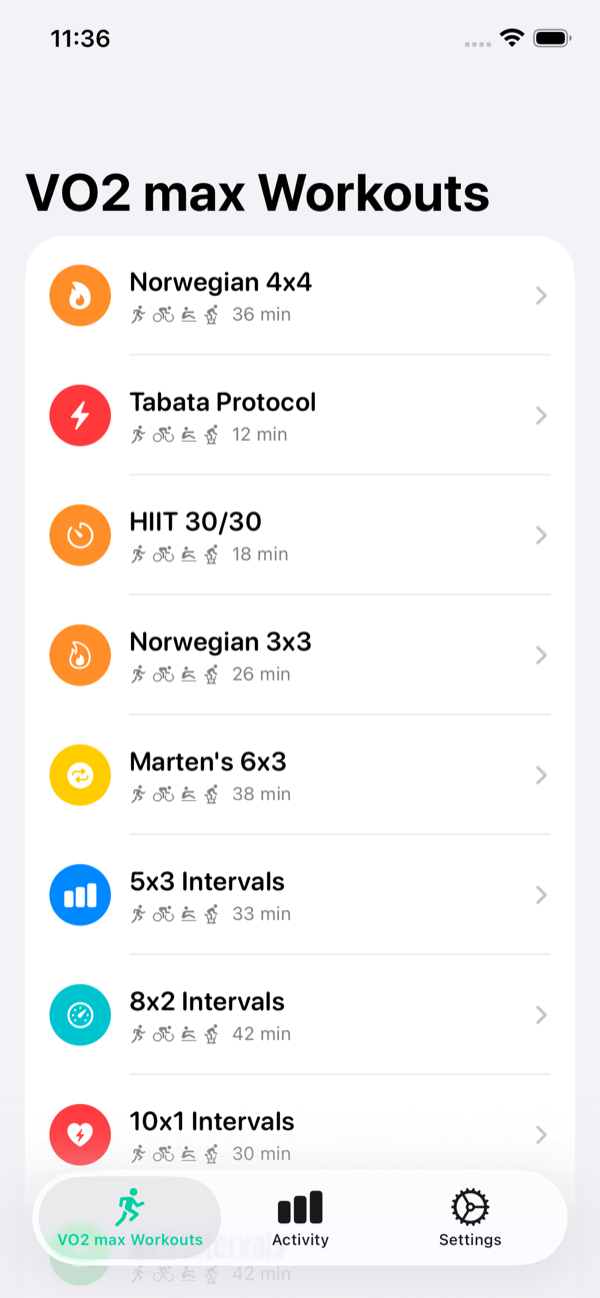
Launch PEAKVO2 and open the VO2 max Workouts tab. For the workouts above, the relevant app protocols are Tabata Protocol (matches workout 1) and HIIT 30/30 (matches workout 2). Tap whichever you want to run.
Step 2: Configure activity and environment
The detail screen lets you pick the activity (Running, Cycling, Swimming, Rowing) and toggle between Outdoor and Indoor. Each protocol has built-in warm-up, work, recovery, and cooldown phases.
Step 3: Send the workout to Apple Watch
With your Apple Watch paired, PEAKVO2 can hand the session off to the watch. The watch runs a native workout using PEAKVO2's interval pattern, capturing continuous heart rate from the optical sensor, calorie estimation, GPS when outdoors, and a workout that lands in Apple Health when finished.
Why this matters more for women: training to heart rate is what makes cycle-phase adjustments work. If your follicular-phase HIIT session sits cleanly in your 88 to 92% HRmax zone but your luteal-phase session at the same pace hits 95%, that is the signal to ease back. Without HR data, you cannot see the difference between "harder because of progesterone" and "harder because the workout is too aggressive for today."
Step 4: During the workout
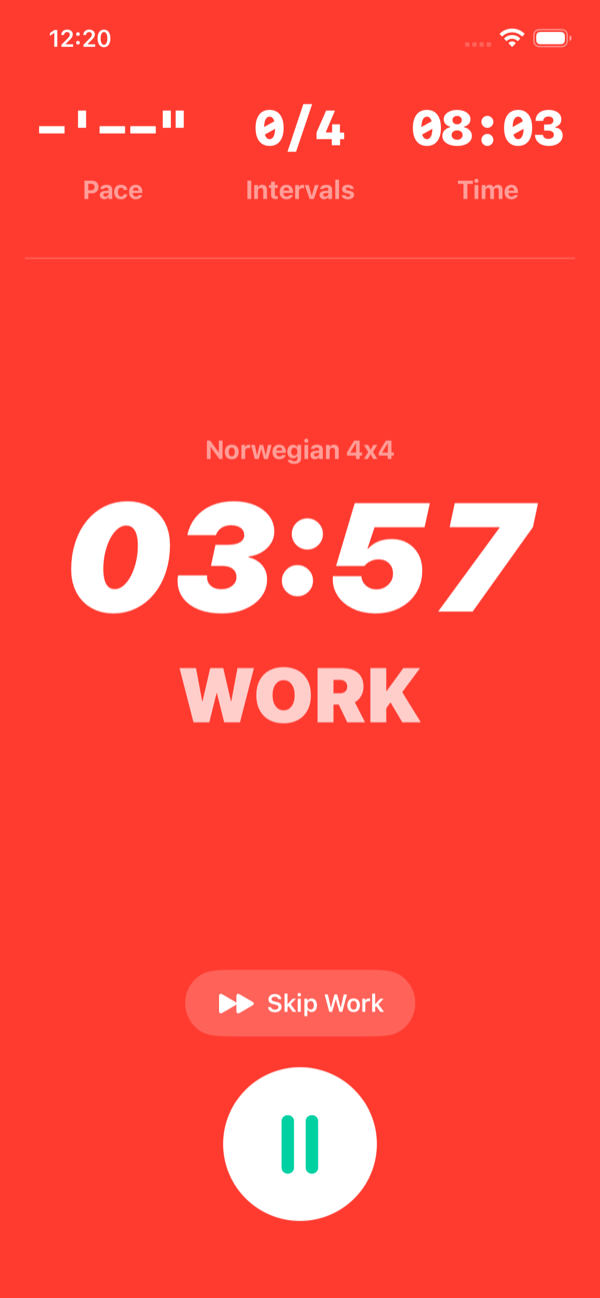
The phase color tells you what to do without reading any numbers. Orange is warm-up, red is work, blue is recovery, green is cooldown. The countdown is in the center. Apple Watch haptic alerts fire at every transition.
Step 5: Track progress across cycles
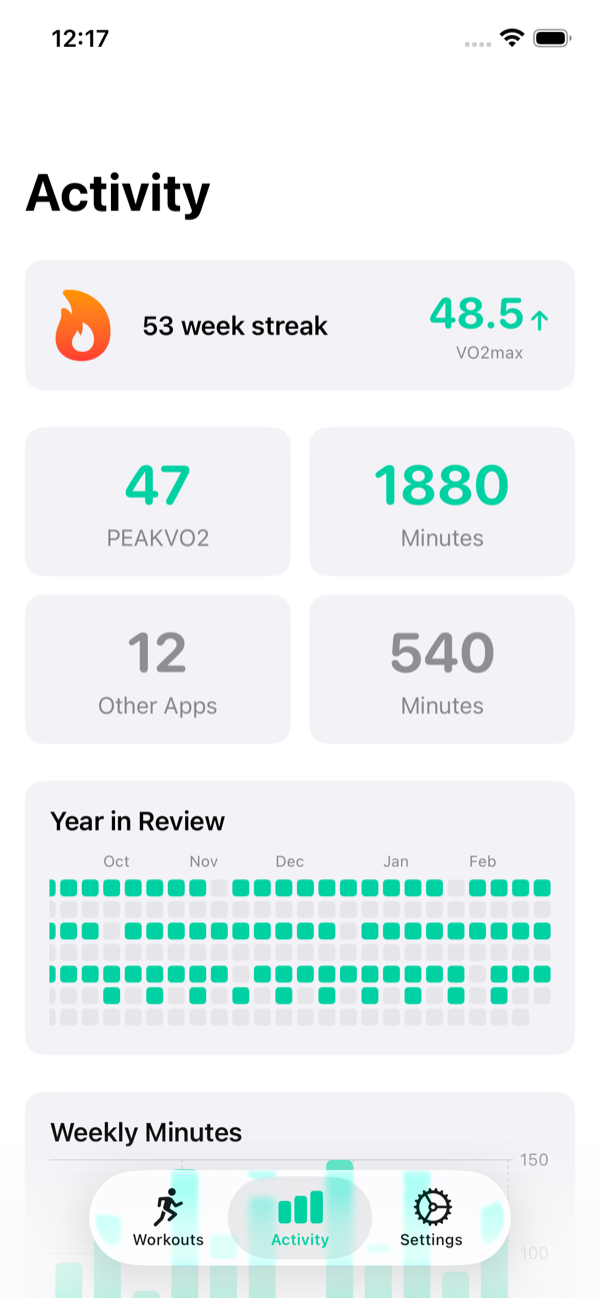
The Activity tab tracks your estimated VO2 max trend over weeks and months. Because women's day-to-day output varies with the cycle, comparing single sessions is misleading. The 4-week and 12-week trend lines are what tell you whether the training is working.
HIIT for Women Over 40
The protocols above all work for women over 40 with two adjustments: extended recovery between sessions and more attention to the strength component.
Recovery time stretches. After 40, the same HIIT session that needed 48 hours of recovery in your 30s often needs 72 hours. Plan two HIIT sessions per week with at least three full days between them, paired with zone 2 sessions on the in-between days.
Strength matters more than ever. Sarcopenia (age-related muscle loss) accelerates from the early 40s onward and accelerates further at menopause. Dumbbell-based HIIT (workout 3) becomes more important than bodyweight-only options because the load stimulates muscle preservation and bone density simultaneously. Aim for two dumbbell HIIT sessions per week and one cardio-only HIIT.
Heart rate maxes shift down. The Tanaka formula (208 − 0.7 × age) is more accurate than the older 220 − age for women over 40. For a 50-year-old woman, that puts HRmax at 173 bpm and the 88 to 95% target zone at 152 to 164 bpm.
For women over 50 specifically, the low-impact HIIT workout (#4) becomes the right starting point. Joint cartilage, tendon resilience, and bone density all change with age, and impact-heavy sessions stop producing better outcomes than the low-impact equivalent.
HIIT During Pregnancy and Postpartum
During pregnancy. Current ACSM guidelines allow continued moderate-to-vigorous exercise during pregnancy for women who were active before becoming pregnant. HIIT is not contraindicated but the protocols need adjustment: lower top-end heart rate (typically capped at 80 to 85% HRmax), no exercises that require lying flat after the first trimester, no exercises with fall risk in later trimesters, and absolute attention to hydration and core temperature. Always clear continued HIIT with your obstetric provider.
Postpartum return. The first 6 to 12 weeks postpartum are for gradual return to movement, not HIIT. Pelvic floor recovery is the limiting factor, and full HIIT (especially jumping or heavy load) before pelvic floor strength returns can cause lasting issues. Start with the low-impact workout (#4) at modest intensity, scale up over 8 to 12 weeks, and seek pelvic floor physical therapy if you experience leakage, heaviness, or back pain.
How Often Plus Recovery
Two HIIT sessions per week is the sweet spot for most women. Three is possible for trained athletes in the follicular phase. More than three accumulates fatigue faster than recovery can clear it, and the body's adaptation signals (heart rate variability, sleep quality, resting heart rate) start to degrade.
Pair HIIT with 1 to 2 zone 2 sessions of 45 to 60 minutes per week. The aerobic base built in zone 2 is what lets you push harder in HIIT, and the polarized 80-20 split (80% easy, 20% hard) consistently outperforms all-HIIT or all-moderate approaches.
Add 2 to 3 strength sessions per week, ideally on non-HIIT days. For women specifically, the bone density benefit of compound strength work compounds with the HIIT cardiovascular benefit.
5 Common Mistakes That Stall Progress
Going too hard in the luteal phase. Progesterone makes work feel harder at the same heart rate. Pushing through and ignoring the signal accumulates fatigue that the next follicular phase has to clear. Adjust intensity to the phase, not the calendar.
Ignoring iron status. Menstruation depletes iron, and chronically low ferritin (even if not full anemia) meaningfully impairs aerobic performance. If HIIT feels disproportionately hard and your motivation is fine, ask your doctor for a ferritin test. Target ferritin above 30 ng/mL (ideally above 50 for active women).
Copying men's program structures. Programs designed by male coaches for male athletes assume a linear week-to-week progression that women's hormonal cycle does not deliver. Expect natural week-to-week variation; track multi-cycle trends instead.
Neglecting strength training. HIIT alone does not build the bone density or muscle mass women need to age well. Two to three strength sessions per week are not optional after 35.
Expecting linear progress. Your follicular-phase sessions will outperform your luteal-phase sessions even when your absolute fitness is improving. Don't read the in-cycle variation as plateau. Look at 4-week trends, not week-to-week comparisons.
PEAKVO2. The interval app for your cardio fitness.
PEAKVO2 runs Tabata, HIIT 30/30, Norwegian 4x4 and 5 other protocols directly on Apple Watch with continuous heart rate, color-coded phases, and haptic alerts.
Download PEAKVO2Frequently Asked Questions
Is HIIT safe for women?
Yes. HIIT has been studied extensively in female populations and produces the same cardiovascular and metabolic benefits as in men, with similar safety profiles (Wewege et al., 2017). The main considerations are starting fitness (build an aerobic base first), proper warm-up, and adjusting intensity to your cycle phase, life stage, and recovery status.
Should I do HIIT during my period?
If you feel like it, yes. Performance during menstruation is often well-preserved despite lower perceived energy (McNulty et al., 2020). If cramps are heavy or you feel depleted, scale back or pick a low-impact session. The session still counts. The bigger issue around menstruation is iron status: chronic low ferritin reduces aerobic performance regardless of cycle phase.
How is HIIT different for women over 50?
Three main adjustments: longer recovery between sessions (72+ hours instead of 48), more emphasis on strength-based HIIT to preserve bone density and muscle mass, and prioritizing low-impact variants when joint discomfort starts to appear. The cardiovascular benefits scale fully into the 60s, 70s, and beyond. The Generation 100 study showed older adults gained measurable VO2 max from HIIT into their late 70s (Stensvold et al., 2020).
Can HIIT disrupt my hormones?
HIIT itself does not disrupt hormones in trained, well-fueled women. What does cause hormonal disruption is the combination of high training volume and chronic energy deficiency, also called Relative Energy Deficiency in Sport (RED-S) (Mountjoy et al., 2023). The signs include missed periods, persistent fatigue, frequent illness, and poor performance. If you see these signs, increase calorie intake, not training volume.
Will HIIT make me bulky?
No. HIIT does not produce hypertrophy gains comparable to dedicated bodybuilding training. Even dumbbell-based HIIT, run at HIIT intensities and durations, produces lean muscle preservation rather than significant size increases. Women who want to add muscle visibly need dedicated strength programming with progressive overload over months, not HIIT alone.
Do I need an Apple Watch to do HIIT properly?
You can run HIIT with just an iPhone timer (the PEAKVO2 app or the interval timer tool on this site). Apple Watch becomes important when you want to train to heart rate zones rather than just timing intervals. For women specifically, where cycle-phase changes physiological response, heart rate data is what tells you whether today's session is in the right zone or not.
Keep Reading
- VO2 Max for Women: What's Different and How to Train
- HIIT Workouts for Fat Loss: 6 Sessions and What the Research Says
- Norwegian 4x4 Training Plan: Week-by-Week Guide with the PEAKVO2 App
- Tabata Workouts: Origins, Science, and 6 Workout Examples
- 15 Best Exercises for HIIT Workouts
- Zone 2 Training: The Foundation of Endurance Fitness
- Free Programmable Interval Timer
References
- Wewege M, van den Berg R, Ward RE, Keech A. The effects of high-intensity interval training vs. moderate-intensity continuous training on body composition in overweight and obese adults: a systematic review and meta-analysis. Obesity Reviews. 2017;18(6):635-646. PubMed
- Mandsager K, Harb S, Cremer P, et al. Association of cardiorespiratory fitness with long-term mortality among adults undergoing exercise treadmill testing. JAMA Netw Open. 2018;1(6):e183605. PubMed
- Janse de Jonge XA. Effects of the menstrual cycle on exercise performance. Sports Med. 2003;33(11):833-851. PubMed
- McNulty KL, Elliott-Sale KJ, Dolan E, et al. The effects of menstrual cycle phase on exercise performance in eumenorrheic women: a systematic review and meta-analysis. Sports Med. 2020;50(10):1813-1827. PubMed
- Stensvold D, Viken H, Steinshamn SL, et al. Effect of exercise training for five years on all cause mortality in older adults — the Generation 100 randomised trial. BMJ. 2020;371:m3485. PubMed
- Mountjoy M, Ackerman KE, Bailey DM, et al. 2023 International Olympic Committee's (IOC) consensus statement on Relative Energy Deficiency in Sport (REDs). Br J Sports Med. 2023;57(17):1073-1097. PubMed
- Helgerud J, Hoydal K, Wang E, et al. Aerobic high-intensity intervals improve VO2max more than moderate training. Med Sci Sports Exerc. 2007;39(4):665-671. PubMed
- Tanaka H, Monahan KD, Seals DR. Age-predicted maximal heart rate revisited. J Am Coll Cardiol. 2001;37(1):153-156. PubMed