Beep Test for Soccer: Scores by Position, Standards, and Training Plan
 Run these workouts on your iPhone, or hands-free on Apple Watch. Get PEAKVO2
 The beep test for soccer is one of the most common fitness assessments in professional and academy settings worldwide, with elite outfield players typically reaching Level 13 to 15 (estimated VO2 max of 57 to 65 ml/kg/min) and central midfielders averaging the highest scores of any position. A study of professional soccer players found a mean VO2 max of 56.8 ml/kg/min, with midfielders reaching 60.7 and goalkeepers averaging 50.2 (Stolen et al., 2005). Whether you play Sunday league or you are preparing for academy trials, your beep test score tells coaching staff how ready your aerobic engine is for the demands of a full 90 minutes.
This guide covers beep test score standards for soccer players by position, how the beep test compares to the Yo-Yo intermittent recovery test, how top leagues and academies use the shuttle run test for soccer evaluations, and a 6-week training plan to raise your score. For a general overview of how the beep test works, levels, pacing, and VO2 max estimation, see our complete beep test guide.
Why Soccer Uses the Beep Test
Soccer is an intermittent sport. Players do not run at a constant pace; they alternate between walking, jogging, cruising, sprinting, and recovering, often dozens of times per half. Match analysis studies show that elite outfield players cover 10 to 13 km per match, with 1 to 3 km of that at high intensity (Krustrup et al., 2003). A central midfielder in the English Premier League may log over 12.5 km total distance and more than 30 high-intensity sprints in a single match.
The beep test captures the aerobic capacity that supports this workload. The progressive shuttle run mirrors the repeated acceleration, deceleration, and direction change that soccer demands. Unlike a straight-line time trial, the 180-degree turn every 20 meters adds a neuromuscular cost that is closer to what happens on the pitch than a simple track run.
The aerobic foundation of soccer performance
A higher VO2 max in soccer translates to measurable on-pitch advantages. A landmark study by Helgerud and colleagues found that when players improved VO2 max by 10.8% through interval training, they also increased total match distance by 20%, number of sprints by 100%, and number of involvements with the ball by 24% (Helgerud et al., 2001). That study remains one of the strongest demonstrations that aerobic fitness directly improves soccer performance, not just endurance numbers on paper.
The beep test quantifies this aerobic foundation cheaply and reliably. All a coach needs is 20 meters of flat space and an audio track. That practicality is why the soccer fitness test of choice for pre-season screening, academy intake evaluations, and return-to-play assessments remains the 20-meter shuttle run.
Test and Track Your Score in PEAKVO2
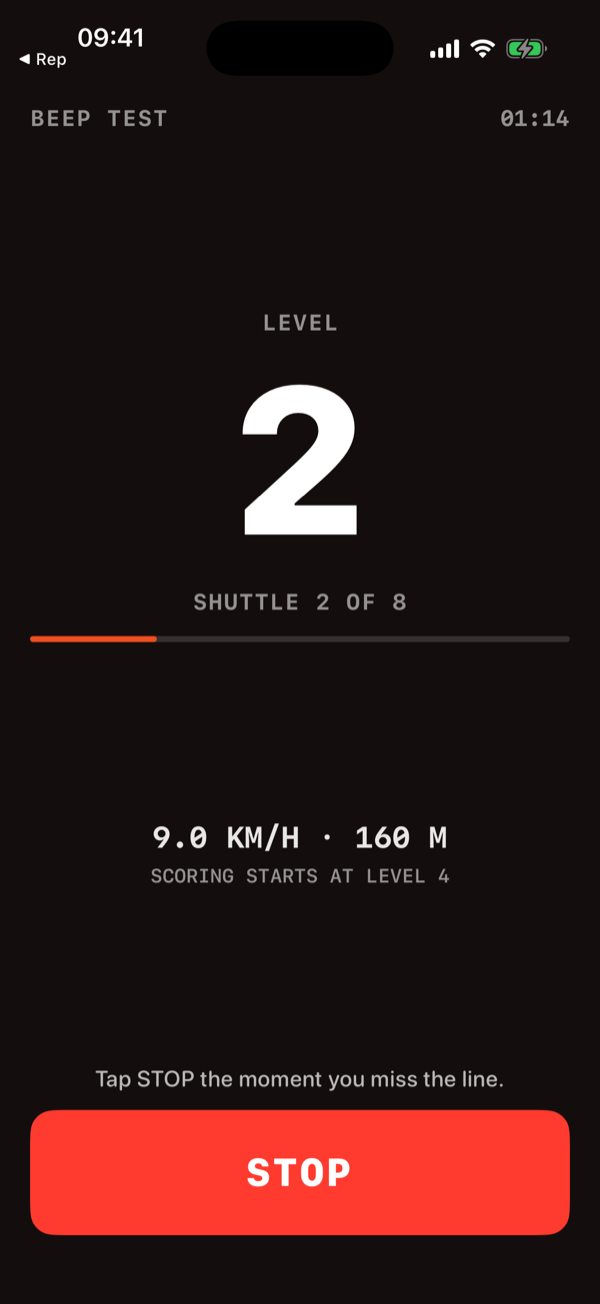
Standards and training only matter if you retest. PEAKVO2 has the beep test built into its Tests tab: mark 20 meters, tap Start, and it plays the shuttle audio, counts your level and shuttle on screen, and turns your last full shuttle into an estimated VO2 max the moment you tap STOP. Retest every 3 to 4 weeks under the same conditions and it logs the trend, so you can watch your number climb across a season, and the same app runs the Norwegian 4x4 and interval sessions you need between tests.
Beep Test Soccer Scores by Position
Not every position has the same aerobic demands. Midfielders cover the most ground, fullbacks perform the most repeated sprints, center backs run fewer total kilometers at lower average intensity, and goalkeepers rarely sustain aerobic running at all. Beep test score expectations reflect these differences.
The following table shows typical beep test targets used across professional and academy settings. Values are drawn from published norms on professional soccer players (Stolen et al., 2005; Castagna et al., 2006).
| Position | Minimum (Professional) | Good | Elite | Est. VO2 Max Range |
|---|---|---|---|---|
| Goalkeeper | Level 10 | Level 11 | Level 12+ | 47-54 ml/kg/min |
| Center Back | Level 12 | Level 13 | Level 14+ | 54-61 ml/kg/min |
| Fullback / Wingback | Level 12.5 | Level 13.5 | Level 15+ | 55-65 ml/kg/min |
| Central Midfielder | Level 13 | Level 14 | Level 15+ | 57-65 ml/kg/min |
| Winger | Level 12 | Level 13.5 | Level 15+ | 54-65 ml/kg/min |
| Striker | Level 12 | Level 13 | Level 14.5+ | 54-62 ml/kg/min |
These are professional benchmarks. Youth academy targets are typically 1 to 2 levels lower, adjusted by age.
Why midfielders score highest
Central midfielders consistently post the highest beep test scores because their match demands are the most aerobically taxing. They cover the most total distance, spend the most time at moderate intensity, and have the fewest rest periods. Studies show that midfielders spend approximately 70% of match time at intensities above 70% of HRmax, compared to roughly 60% for center backs (Stolen et al., 2005).
Goalkeeper standards
Goalkeeper beep test standards are lower for a reason. The position demands explosive short-distance power, reaction time, and lateral agility rather than sustained aerobic running. A Level 10 to 11 score (VO2 max of roughly 47 to 51 ml/kg/min) is considered adequate at the professional level. That said, the modern game increasingly requires goalkeepers to participate in build-up play, and some top clubs now hold goalkeepers to Level 12 or higher.
Beep Test vs. Yo-Yo Intermittent Recovery Test
The beep test is not the only shuttle run test used in soccer. The Yo-Yo intermittent recovery test (Yo-Yo IR1), developed by Jens Bangsbo specifically for team sports, has become equally popular and is arguably more relevant to match play.
The key difference: the Yo-Yo test includes a 10-second active recovery period (a 2 x 5m jog) between each pair of 20m shuttles. This work-rest pattern mimics the intermittent nature of soccer more closely than the continuous running of the standard beep test.
| Standard Beep Test | Yo-Yo IR1 | |
|---|---|---|
| Protocol | Continuous 20m shuttles | 2 x 20m shuttles + 10s recovery |
| What it measures | Maximal aerobic capacity (VO2 max) | Ability to repeatedly perform high-intensity work |
| Duration | 6-14 minutes | 6-20 minutes |
| Correlation to match performance | Moderate (total distance, general endurance) | Strong (high-intensity running distance) |
| Best for | Baseline aerobic assessment | Soccer-specific intermittent fitness |
Bangsbo's research showed that the Yo-Yo IR1 correlates more strongly with the amount of high-intensity running a player performs during matches than the standard beep test does (Bangsbo et al., 2006). Specifically, Yo-Yo IR1 performance correlated at r = 0.71 with high-intensity match distance, compared to r = 0.54 for VO2 max measured in the lab.
That said, both tests provide valuable and complementary information. The beep test gives a clean VO2 max estimate, while the Yo-Yo test captures the repeated sprint recovery capacity that separates fit soccer players from aerobically fit non-soccer athletes. Many clubs administer both.
Which test should you prepare for?
If you are preparing for academy trials or pre-season testing, find out which test your club uses. In the UK, the Yo-Yo IR1 is more common in professional academies. In the US, MLS clubs and college programs often use the standard beep test or a combination. If you do not know which will be used, prepare for the standard beep test. The aerobic gains will transfer to the Yo-Yo test, but the reverse is not always true because Yo-Yo preparation can emphasize recovery capacity over raw VO2 max.
How Top Leagues and Academies Use the Beep Test
Premier League and English academies
English Premier League clubs test players at the start of pre-season, midseason, and upon return from injury. The beep test or Yo-Yo IR1 is a standard component of the Elite Player Performance Plan (EPPP), which governs academy development for all professional English clubs. Academy players are tested multiple times per season, and results factor into progression decisions between age groups.
Published data from English professional clubs suggest outfield players average Level 13 to 14 on the standard beep test, with some midfielders and fullbacks reaching Level 16 (Stolen et al., 2005).
MLS and North American soccer
Major League Soccer (MLS) combines the beep test with GPS tracking data and other fitness metrics. MLS teams increasingly use GPS vests during training and matches to track live running loads, but the beep test remains a pre-season baseline because it provides a controlled, repeatable comparison across players.
US Soccer Development Academy programs use the beep test as part of fitness screening for age groups from U-14 through U-19. The shuttle run test in soccer at the academy level serves as both a fitness assessment and a benchmark for monitoring training adaptations across a season.
Youth soccer academies
For youth players, the beep test provides an objective, age-normed measure of aerobic development. A 14-year-old reaching Level 11 is in excellent territory. By 17, academy coaches expect outfield players to reach Level 12 or higher. The test is especially useful at the youth level because it removes the pacing strategy variable; the beeps dictate the pace, so the test rewards fitness rather than tactical experience.
6-Week Training Plan to Improve Your Beep Test Score for Soccer
Improving your beep test score requires building both your VO2 max ceiling and your shuttle-specific efficiency. The plan below combines high-intensity interval training, tempo work, and soccer-specific conditioning. It assumes you are already playing soccer regularly (2 to 3 sessions per week) and have a basic aerobic base.
Before starting, establish your current beep test level so you can track progress. Retest at the end of Week 6.
Weeks 1-2: Aerobic base and shuttle familiarization
Goal: Build aerobic capacity and practice shuttle mechanics.
- 3 x per week: 30 to 40 minutes of zone 2 training (easy jog, cycling, or swimming at 60-70% HRmax). This builds the mitochondrial density that fuels sustained running.
- 1 x per week: Shuttle familiarization. Run the beep test protocol at a submaximal level (stop 2 to 3 levels below your max). Focus on tight turns and efficient deceleration.
- 1 x per week: Tempo run. 20 minutes at 80-85% HRmax on a flat surface. This builds lactate clearance capacity.
Weeks 3-4: High-intensity interval introduction
Goal: Push VO2 max higher with structured intervals.
- 2 x per week: Zone 2 training, 30 minutes.
- 1 x per week: Norwegian 4x4 protocol. Four 4-minute intervals at 90-95% HRmax, separated by 3-minute active recovery jogs. This protocol has been shown to increase VO2 max by 0.5% per session in trained athletes. An Apple Watch app like PEAKVO2 runs this as a guided session, showing the 90-95% HRmax target on your wrist during each 4-minute push and tapping you when the recovery jog starts.
- 1 x per week: Short intervals. 8 to 10 x 30 seconds at maximum effort with 30 seconds rest. Use a programmable interval timer to keep the timing precise. These develop the anaerobic speed reserve that helps at higher beep test levels.
- 1 x per week: Small-sided game (3v3 or 4v4 on a small pitch, 15 to 20 minutes). Small-sided games produce heart rate responses similar to interval training while adding soccer-specific movement patterns (Castagna et al., 2006).
Weeks 5-6: Peak and taper
Goal: Maximize shuttle-specific performance and taper for the test.
- 2 x per week: Norwegian 4x4 or equivalent HIIT workout.
- 1 x per week: Shuttle-specific intervals. Run 3 to 4 sets of 3-minute beep test segments at your target level pace, with 2-minute recovery between sets. This trains pacing, turning efficiency, and familiarity with the later, harder levels.
- 1 x per week: Interval training for running session. 5 x 1,000m at 5K race pace with 90-second rest. This builds the sustained speed that translates to higher beep test levels.
- Final 3 days before test: Reduce volume to light jogging only. Arrive at the test well rested, hydrated, and fueled.
Research on soccer players confirms that 6 to 8 weeks of combined interval and aerobic training can improve VO2 max by 7 to 11%, translating to roughly 1 to 3 beep test levels (Helgerud et al., 2001).
Match Fitness vs. Beep Test Fitness
A common frustration among soccer players: "I can play a full 90 minutes, but my beep test score is lower than expected." The reverse also happens: a player with a great beep test score fades in the second half.
The disconnect exists because match fitness and beep test fitness are related but not identical.
The beep test measures maximal aerobic capacity in a continuous, progressive effort. It rewards a high VO2 max and the ability to sustain increasing speed without rest. This is a pure cardiovascular ceiling test.
Match fitness adds several layers on top of that ceiling. Soccer matches include constant changes of direction, physical contact, deceleration, cognitive decision-making under fatigue, and repeated bouts of sprinting separated by low-intensity recovery. These additional demands recruit the anaerobic energy system, neuromuscular coordination, and mental resilience in ways that a straight shuttle run does not.
A player who only trains with shuttle runs may score well on the beep test but lack the repeated sprint ability, agility, and game-specific conditioning needed to perform well in matches. Conversely, a player who only plays matches may develop excellent soccer-specific endurance but never push their VO2 max high enough to score well on the beep test.
The solution is to train both systems. Use the training plan above to build your VO2 max ceiling, and supplement it with soccer-specific conditioning: small-sided games, position-specific drills, and repeated sprint training.
Common Mistakes Soccer Players Make on the Beep Test
1. Treating the early levels like a warm-up you can skip
The first 4 to 5 levels of the beep test feel very easy for a trained soccer player. The temptation is to jog lazily or start after the first beep. But proper pacing from Level 1 establishes your rhythm, turn timing, and breathing pattern. Arriving at the line too early and waiting wastes energy through unnecessary deceleration and reacceleration. Match the beeps exactly from the start.
2. Not warming up before the test
Many players assume the first few levels serve as a warm-up. They do not. The beep test starts at 8.5 km/h, which is a light jog, but your cardiovascular system needs to be primed before the test begins. Spend 8 to 10 minutes jogging, then do 4 to 6 short accelerations (strides) to activate your fast-twitch fibers. You should be lightly sweating before the first beep.
3. Wide turns
Soccer players are accustomed to curved running paths. On the beep test, every meter added by a wide turn costs time. Plant your foot at the line, drop your hips, and pivot 180 degrees as tightly as possible. Over 100+ shuttles, the difference between tight and wide turns can equal an entire level.
4. Holding back because "the game matters more"
Players sometimes deliberately underperform on the beep test to save energy for an upcoming match or training session. This produces an inaccurate score that underrepresents their fitness. If the test is scheduled, treat it as a maximal effort. Run to genuine failure. A submaximal score is not useful to you or your coaches.
5. Neglecting aerobic training between tests
Soccer training alone does not maximize VO2 max. Match play and technical sessions develop soccer-specific fitness, but they rarely sustain the 90-95% HRmax intensity required to push the VO2 max ceiling higher. Dedicated aerobic work, both zone 2 base building and high-intensity intervals, is necessary to see meaningful improvement in beep test scores between testing periods.
The Bottom Line
The beep test for soccer provides an objective, repeatable measure of the aerobic capacity that underpins match performance. Your score tells you where your cardiovascular ceiling stands relative to the demands of your position and level of play. Midfielders need the highest scores, goalkeepers the lowest, and every outfield player benefits from a VO2 max above 55 ml/kg/min.
Combine dedicated interval training with soccer-specific conditioning, and a 1 to 3 level improvement in 6 to 8 weeks is realistic. For a full explanation of how the beep test works, scoring tables, and VO2 max estimation, see our complete beep test guide.
Test your beep score in PEAKVO2
PEAKVO2 has the beep test built in: mark 20 meters, tap Start, and it counts your level and estimates your VO2 max. Then run the Norwegian 4x4 and interval sessions that raise your score as guided Apple Watch workouts, with a target heart rate zone for each phase. Test and train in one app.
Get PEAKVO2 freeFrequently Asked Questions
What is a good beep test score for soccer?
For professional outfield soccer players, Level 13 or higher is the standard expectation, with elite midfielders and fullbacks reaching Level 15 or above. For academy players aged 14 to 17, Level 11 to 13 is considered good depending on age. Goalkeepers are typically held to a lower standard of Level 10 to 12. These targets correspond to VO2 max values of approximately 55 to 65 ml/kg/min for outfield players.
How does the beep test compare to the Yo-Yo test for soccer?
The standard beep test measures continuous aerobic capacity (VO2 max), while the Yo-Yo intermittent recovery test includes a 10-second rest between shuttle pairs and measures the ability to recover from repeated high-intensity efforts. Research by Bangsbo et al. (2006) found that the Yo-Yo IR1 correlates more strongly with high-intensity match running distance (r = 0.71) than VO2 max alone. Many professional clubs administer both tests because they capture complementary aspects of soccer fitness.
How far do soccer players run in a beep test?
A soccer player reaching Level 13 completes approximately 2,620 meters (2.6 km) during the beep test. At Level 15, total distance is approximately 3,180 meters. The test typically lasts 10 to 14 minutes for professional players, which is similar to the duration of a half-time break.
Can the beep test predict match performance?
Yes, indirectly. Research shows that improving VO2 max by roughly 10% through interval training led to a 20% increase in total match distance and a 100% increase in the number of sprints per match in professional soccer players (Helgerud et al., 2001). The beep test provides the VO2 max estimate that predicts this match performance capacity.
How often should soccer players take the beep test?
Most professional clubs test players 3 to 4 times per season: at the start of pre-season, midseason, late season, and upon return from injury. Youth academies may test every 8 to 12 weeks. Testing more frequently than every 6 weeks is unnecessary because meaningful VO2 max changes require at least 4 to 6 weeks of structured training to manifest.
Keep Reading
- The Beep Test: Scores, Levels, and VO2 Max Estimation
- Norwegian 4x4 Protocol: Proven HIIT to Raise VO2 Max
- Interval Training for Running: Workouts, Programs, and Plans
References
- Stolen T, Chamari K, Castagna C, Wisloff U. Physiology of soccer: an update. Sports Med. 2005;35(6):501-536. PubMed
- Krustrup P, Mohr M, Ellingsgaard H, Bangsbo J. Physical demands during an elite female soccer game: importance of training status. Med Sci Sports Exerc. 2005;37(7):1242-1248. PubMed
- Helgerud J, Engen LC, Wisloff U, Hoff J. Aerobic endurance training improves soccer performance. Med Sci Sports Exerc. 2001;33(11):1925-1931. PubMed
- Bangsbo J, Iaia FM, Krustrup P. The Yo-Yo intermittent recovery test: a useful tool for evaluation of physical performance in intermittent sports. Sports Med. 2008;38(1):37-51. PubMed
- Castagna C, Impellizzeri FM, Chamari K, Carlomagno D, Rampinini E. Aerobic fitness and yo-yo continuous and intermittent tests performances in soccer players: a correlation study. J Strength Cond Res. 2006;20(2):320-325. PubMed
- Helgerud J, Hoydal K, Wang E, et al. Aerobic high-intensity intervals improve VO2max more than moderate training. Med Sci Sports Exerc. 2007;39(4):665-671. PubMed